
What Does A Yellow Speed Sign Mean On A Highway Curve?
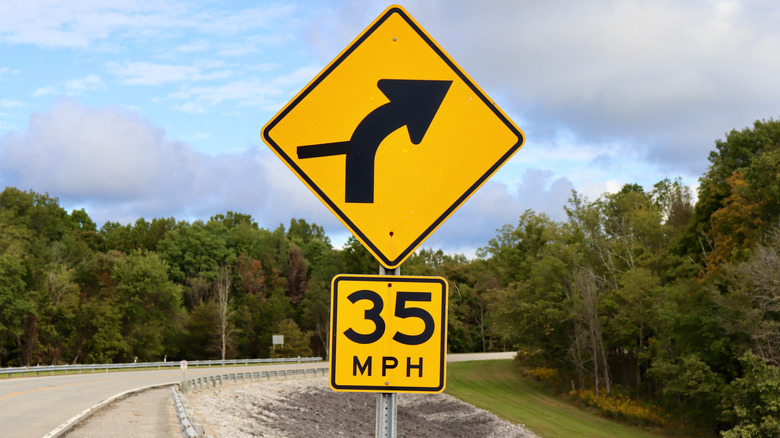
There's nothing quite like hitting the open road and embarking on an epic trip. Windows down, music playing, and unforgettable memories await around every corner. Speaking of corners, imagine coasting along on an unfamiliar highway and, all of a sudden, a tight bend catches you off guard, and you find yourself going much too fast for what the posted speed limit was. Well, paying close attention to road signs is undoubtedly a way to keep everyone safe on the roads, and those yellow speed signs we so often see on curvy roadways and highways indicating a slower speed than the posted limit are more important than they may seem.
When driving down a highway, you may see a posted limit of 45 mph, but when approaching a bend or curve in the road, just before the upcoming corner, you'll notice a bright yellow diamond-shaped sign with bold, black text indicating which way the curve is coming, as well as the recommended speed limit you should be taking it at. This is called an advisory speed sign, and the posted speed limit is usually lower than the rest of the road. If the posted limit is 45 mph, for example, but the sign indicates 25 mph, take heed because the upcoming bend is best navigated at the slower speed.
The Manual on Uniform Traffic Control Devices (MUTCD) determines where and when a speed advisory sign gets posted, and makes sure it's placed far enough in advance to allow the driver to process and react to the signage. Whether you're new to the roadways or have been driving for decades, these warning signs play an important role in keeping drivers safe. These may also appear on highway on- and off-ramps, approaching a bridge, on mountainous roads, or when coming up to a construction zone.
The advisory speed sign is not a speed limit sign
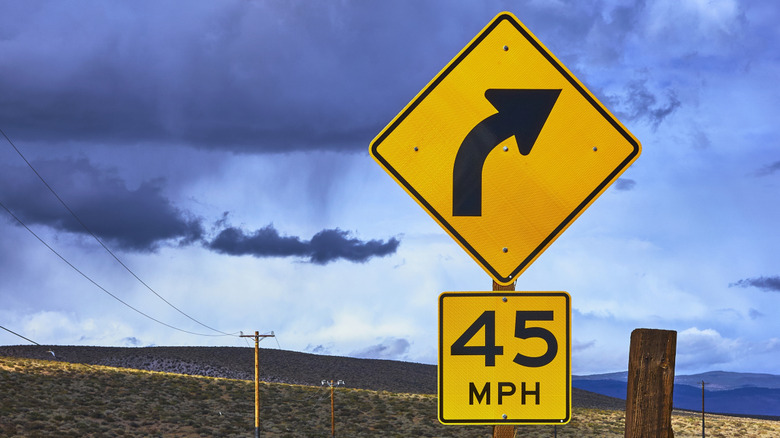
Now, these recommended speeds aren't just picked out of the air. Advisory speeds are posted depending on the severity of the curve, as well as the speed study results, with the curves being marked in both directions indicating the advised lower speed to use. They are determined using a method called a ball-bank indicator test, which helps to determine the speed at which a certain corner can be completed safely. The device is mounted to a test vehicle and is driven through the curve multiple times at different speeds. The steel ball within the curved glass tube filled with liquid moves in accordance with the curvature of the road and with the force. It assists in determining how much force a vehicle may experience while taking the corner, and collects important data for engineers to decipher.
Just as someone wouldn't drive during bad weather – a reckless mistake to make during a road trip — speed advisory signs can help a driver along the way if the road is especially unknown to them. If you find yourself driving along one of Montana's most scenic roads and a curve is approaching with a marked down speed, what should you do? The short answer is slow down. Although driving faster than the advisory speeds isn't a traffic violation on its own, ignoring them can still have serious consequences, especially if it results in an accident.
Speed advisory signs are equally important for motorcyclists traveling on the road. When approaching a curve with a reduced recommended speed, riders can use these signs to anticipate the turn and adjust their body positioning before entering it. The signs serve as a reminder to downshift, reduce speed, and prepare to lean into the curve. This allows riders to maintain better control and balance while navigating the bend, making for a more controlled entry and exit. For even more road safety hacks, check out what the 3-3-3 rule means.