
The Hiking Gear That Will Be Taken Away By Airport Security
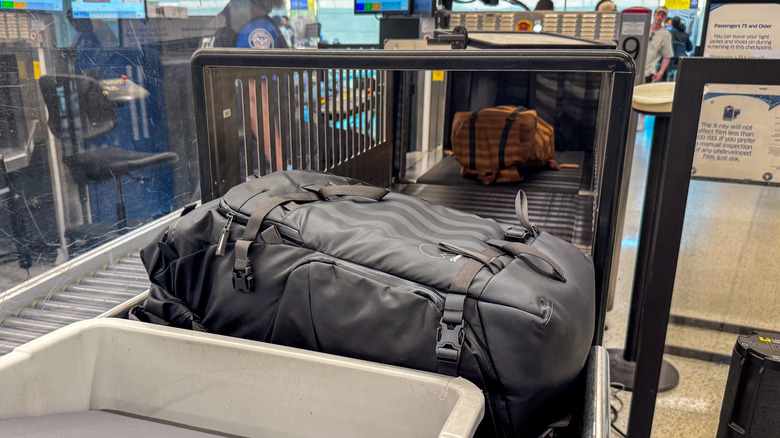
Hiking and backpacking are growing in popularity, and an increasing number of hikers are traveling far and wide to tackle the next trail. Whether you're a hiker planning a trip within the U.S. or to a bucket-list hiking destination across the globe, if you're flying, you may be tempted to stuff all your essential hiking gear into your carry-on. This might seem like a way to alleviate the possibility of a lost checked bag and ensure your gear gets to your destination. However, the reality is that putting certain types of hiking gear in your carry-on luggage is a surefire way to make sure they won't make the trip with you, as items ranging from sharp trekking poles to bear spray will be taken away by airport security, according to the Transportation Security Administration (TSA).
The reason these items are not allowed in your carry-on — or even in checked luggage, in some cases — comes down to safety. While these accessories seem rather innocuous to those who use them for their intended purpose, many pieces of camping gear can pose a danger to fliers. Sharp-tipped trekking poles, for example, can be used as a weapon and are considered too dangerous to have on board the plane. Ditto for snow spikes; pocket knives; and multi-tools with knife blades, long scissors, or other cutting implements.
Other items, such as bear spray and propane cylinders for lanterns and stoves, are not allowed on planes at all, either in checked or carry-on bags. That is because these items are both seen as hazardous materials and their pressurized containers could rupture in flight. The camp stove for which the propane cylinder is intended, however, is in somewhat of a gray area, and it may or may not be allowed, depending on its condition.
How to make sure your hiking gear makes it to your destination
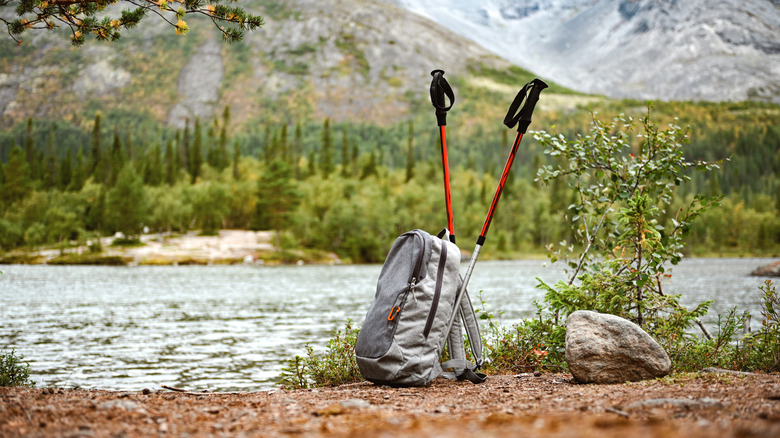
Given the TSA restrictions, you may be wondering how it's possible to travel by air and still have the gear you need. The solution for making sure your hiking gear makes it to your destination and doesn't get yanked by security is multifold. First, see if there are certain versions of your hiking gear that may be allowed in your carry-on. For example, blunt or soft-tipped trekking poles are generally allowed by TSA. That said, your airline may not allow them, so be sure to check your air carrier's guidelines, too.
If you intend to take all your hiking gear with you, inevitably some of it will need to go in a checked bag. Sharp-tipped trekking poles, tent spikes, knives, multitools, and snow spikes are among the items that must always go in a checked bag. Self-inflating air pads, crampons, and tent poles may be allowed in carry-on bags under some circumstances. Even then, they are subject to removal at the discretion of the TSA agent and/or the airline. So, to be on the safe side, it is generally best to pack them in a checked suitcase to help you zip through TSA quickly.
Camp stoves may or may not be allowed in either carry-on or checked bags. In either instance, they must be thoroughly cleaned so that no fuel residue remains and all fuel sources are removed. Showing up with a camp stove full of fuel — or even residual vapors in the tank — is a definite don't for getting through airport security. So, if your stove has a refillable fuel tank (as opposed to a screw-on canister), it likely won't be safe to fly. Items such as propane canisters and bear spray should be purchased locally when you arrive.