
Half An Hour From Ulm Is A Breathtaking Freshwater Spring That Changes Colors
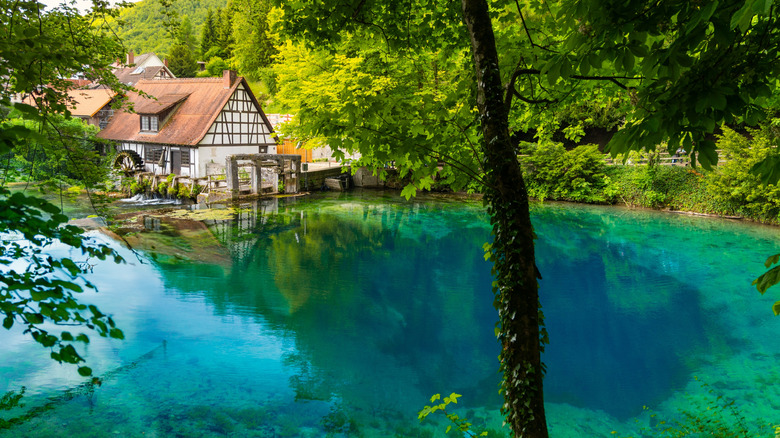
The southwest of Germany is home to the Swabian Alps (or Swabian Alb) — a somewhat less lofty mountain range than the true Alps, but full of its own visually striking discoveries. One of its natural gems is a spring with a round shape called the Blautopf, which appears in vivid colors. The spring has inspired numerous legends, from the story of a laughing water nymph to an old myth about the spring being bottomless. But the spring's most mesmerizing quality is hardly a myth — its brilliant color, which shifts between shades of blue and turquoise depending on weather and time of day. Visitors can come to admire the spring themselves, set among trees with a historic mill building by the water, and look for the sculpture of the legendary water nymph.
Located in Blaubeuren, about a 30-minute trip from Ulm, a city with historic churches and Danube River views, the Blautopf is a product of the karst landscapes of the Swabian Alps. LGRBwissen, the official geoscientific portal for the state of Baden-Württemberg, describes the spring as funnel-shaped and connected to a system of water caves formed from the area's limestone. As the caves collect rainwater, it emerges into the Blautopf. Sometimes, when rainfall is heavy, the spring can appear to bubble from the high water pressure.
The distinctly blue color owes to a mix of the water's depth (it goes down nearly 70 feet) and calcium carbonate particles, which scatter light. The color can change slightly depending on the angle of the sunlight throughout the day and how many particles are present. During dry spells, when fewer particles are carried in from rainfall, the water appears most vivid. Nevertheless, scientific explanations for the Blautopf's phenomena don't stop it from having an appearance fit for fairy tales.
Visiting the legendary Blautopf
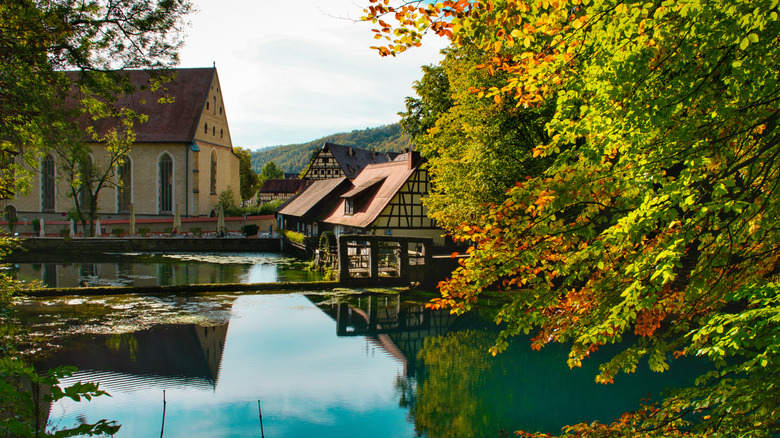
Walking around the Blautopf, you might notice a sculpture of a woman standing by the water. The sculpture is a nod to one of the Blautopf's most renowned legends, that of the beautiful Lau. The story, written by the German Romantic poet Eduard Mörike, tells of a water nymph who could only bear dead children because of her melancholy and was, as a result, exiled to the spring. An innkeeper and amusing encounters helped her rediscover laughter there, which caused the spring to grow bountiful and overflow. The town of Blaubeuren even offers guided tours for families centered around the tale, where a guide tells the story costumed as the nymph herself (tours are only offered in German, though).
You don't need a guided tour to visit the Blautopf, however. It's free to visit, located about a 20- to 30-minute walk from the Blaubeuren train station. The area around the spring is under renovation until the end of 2028, but the spring is still accessible to visitors during this time, according to Blautopfsanierung Blaubeuren. You'll also see the Hammerschmiede ("hammer mill") next to the spring, which once used the spring's flow to power the mill works. Unfortunately, you can't go inside during the renovation period.
The Blautopf is simple to reach from Ulm, with a roughly 10-minute train ride followed by a walk from the station through the village. You can also get there from Stuttgart, Germany's underrated walkable haven of culture and art, in under two hours by train or an hour by car. Travelers looking for other day trips from Stuttgart can also consider an outing to Nördlingen, a Romantic Road town with an otherworldly origin story, about two hours away.