
What Do The Yellow Lines On Airport Tarmacs Mean?
Airport tarmacs are a fascinating sight, with their scurrying workers, blinking lights, and organized chaos. The tarmac itself is a mosaic of colorful markings, with unbroken lines, dashes, parallel lines, and more forming a complex system of communication. White lines denote a runway, the long, straight strip of tarmac where planes take off and land. But most markings outside the runway are yellow, so what do they mean? According to the Federal Aviation Administration (FAA), "markings for taxiways, areas not intended for use by aircraft (closed and hazardous areas), and holding positions (even if they are on a runway) are yellow." Let's break this down.
These tarmac markings are standardized worldwide to help pilots navigate unfamiliar airports and prevent miscommunication between pilots and air traffic control (ATC) due to language barriers. Most passengers on a plane will first notice the yellow lines of the taxiway — the part of the tarmac that connects the runway with the airport's hangars and terminals. However, the exact meaning of a yellow line — or multiple lines — depends on its placement and length.
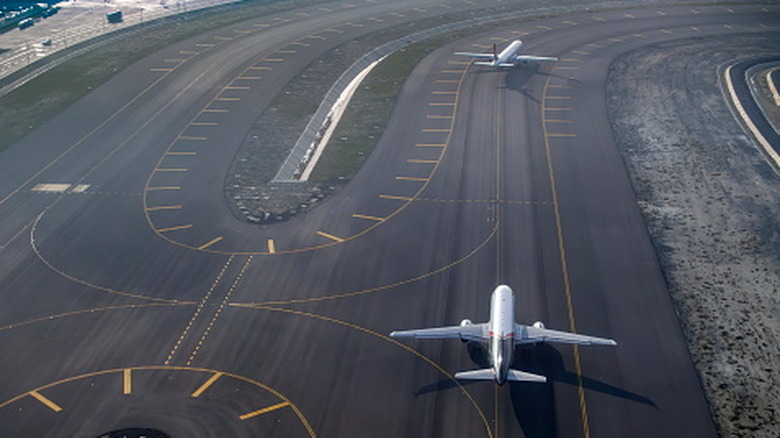
A long, unbroken strip of yellow paint marks the centerline, or middle, of the taxiway. A series of short yellow dashes mark the taxiway's edges where it intersects with other taxiways; elsewhere, the edge markings consist of a continuous, unbroken yellow line. Both markings help pilots ensure their planes stay within the taxiway's boundaries. A third type of yellow marking is the runway holding position line, which indicates intersections between taxiways or the entrance to a runway. It consists of two solid yellow lines and two parallel dashed yellow lines (four lines in total). These markings indicate where pilots must stop and wait for ATC permission before proceeding.
Other types of yellow tarmac markings
Air travel remains a safe mode of transport, but a lot of behind-the-scenes work goes into making it so. Pilots, ground staff, ATC, and other departments work around the clock to identify the most common causes of plane accidents and develop comprehensive systems to mitigate those risks. Airport tarmac markings are one such essential system. Pilots rely on them to know where to go, when to stop and wait for permission, which areas are off-limits, and how to avoid obstacles. As a visual guidance system, these markings also help reduce friction between pilots and air traffic controllers.
Besides the general taxiway markings, yellow strokes indicate other areas beyond the main runway or are added to existing markers for better visibility. For example, some larger airports, like Chicago O'Hare, which was "America's most connected airport" in 2025, might add parallel dashed lines on either side of their taxiway centerline to create an enhanced centerline. Some airports might also have paved areas running parallel to the main taxiway or runway, called shoulder areas, to protect the main runway's edges from erosion. However, these paved paths aren't strong enough for moving aircraft, so they're marked in yellow stripes perpendicular or diagonal to the runway or taxiway.
Yellow markings are also used in areas where a plane must not enter. In some airports, the runway might seemingly extend slightly beyond its official length, but — like shoulder areas — these sections do not handle active aircraft. These parts of the runway are marked by chevrons — parallel, V-shaped yellow lines covering the entire surface of the out-of-bounds section. The boundary between this section and the actual runway is marked by a demarcation bar, which is a 3-foot-wide yellow line across the width of the runway.