
The Popular National Park Tourists Are Being Cautioned To Avoid In 2026
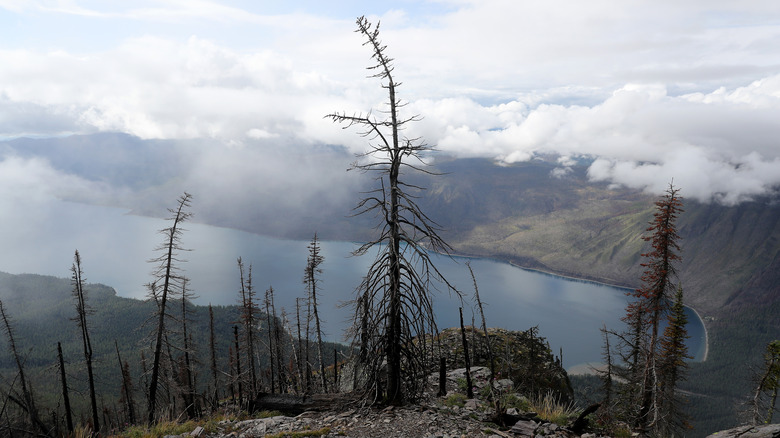
As climate change continues to affect the world's various ecosystems and natural structures, certain places are attracting more tourists desperate to see them before they change irrevocably or disappear entirely. Known as last-chance tourism (LCT), this relatively new trend sees people visiting many of the world's natural wonders in increasingly unsustainable numbers. As one 2025 study found, these visitors often end up damaging the environments they're so desperate to see, speeding up their deterioration. LCT is also one of the main reasons why the beautiful Glacier National Park, known as the "Crown of the Continent," is on Fodor's No List for 2026.
The infamous No List has been a yearly occurrence since 2017, highlighting places around the world suffering from overtourism while also persuading people to stop visiting them. Glacier National Park's inclusion on the latest version comes as it's seeing its highest year-to-date visitor numbers in 2025. This is also off the back of a very busy 2024, when the national park saw its second-highest visitor numbers — around 300,000 more than 2023 — since opening in 1910. Visitor numbers were already high before this recent surge, consistently hitting around 3 million annually since 2019.
Although they're bringing in more revenue, these visitors are disrupting the park's environment in increasingly concerning ways. Greater motor vehicle congestion and trash accumulation are damaging the Glacier National Park's air quality, with raised carbon dioxide levels. Wildlife is also being disturbed, and the increase in wildfires is no doubt related to the park's higher temperatures, which are also melting glaciers faster. Fewer than 30 glaciers remain from the original 150, which is partly why so many people want to see them. The irony of this isn't lost on conservation activists, who believe the park is facing more threats to its environment than ever before and needs immediate changes to stop deteriorating.
Is there a way to preserve Montana's Glacier National Park?

Efforts are being made to try to curb the effects of climate change and overtourism, in the hopes of helping preserve Glacier National Park's environment. Timed reservations for visitors during peak seasons and the use of solar and hydro power have helped slightly. Spreading visitors out has led to fewer road closures and less traffic congestion at times, but it hasn't dropped the overall numbers. These changes alone can't counteract the negative effects of overtourism, which is driven by visitors, not the national park. Avoiding Glacier National Park in 2026 to give it a break simply means looking elsewhere for those same magical experiences amongst nature.
The National Park Service (NPS) recommends visiting Waterton Lakes National Park in Alberta instead, an uncrowded paradise of shimmering lakes. The NPS also highlights a range of other sites of natural beauty in Montana near Glacier National Park, which are worthwhile alternatives. For instance, there's the lesser-known Bighorn Canyon National Recreation Area, a massive canyon offering water recreation. Meanwhile, Montana's 55 state parks provide tranquil escapes if you want to explore the outdoors.
If, for whatever reason, you absolutely must visit Glacier National Park, there are ways to do so without contributing so much to its overtourism. You could visit the park with a tour company instead of your own car to help reduce traffic congestion. You could also try hiking or kayaking here instead of driving everywhere to lower your carbon emissions. While doing this may lessen the impact, experts don't think it's enough to reverse the effects entirely. That would require a significant drop in visitor numbers, which doesn't seem feasible in this current era of travel, which some people refer to as "wreckreation."