
Arizona's Largest Garden Is A Secret Canyon Oasis Near Phoenix With Art, Trails, And Wildlife
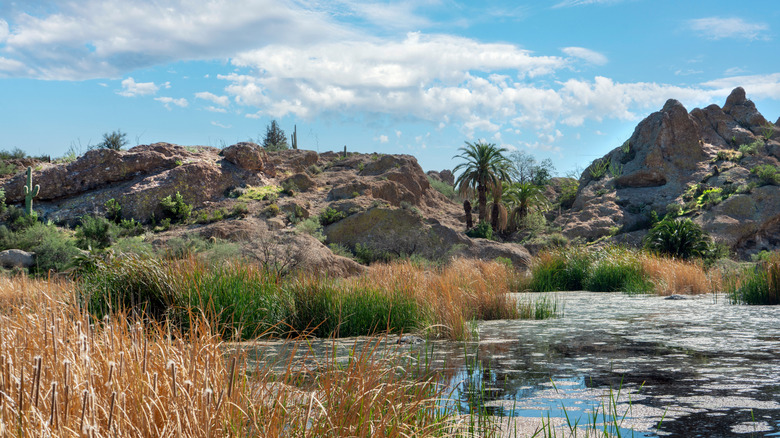
Arizona's striking scenery, furnished with red-rock spires and giant cacti, provides a sublime environment for a foray into botany and geology. That's what's made the Arizona-Sonoran Desert Museum, a rich botanical garden, so world-renowned, but it's far from the only exemplar of Arizona's nature, and it's not even the state's biggest. That title is held by the Boyce Thompson Arboretum, about an hour outside of Phoenix, referred to by the Southwest travel blog Nightborn Travel as "Central Arizona's other premier garden." It's both the oldest and largest botanical garden in the state, encompassing 343 acres and miles of trails showcasing flora from deserts around the world and artwork complementing the gardens. This is all set against the magnificent peaks of the Superstition Mountains to the north.
Some of the Boyce Thompson Arboretum's oldest inhabitants are trees, specifically, eucalyptus trees. When the gardens were founded by William Boyce Thompson, a mining engineer, in 1924, among the first 500 plants was a grove of eucalyptus trees. Thompson's interests extended far beyond just the native cacti of the Sonoran Desert. He wanted the arboretum to reflect a breadth of desert flora, native and non-native, for the sake of desert conservation and research.
Expanding upon Thompson's vision, the garden has since evolved into much more than just a plant collection. Its trails wind through the rocky folds of Queen Creek Canyon, a wildlife corridor with several species of lizards and a noted birding hotspot. In 1927, the Boyce Thompson Arboretum also became Arizona's first official, science-centered nonprofit. Today, its mission remains to advance public education and appreciation of desert life, and you can even see some of the original eucalyptus trees that were planted in the 1920s.
Trails and tours at Arizona's Boyce Thompson Arboretum
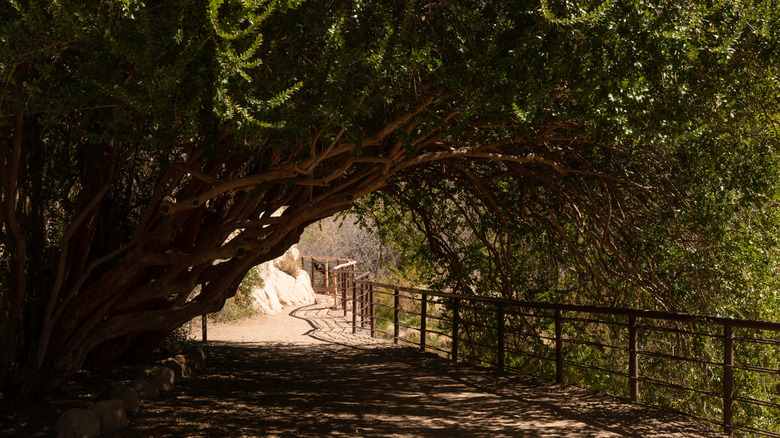
The Boyce Thompson Arboretum has since expanded to include much more than just trees and cacti. Its botanical exhibits are spread across 4.7 miles of walking trails, which traverse suspension bridges, desert creeks, and even pass a pioneer house. "I definitely recommend walking the large loop trail through the canyon as that's the most scenic area," a Google Review local guide wrote. That trail — the Main Trail — is about 1.5 miles and wheelchair-accessible. The trails are rich with wildlife, too: Spiny lizards, golden eagles, and white-nosed coati are a few of the many species observed around the garden's acres.
If you're not sure where to start, the arboretum offers free, guided walks catered to different interests, whether that be bird spotting, edible plants, or learning about the land's geology. "We had a fabulous tour guide who was extremely well trained, knowledgeable, but explained biological processes in lay terms," a Tripadvisor reviewer wrote. If you want to explore more of the local trails, you could also check out some of those just north of the gardens. One, the Hieroglyph Trail, showcases rugged canyons and ancient rock petroglyphs, and begins about a 30-minute drive from the gardens.
How to visit the Boyce Thompson Arboretum in Arizona
The Boyce Thompson Arboretum sits in Superior, one of Arizona's most charming small towns that hides serene lakes and immaculate hikes. It's less than an hour away by car from the Phoenix Sky Harbor International Airport. As one local guide wrote in a Google review, "It's far enough out of the city that it's never too crowded," making it a great option for a relaxing day trip from Phoenix. Indeed, you may want to dedicate a full day to exploring the garden's expansive footprint: There are around 20,000 plants in total, plus picturesque uplands. The arboretum is open throughout the year, with its hours shortened during the summer months. Tickets cost $24.95 for adults and $10 for children between five to 12 years old, while those under five can enter for free (at the time of writing).
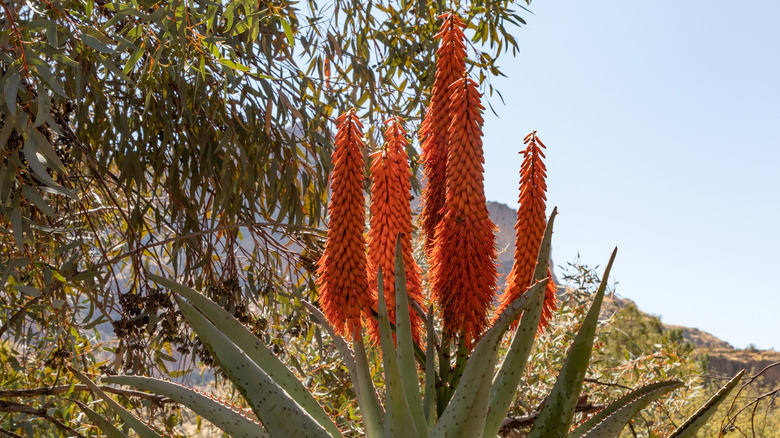
The arboretum has dozens of themed garden exhibits, organized around different ecosystems, plant types, and even wildlife. Some of the highlights are the Australian Deserts Exhibition (where the old eucalyptus grove lives), the butterfly-filled Rodica Heinz Pollinator Garden, and the Children's Garden, complete with a botanical maze and sensory garden plots. You'll also see some unique artworks interspersed with the plant exhibits. One of those, "Glass in Flight," is an installation of glass sculptures of local pollinators, which are on view through January 2026.