
The 5 Best State Parks In North Carolina For Camping
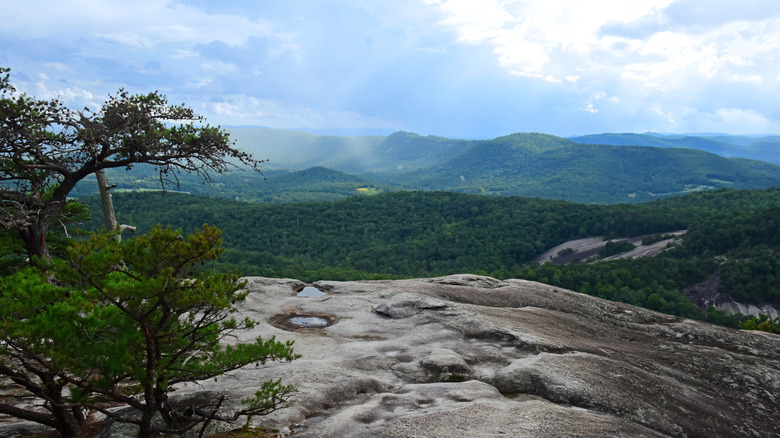
From its gorgeous, island-laden coastline in the east to its awe-inspiring Great Smoky Mountains in the west, North Carolina has perhaps the best opportunities for outdoor recreation in the Eastern United States. No matter where you go in North Carolina, you can likely find amazing hikes, gorgeous views, and ample recreational opportunities in some of the most beautiful settings that Appalachia has to offer. If you're only spending a day in North Carolina's great outdoors, you can do everything from climbing to the top of the birthplace of aviation at the Wright Brothers National Memorial to exploring the Blue Ridge Parkway's most beautiful waterfall on the short but scenic Erwins View Trail. Of course, such an abundance of spectacular outdoor settings also means an abundance of top destinations for overnight camping. And while national parks and forests tend to get all the attention, North Carolina's state parks actually have many of the area's best campgrounds.
Not every North Carolina state park site offers overnight camping, but the ones that do provide unforgettable outdoor experiences for campers of all ages. And with these park campgrounds spread out across each corner of the state, prospective campers have excellent opportunities to experience everything North Carolina's majestic landscape has to offer. The only true downside of camping in a North Carolina state park is narrowing it down! And while it's impossible to compile a truly "objective" ranking of the best North Carolina state parks for camping, a few do stand out for their distinctive natural features, extensive campground offerings, and unique camping amenities. Based on these key factors, it's possible to select the five state parks that are the best for camping in North Carolina. Note that before you hit the trails or reserve a campsite in any of these areas, check the official North Carolina State Parks website for up‑to‑date closures and facility notices, as conditions, closures, and campground availability can change seasonally or due to maintenance projects.
Merchants Millpond State Park
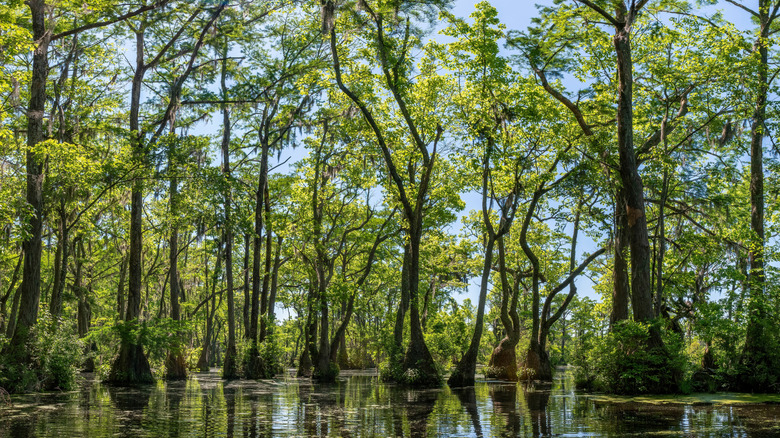
While the epic Appalachian mountains in the west get most of the state's well-deserved acclaim, North Carolina also has plenty of gorgeous waterside destinations. North Carolina's coastline obviously has numerous seaside state parks with incredible views, but the best waterside camping spot in the state may very well be the under-the-radar Merchants Millpond State Park. In contrast to the scenic dunes and bright blue Atlantic of North Carolina's coastal region, Merchants Millpond State Park is located near the somewhat off-puttingly-named Great Dismal Swamp. Despite its bleak name, however, the Great Dismal Swamp and its surrounding wetlands are actually a remarkable ecosystem along the border of North Carolina and Virginia. The Great Dismal Swamp itself is home to North Carolina's gorgeous (and swampy) Dismal Swamp State Park. Unfortunately, the Dismal Swamp State Park does not currently have overnight camping facilities. The nearby Merchants Millpond State Park, therefore, offers the best opportunities to camp in the heart of North Carolina's unjustly overlooked wetlands.
Merchants Millpond State Park is about 30 miles west of Dismal Swamp, protecting 760 lush acres around a 190-year-old millpond and part of the diverse Lassiter Swamp, where visitors can explore the lasting remains of an ancient bald cypress swamp. Together, these wetlands created an "enchanted forest" of cypress, Spanish moss, and mistletoe, all sheltering a mysterious black water. As a result, Merchants Millpond State Park is rich in both land-based hiking trails and alluring paddling routes. Interestingly, the park's six campgrounds are all located along these very paddle routes. Visitors will often have to canoe or kayak a few miles through the wetland forests to get to some of these campsites. And while this requires extra effort, it ultimately creates a truly one-of-a-kind overnight experience that sets Merchants Millpond State Park apart.
South Mountains State Park
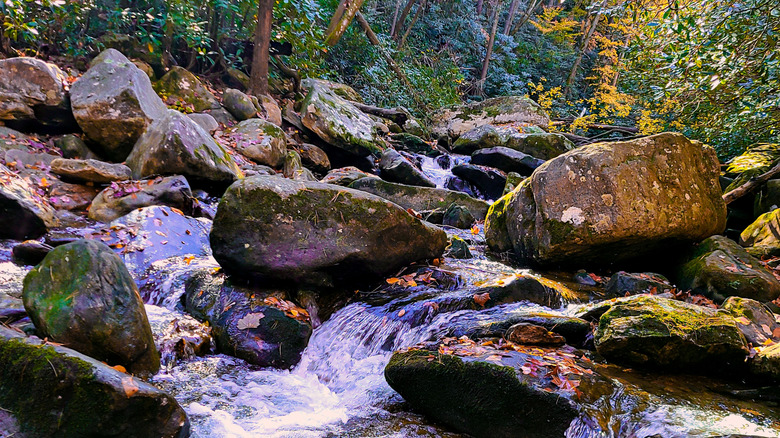
The epic South Mountains State Park has the distinction of being the largest state park in North Carolina. This superlative alone would likely place it among North Carolina's best state park destinations for both day-use and overnight stays. Yet South Mountains State Park is as rich in quality as it is in quantity. The park's roughly 18,000 acres protect a rugged landscape at the intersection of the higher Blue Ridge Mountains to the west and the lower Piedmont Foothills to the east. The result is a vast nature preserve featuring deep forests, 3,000-foot-high mountains, and one of the most beautiful waterfalls in the state, the High Shoals Falls. In addition to their distinctive, wind-carved beauty, the South Mountains also protect numerous stories from North Carolina history, from ancient Native American trade routes to Civilian Conservation Corps projects in the 20th Century. South Mountains State Park's impressive size accommodates numerous opportunities for outdoor activities, including 112 miles of trails suitable for hiking, mountain biking, and horseback riding.
South Mountains State Park's camping options are as rich and diverse as the park itself. The park's numerous campgrounds range in size and amenities, but all provide a front-row seat to the majestic grandeur of the South Mountains. For example, the South Mountains State Park Family Campground offers both non-electric tent campsites and a handicap-accessible family campsite with electrical hookups (all pet-friendly). In contrast, the primitive campsites at the park's backcountry campgrounds offer a much more rugged backpacking overnight experience as close to nature as you can get. If you and your hoofed friend are taking advantage of South Mountains' equestrian trails, you can stay overnight at the South Mountains Equestrian Campground, which offers both horse stalls and human campsites with electric hookups.
Hanging Rock State Park
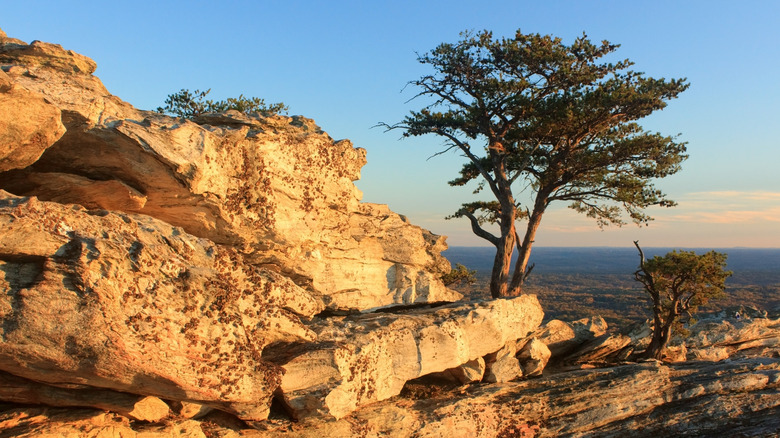
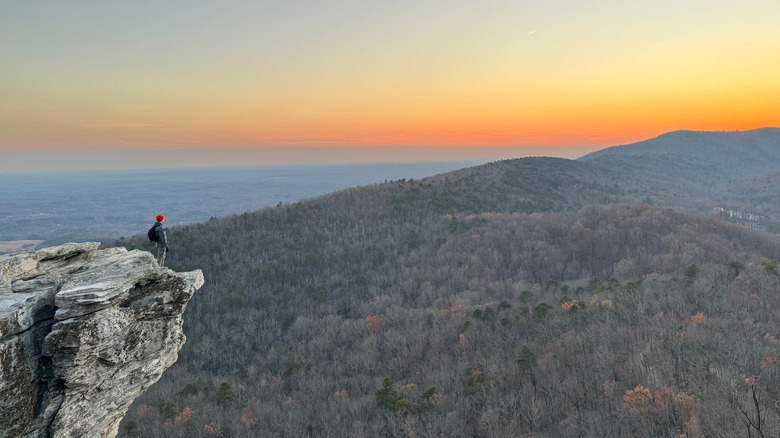
The namesake feature of Hanging Rock State Park is perhaps the most notable geological formation in North Carolina outside of the Blue Ridge Mountains. Located about 30 miles north of Winston-Salem, the 9,000-acre Hanging Rock State Park is a North Carolina wonderland of majestic waterfalls, picturesque trails, and a sandy beach, even without its defining rock formation! Said formation, as its name suggests, is a rocky outcrop that literally hangs over a precarious cliff and a spectacular overlook. Despite being the park's namesake, Hanging Rock actually sits at a lower elevation than the park's Moore's Knob and its Moore's Knob Observation Tower (a repurposed fire observation tower), which hits an elevation of 2,497 feet — and provides a panoramic view to match.
Hanging Rock State Park's intriguing geology stems from the surrounding Sauratown Mountains, a North Carolina topographical oddity that was isolated from the nearby Blue Ridge Mountains by eons of geologic drift. Sauratown Mountain parks, like Hanging Rock State Park, feature highly distinctive quartzite peaks defined by rich forest ecosystems intertwined with bare rock faces. Hanging Rock State Park in particular boasts many of the Sauratown Range's loveliest waterfalls.
Fortunately for anyone who wants to explore this one-of-a-kind landscape in person, Hanging Rock State Park offers camping opportunities to match its magnificent views. The Hanging Rock Family Campground's upper and lower loops offer over 100 tent campsites, including handicap-accessible spaces. The family campground also offers amenities like picnic tables and fire pits, not to mention excellent access to the park's incredibly scenic trails. Hanging Rock State Park also has ten reservable family cabins, primitive backcountry camping areas, and picnic shelters for larger groups.
Gorges State Park
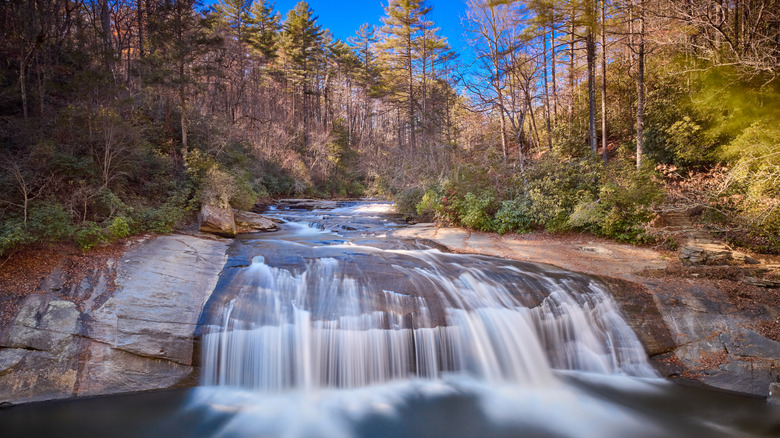
Other than parks named after actual mountains, Gorges State Park may be the most accurately-named state park in North Carolina. Located just north of the North Carolina-South Carolina border, Gorges State Park protects around 7,500 acres of North Carolina's portion of the breathtaking Jocassee Gorges. Here, the rolling peaks of the Appalachian Mountains meet an intricate network of rivers, which carve the area's rocky foundation into an eye-catching display of gorges, valleys, and rocky cliffs. While rocky gorges like this are generally the domain of parks in the Southwest, Gorges State Park adds an East Coast twist.
With a temperate climate and abundant rainfall, the eponymous gorges of Gorges State Park bear one of the most diverse forest ecosystems in the country, including a rare East Coast tropical rainforest. And when you combine steep terrain with plenty of rainfall, you usually get lots of amazing waterfalls. Gorges State Park is home to three picture-perfect cascades: Rainbow Falls, Turtleback Falls, and Bearwallow Falls, plus several smaller waterfalls. Rainbow Falls, in particular, is acclaimed for its magical 150-foot drop through the surrounding gorge, while Turtleback Falls features a swimming hole and natural water slide.
Gorges State Park's extraordinary ecology makes for one of the most magical and dream-like camping experiences you're likely to find in North Carolina (and maybe the country as a whole). The park's campgrounds include both tent campsites and RV sites, as well as electrical hookups in certain areas. The Gorges State Park Family Campground also offers cabins, picnic pavilions, reservable auditoriums, pet-friendly campsites, and ADA-accessible sites. These campsites also put visitors in proximity to Gorges State Park's most scenic waterfalls and gorges, via the park's diverse assortment of excellent hiking trails.
Stone Mountain State Park
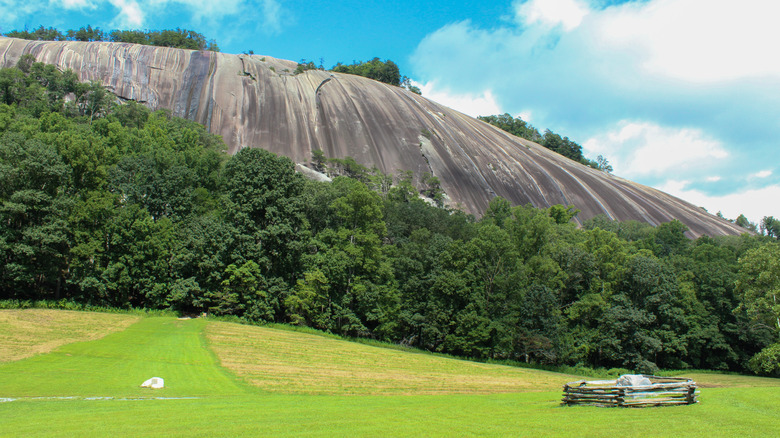
The "Stone Mountain" that gives Stone Mountain State Park its name is far from the highest mountain in North Carolina. However, with a distinctive bare rock face spotted with patches of green trees, Stone Mountain may be the most unique. The acclaimed Stone Mountain is actually a 600-foot granite dome that resembles a miniature version of the iconic domes of Yosemite. Geologists believe that Stone Mountain may be around 300 million years old, so visitors can experience a geological time machine on top of its incredible views.
Funnily enough, the park's 14,000 acres are so rich in exceptional natural scenery that you can't even see the namesake rock from many of its major areas! The surrounding parklands feature gorgeous meadows (some at the base of the notable rock itself), ravishing mountain rivers, and (like many North Carolina parks) numerous waterfalls. And, following the lead of its 300-million-year-old granite dome, Stone Mountain State Park also preserves many unique aspects of North Carolina's history. Before it was a park, Stone Mountain was home to old farming communities going back centuries. More recently, the area was even a center for illegal moonshine distilling.
Stone Mountain State Park also has one of North Carolina's most comprehensive offerings of campsites. The park's campground loops include both electric and non-electric tent camping sites, RV sites, handicap-accessible sites, group camping sites, picnic shelters, and even primitive backcountry camping areas for those who want to eschew modern luxuries entirely. For all of its natural beauty, Stone Mountain also boasts notably clean and well-maintained facilities, with terrific access to the park's scenic trails and viewpoints (including part of North Carolina's epic 1,175-mile Mountains-to-Sea Trail).
Methodology
Dozens of state parks in North Carolina offer some type of camping facilities, and with preferences differing dramatically between campers, an "objective" ranking of the top five best North Carolina state parks for camping is somewhat impossible. To cut through the various pros and cons of each state park and arrive at a list that, while not definitive, is at least satisfactory, we looked at two main factors. First, we looked at the types of camping opportunities each park offered, with a preference for parks that feature different types of camping experiences and camping amenities.
North Carolina's state parks feature camping facilities that appeal to virtually every type of camper. Depending on which park you visit, you may find standard tent or RV camping, primitive backcountry camping, comfy family cabins, large group campsites, or even campgrounds centered around a unique type of experience, like equestrian or paddle-in campsites. In compiling this list, we favored state parks that had a diversity of different camping options (such as Gorges and South Mountains State Parks), or at least parks that focused on a rare and memorable type of camping experience that showcases an unsung side of North Carolina (such as Merchants Millpond State Park and its paddle-in campsites).
Secondly, we focused on a park's scenic features and recreational opportunities to differentiate parks with similar camping offerings. The five parks on this list do not merely have diverse and well-maintained campsites. They also have unique and remarkable views that campers can enjoy while staying overnight. For example, Hanging Rock State Park and Stone Mountain State Park both have remarkable geological features and spectacular viewpoints, all available to overnight campers. Plus, these parks offer a diverse range of recreational opportunities that campers can enjoy during their stays.