
These 5 American States Have More Brutal Blizzards Than Any Others
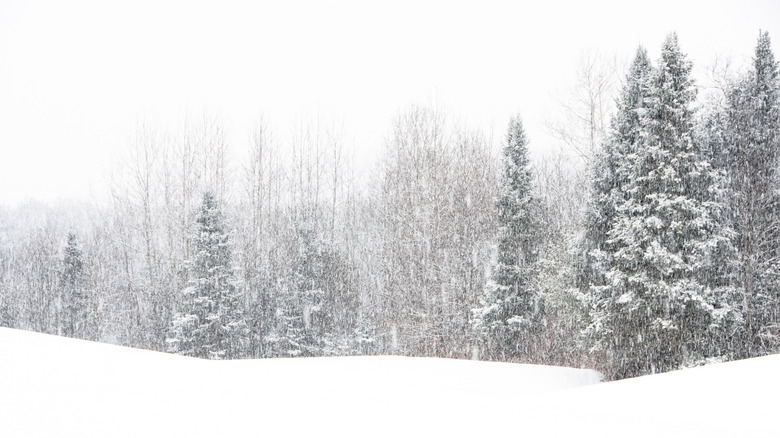
Winter can look very different depending on where you are in the United States. The Northeast and Midwest are great spots for a real winter wonderland vacation, full of snow and skiing, while snowbirds fleeing cold weather will likely flock to Florida's beaches and other iconic tourist attractions. Whatever type of weather you prefer, this list of the five states with the most brutal blizzards should help inform your winter plans.
Blizzards are becoming more common throughout the U.S., due to climate change. According to National Geographic, warmer winters mean that the atmosphere holds more moisture, making blizzards more likely to occur. In 2024, Policygenius crunched the numbers from the National Oceanic and Atmospheric Administration (NOAA) to find the states with the most blizzards annually on average for 2020-2021 winter season. The National Weather Service defines a blizzard as "a storm which contains large amounts of snow OR blowing snow, with winds in excess of 35 mph and visibilities of less than 1/4 mile for an extended period of time (at least 3 hours)." While the exact rankings will vary a little from year to year, these states all consistently get more and worse winter storms than most of the rest of the United States. Without further ado, let's take a look at the five U.S. states with the most brutal blizzards.
5. Alaska
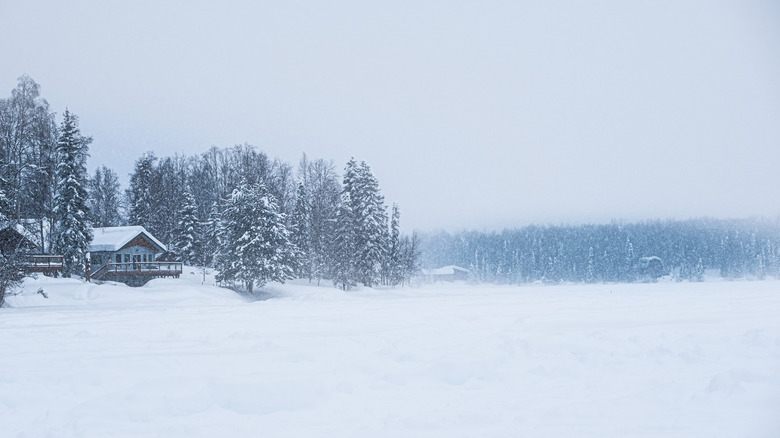
Alaska came in number 5 in Policygenius's analysis, and it's easy to see why. Alaska is the northernmost state in the U.S., which helps explain the freezing cold weather and frequency of blizzards. Although it's not all bad, its latitude is also why Northern Alaska is one of the best places on earth to see the Northern Lights.
In 2023, a single storm dumped 72 inches (yes, 6 feet) of new snow in less than 24 hours in an area northeast of the Thompson Pass — one of the heaviest one-day snowfall totals recorded in U.S. history. The storm resulted in widespread power outages, school closings, road closures, and car accidents. This storm also led people to reconsider Alaska's blizzard history. Claims that a February 7, 1963, blizzard brought 78 inches (or 6 feet, 6 inches) of snowfall in a single day were previously thought to be exaggerated. In fact, Alaskan blizzards can be very dangerous. In 2020, four children ages 2 through 14 went out on a snowmobile ride but got caught in a blizzard. One day later, they were found 18 miles away from their village of Nunam Iqua with severe hypothermia. An official cited low visibility as the reason why they were so confused, saying, "In wintertime our storms are very bad. Sense of direction is not to be played with."
4. Colorado
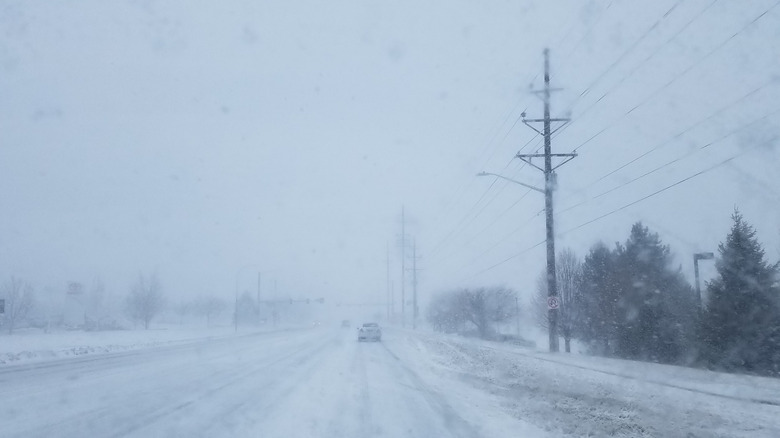
Colorado is home to the absolute best skiing in the United States, thanks to its mountainous landscape and powdery snowfall, but it also gets brutal blizzards nearly every winter. Per Policygenius's analysis, Colorado ranks #4 in the country for the worst blizzards. One of the worst Colorado blizzards in modern times took place in December 2006, when snowfall from a single blizzard reached up to 44 inches in some areas of the state, prompting the governor to declare a disaster emergency and activate the National Guard.
The worst blizzard in Colorado history occurred in December of 1913 and lasted five days. It was called "the Great Front Range Blizzard of 1913." Many areas in and around Colorado's Front Plains received at least 40 inches of snow, and Georgetown received 86 inches in five days, including 63 inches in one 24-hour period. Contemporaneous reports from the Georgetown Courier proclaimed it the "deepest snow since the Glacial Period."
3. New Hampshire
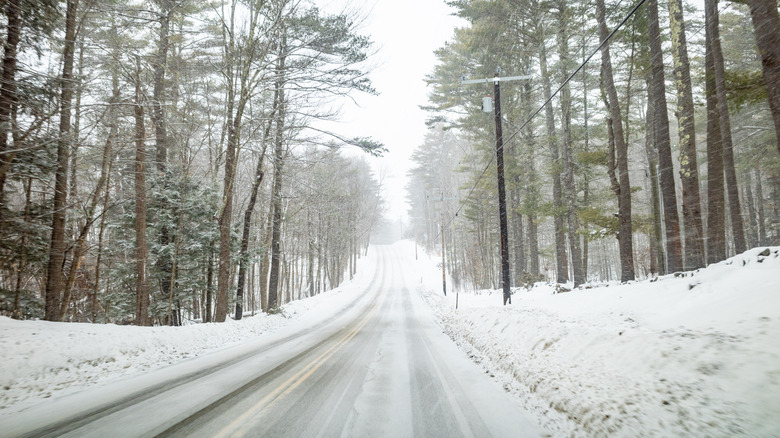
New England is one of the snowiest areas of the United States, and New Hampshire sees an average of 71 inches of snowfall per year with an average winter temperature of 23.8 degrees Fahrenheit. Policygenius ranks the state as #3 on its list. One of the worst blizzards in the state's history occurred in February 1978. Nicknamed "the blizzard of '78," the storm affected many states in New England. New Hampshire was hit particularly hard with $14 million in damage, up to 21 inches of snow, and tides running 14 feet above normal. According to local news station WMUR, the blizzard brought "hurricane-force winds" that led to eight-foot snowdrifts, and "the snow was so blinding, a normal one-hour commute turned into five hours for some."
In more recent years, the "Great Blizzard of 2011," also known as "Snowtober," brought two to three feet of snow to areas of New Hampshire on October 30 and 31 in 2011. Around 300,000 people lost power, and Halloween trick-or-treating had to be cancelled or rescheduled in much of the state.
2. Maine
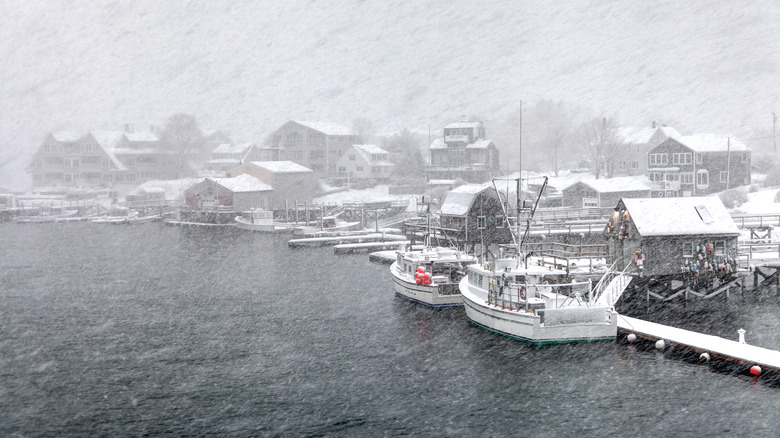
New Hampshire's neighboring state, Maine, comes in #2 on the Policygenius list. It's easy to see why. In January 2015, a single blizzard brought more than 2 feet of snow in some areas, and up to 27.4 inches in areas of Portland. Coastal flooding, snowdrifts, and low visibility made driving dangerous, and Gov. Paul LePage declared a state of emergency. "You can't tell whether you are on the road or off the road. ... It is very, very easy to get disoriented," Bob Bohlmann, retired director of the York County Emergency Management, told the Portland Press Herald at the time.
The Great Blizzard of 1952 was even worse. Over a two-day period in February of 1952, Maine received up to 36 inches of snow, with wind gusts up to 65 miles per hour and 15-foot snow drifts. According to the Portland Press Herald, conditions were so bad that "people traveling were forced to abandon their cars on roads throughout the state." School was canceled, roads were impassable, and postal workers had to deliver mail by horse. The Portland Press Herald reports, "One young grocery store worker who was snowshoeing his way to work made an astounding discovery during his travels when the tip of his snowshoe struck metal, and he realized a city bus had been buried beneath the snow."
1. Vermont
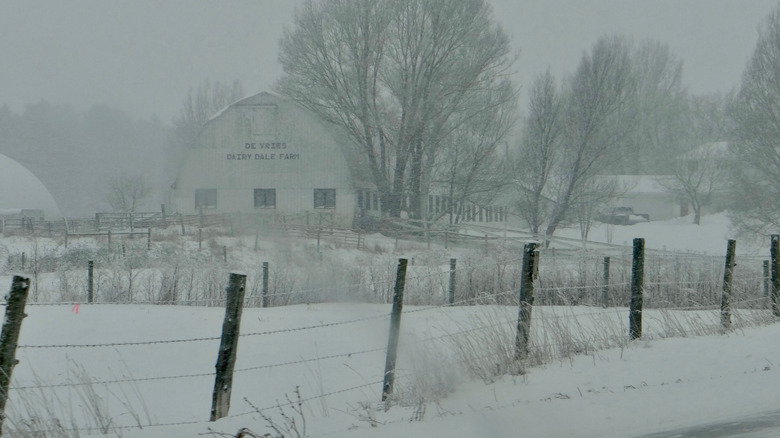
Vermont takes the top spot when it comes to winter storms in Policygenius's analysis. The worst blizzard in the state's history is widely believed to be the Great Blizzard of 1888, also known as "the Great White Hurricane" due to the extreme wind. Over the course of three days, temperatures reached below 6 degrees Fahrenheit, 3 to 5 feet of snow fell, winds were over 40 MPH, and snowdrifts reached 6.5 feet. Trains were overturned, telegraph wires were downed, and people were buried in snowdrifts, resulting in the death of 400 individuals. Local paper the Bellows Falls Times summarized the storm as: "No paths, no streets, no sidewalks, no light, no roads, no guests, no calls, no teams, no hacks, no trains, no moon, no milk, no paper, no mails, no news, no thing – but snow."
More recently, the "Valentine's Day Blizzard" of 2007 became the fourth-largest blizzard in state history on February 14 and 15, 2007, bringing 20 to 30 inches of snow and strong winds. The storm caused barns to collapse, killing several cows, and over a dozen people experienced carbon monoxide poisoning due to the snow blocking gas vents.
Methodology
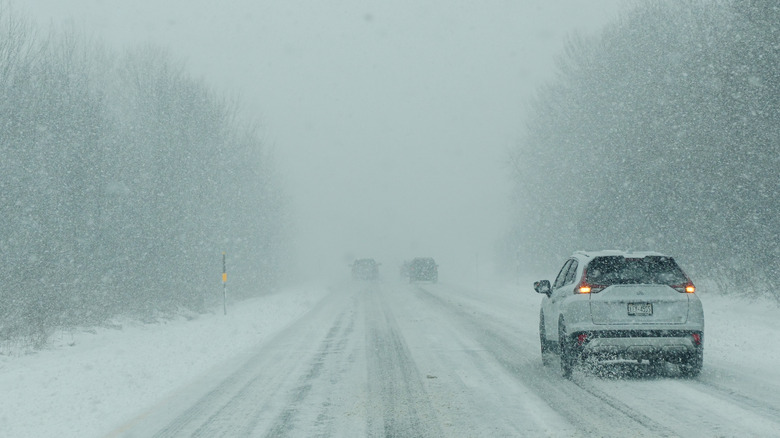
We looked at Policygenius's report of the states with the worst winter blizzards, which gathered data from the National Oceanic and Atmospheric Association (NOAA) to determine this list. NOAA uses the Regional Snowfall Index (RSI) to rate the severity of a winter storm on a scale of 1 to 5, where 1 is noticeable, 2 is significant, 3 is major, 4 is crippling, and 5 is extreme. This index is based on the amount of snowfall, the spatial extent of the storm, and the population of the area affected. After that, we sifted through local accounts, from newspaper articles to firsthand accounts, detailing some of the worst blizzards in the state's history.