
Europe's Most Castle-Lined River Is A Breathtakingly Scenic Natural Marvel Steeped In History
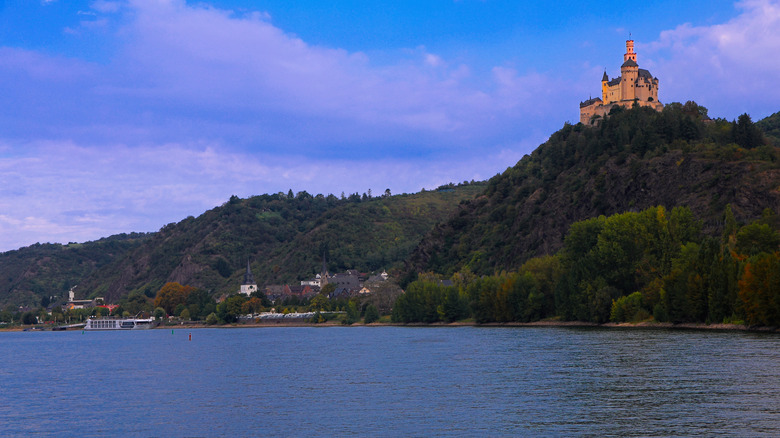
Europe is home to some of the most fairytale-like hidden castles with historic charm that transports you to another century. But there's something bewitching about the 765-mile-long Rhine River, which flows through Switzerland towards Austria and Germany, before streaming through France, Liechtenstein, and the Netherlands. In fact, a winter cruise up this enchanting river gorge will have you enjoying it blissfully crowd-free. Some might say that the 40-mile Upper Middle Rhine is the most fascinating portion of the river, meandering through southwestern Germany's Koblenz and Bingen. This stretch holds more castles than any other river, with a whopping 40 medieval castles and fortresses guarding its banks. It comes as no surprise that this section of the Rhine is a designated UNESCO World Heritage Site.
The Upper Middle Rhine Valley is dotted with quaint towns providing abundant lodging. Depending on which attractions are on your itinerary, you can spend the night at a fancy hotel, themed Airbnb, or even a castle. It's a good idea to pick out a base city to stay in on the Upper Middle Rhine and then continue your exploration of the area from there. Stahleck Castle, for instance, is a 12th-century structure that was converted into a hostel in the 20th century. The accommodation is located in Bacharach, which is a little over an hour's train ride from Frankfurt. Liebenstein Castle, dating back to the 13th century, offers lodging and has the highest location out of all the castles on the Middle Rhine. The best way to get here is to fly into Stuttgart, take a train to Kirchheim, and then a bus to Liebenstein (the entire journey lasts one hour).
Discover fortresses and medieval history along the Upper Middle Rhine
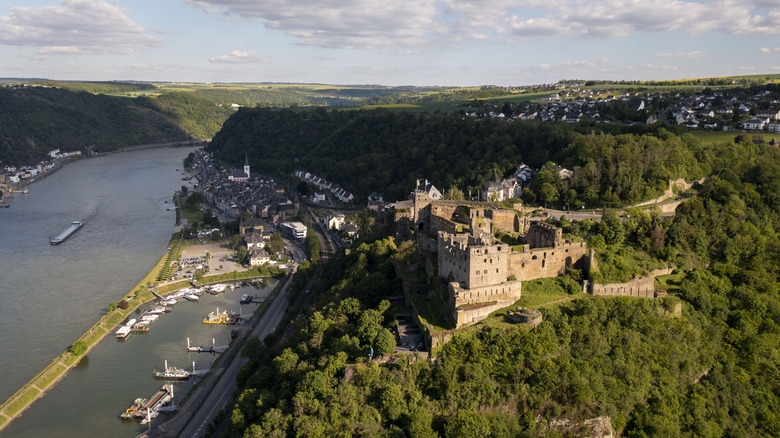
The thrilling rapids of the Upper Middle Rhine are all the more magnified by the presence of medieval castles, with the Marksburg being one of its highlights. Dating back to 1117, this mighty fortress was built not only to guard over Braubach, but also to serve as a toll station and levy charges on passing vessels. Boasting Romanesque and Gothic characteristics, the castle has stood the test of time, even withstanding shelling during WWII. Unlike other structures on the Upper Middle Rhine, the Marksburg never succumbed to destruction.
Pfalzgrafenstein Castle also graces the Rhine's banks, and is an interesting stop for history enthusiasts. King Ludwig of Bavaria erected the toll castle in the 14th century, with defining elements like its islet location in the heart of the river. Its exterior is black and white with red accents. The castle almost looks like a ship in the river — while it was originally built for military purposes, the 18th century Prussian rule integrated Baroque motifs to Pfalzgrafenstein. Despite being small, it's worth touring the castle, viewing its central courtyard, and checking out the cannons.
Stolzenfels Castle embodies Rhine Romanticism, with its original structure going back to 1244. After the War of the Palatinate Succession, it was heavily damaged and its ruins were eventually transferred to the Prussian government and reconstructed in 1842. Inside, the pergola garden is as incredible as the castle's Neo-Gothic exterior, complete with an ornamental fountain at its center. However, while all of these structures are gorgeous, some historic castles have not held up over time. One such example is the vast ruins of Rheinfels Castle, built in 1245. This fortress is the largest of its kind along the Rhine — although only part of its walls are intact, you can still wander its corridors, observe the museum exhibits, and climb the clock tower.
How to experience the Upper Middle Rhine
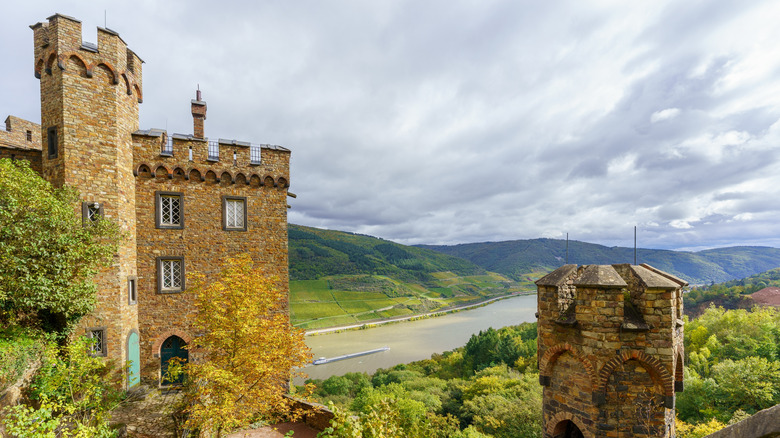
One great way to access and explore this area of the Rhine is through Europe's extensive and fast rail network. This way, you get central stations, picturesque routes, and zero parking stress. If you want to see this castle-lined portion of the Upper Middle Rhine in one go, take the RB26 from Koblenz Hauptbahnhof, which goes all the way down to Bingen's central station. Lasting about 50 minutes, the train ride goes past Rhens, Sankt Goar, Oberwesel, Bacharach, and Niederheimbach, with more stops in between. One recommended way to go about seeing all these spots is to do a southbound train trip to Bingen, then making your way back to Koblenz, getting of at key stops along the way.
Those who aren't used to relying on public transportation can rent a car and do the scenic drive at their own pace. A round-trip journey takes two hours — stick to one side of the Rhine going out, then cross over and do the other side coming back. Even more romantic is going on a river cruise, where you'll be completely surrounded by medieval attractions. KD offers winter trips along the river, running two hours from Rüdesheim to Sankt Goar. Meanwhile, Arosa has multi-day cruises that span the entire length of the Rhine.
If you'd rather explore on foot, hikers can follow portions of the RheinBurgenWeg Trail, which covers 124 miles of the Upper Middle Rhine's left bank. This path not only traverses the castles, but also vineyards, mountains, and natural attractions. On the right side of the river, hike the Rheinsteig Trail, which starts at Wiesbaden and ends at Bonn, covering almost 200 miles. With so many ways to view the UNESCO World Heritage Site, there's no wrong way to discover its beauty. Don't forget to visit nearby towns like Limburg that also burst with medieval charm.