
Montana's 'Open Air Ghost Town' Is A Once-Thriving, Now Almost Abandoned Vestige Of The Old West
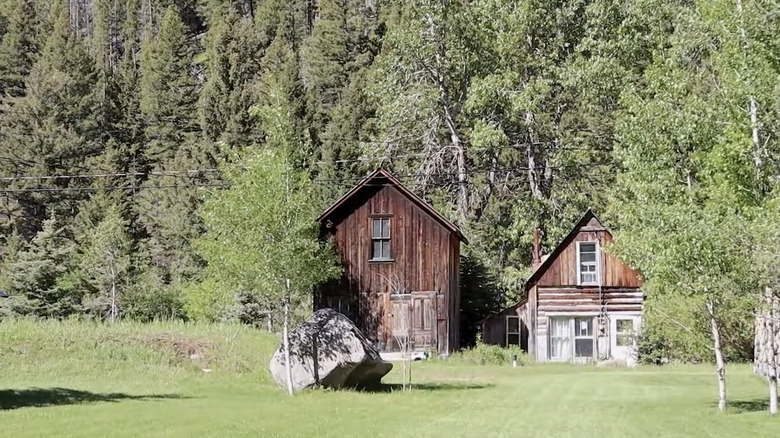
Visitors to Montana — and in 2024, that was a record-breaking 13.7 million people (via NonStop Local) — are drawn to this northwestern state for its dramatic mountain ranges, historic sites, and exquisite national parks teeming with wildlife. Indeed, the state contains the famed Glacier National Park, a large section of Yellowstone, and one of the largest bison populations in the U.S. But beyond the natural beauty and outdoor adventure that Montana provides, wandering through the buildings of its abandoned mining towns might just be the best thing about a visit to the Treasure State. From Garnet, Montana's "best preserved ghost town," to Elkhorn, a mountain ghost town and state park with scenic trails, these places offer an extraordinary glimpse into a bygone era. And Rimini (pronounced "RIM-i-nee"), in the central west of the state, is no different, with its simple log cabins and storied history.
Located in Lewis and Clark County, this town was once thriving in the late 19th century. While it was known by other names originally, including Young Ireland, its current name comes from the play and its eponymous lead character, "Francesca da Rimini." This traveling production was running in Helena and would have been well-known at the time. Da Rimini was a real person — a 13th-century noblewoman famously murdered by her husband for adultery — and was first popularized in "Inferno," Dante Alighieri's epic poem. Her legacy now lives on in Montana, as she became the namesake of this formerly bustling mining town.
Rimini isn't technically abandoned — it does have some permanent residents. It's considered to be an "open air ghost town," according to Visit Southwest Montana, as there are no full-time staff here to escort guests or lead tours. Instead, you can walk through on your own, using the interpretative signs to guide your visit.
Rimini, past and present
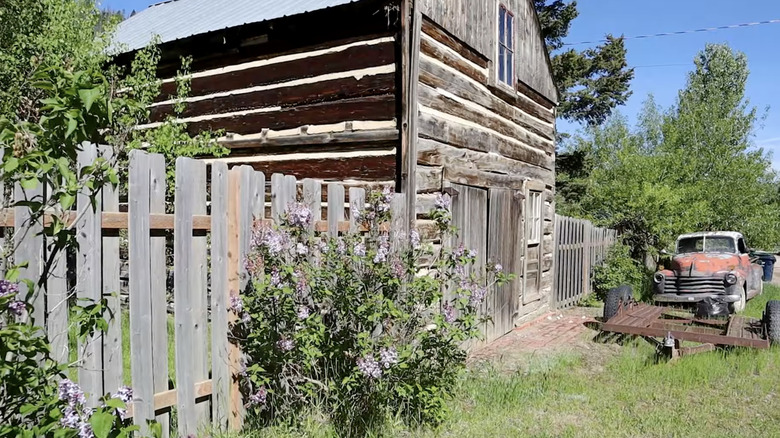
Rimini's mines — and, subsequently, the settlement itself — were established in the 1880s, after a rich vein was discovered in 1864. Due to its location in a valley between Red Mountain and Lee Mountain, and its lack of railway access, the ore from the mines was challenging to transport. However, this changed in 1885, when the Northern Pacific Railroad's Rimini-Red Mountain line was created. While the boom began with silver lode mining, it expanded over time to encompass gold, zinc, lead, and more. As laborers young and old, many from Ireland, were drawn to the town, the number of services and businesses increased. The town eventually came to include a post office, hotels and boarding houses, saloons, a livery stable, a school, and a church.
At its height, in 1890, Rimini had a population numbering around 300 residents. It was shipping 400 tons of ore weekly to the smelter; and in total, the mining district generated about $7 million. But all good things come to an end, and this town of 0.3 square miles in area petered out to just 20 residents by 1920. Mining had waned overall, and as the price of silver declined, most of the town's inhabitants moved on to seek out fortunes elsewhere.
Rimini received a new lease on life in 1942, when it became the location of the U.S. Army's War Dog Reception and Training Center. For two years, dogs were trained here for Arctic search and rescue operations during World War II. Nowadays, you won't find elite canines in Rimini, but you will find some human residents. As per a 2020 census report, the town's population sits at just under 100 — 93, to be exact — many of them inhabiting the painstakingly restored log cabins that previously housed miners and their families.
How to get to and experience Rimini
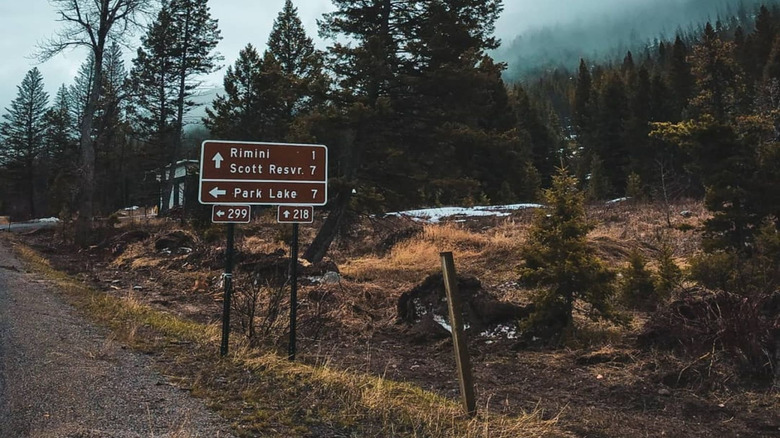
The road to Rimini is maintained, and the town is easy to reach. It's located around 25 minutes southwest of Helena, one of the smallest and most underrated state capitals in America. From Helena, you'll take US-12 W, turn onto Rimini Road, and drive for 7 miles. Keep in mind that certain rural roads may be impassable during the winter, particularly after heavy snowfall. For the most up-to-date road conditions, use the Montana Department of Transportation's 511 service.
If you're coming from outside the state, you can fly into one of two major hubs. Helena Regional Airport (HLN) is the closest, with direct flights available from places such as Denver, Seattle, and Salt Lake City. Meanwhile, Bozeman Yellowstone International Airport (BZN) is around two hours away but is serviced by eight airlines. You'll find direct flights from a much greater range of destinations, including Los Angeles, Boston, Chicago, Las Vegas, and New York.
As Rimini isn't a full-fledged ghost town, there aren't specific hours of operation, so you're free to enter at any time. But note that some people still call Rimini home, so be respectful while visiting. Upon arrival, explore the town at your leisure, taking time to wander through the log cabins dating back well over a hundred years. Many of these fascinating buildings contain false fronts, and they were constructed in the practical style typical of frontier-era architecture. Additionally, like many abandoned mining towns in the Old West, Rimini could be haunted. Travelers claim to have seen headlights and heard whistles from the "Phantom Train" along the old railway tracks. But whether you believe in ghosts, Rimini remains an intriguing vestige of the Old West and a fascinating piece of living history to visit, haunted or not.