
Montana's Crowd-Free Mountains Have Gorgeous Trails And One Of The Largest Wild Horse Ranges In America
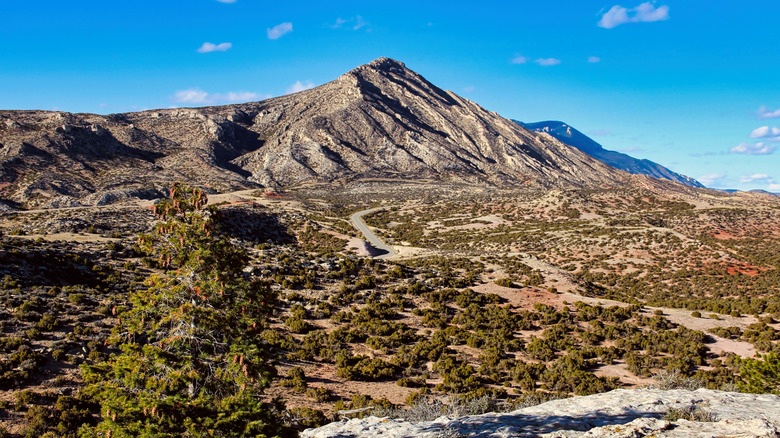
"My favorite state has not yet been invented. It will be called Montana and it will be perfect," proclaimed Abraham Lincoln back in 1864. Well, Montana has now been invented — and there are plenty of folks out there who would agree that "perfect" is a good descriptor. Nicknamed Big Sky Country for its vast domains of sublime wilderness, Montana is where you come to wonder at the unmatched beauty of Glacier National Park or cruise through bright blue glacial lakes and alpine vistas on an epic road trip. It's also where you can step into the Pryor Mountains, a range that's not quite as famed as other corners of old Big Sky.
But the Pryor Mountains are indubitably gorgeous, showcasing an ecological makeup that's largely unique within Montana itself. Think blooms of rare wildflowers, habitats for black bears and cougars, soaring prairies, the first public wild horse range in the United States, and thick stands of Douglas fir lofting thousands of feet above the plains. What's more, these peaks are now home to a growing array of hiking paths that include routes to hidden ice caves and summits with sweeping views.
Tempted? Thought you might be. The good news is that the Pryor Mountains are just 33 miles south of Billings, where the local Billings-Logan International Airport offers flight connections to Las Vegas, Salt Lake City, and Denver, just to name a few. Meanwhile, you're looking at a drive of just under four hours from the city of Bozeman. Access to the range itself is available via two roads: Pryor Mountain Road and Crooked Creek Road.
Enticing and crowd-free hiking in the Pryor Mountains
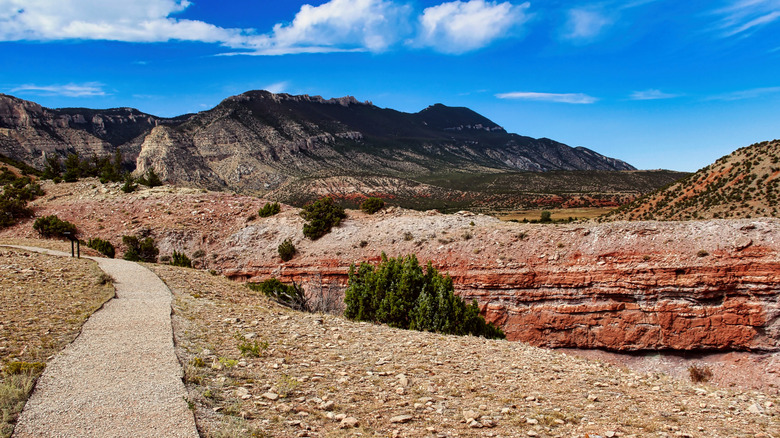
The vibe in the Pryor Mountains carries a distinctly untamed feel, with relatively low visitor numbers, light-touch management of the backcountry, and the lack of permits — there's no Half Dome lottery system here, folks! Meanwhile, The Pryors Coalition, a local organization dedicated to the conservation and sustainable promotion of the landscape, underscores that hiking paths in the area remain firmly under the radar for most visitors.
And there are some seriously wonderful routes. The 3.4-mile path up Big Pryor Mountain was highlighted as one of the "Trails of the Week" on Wild Montana, which extolls the panoramas of the Beartooth Mountains at the top, and the way the trail moves through evergreen woods and wildflower meadows — blooming in earnest throughout June and July — as it creeps upward. That hike is also a ticket to the unusual Big Ice Cave, an opening in the mountaintop that's got its own fridge-like microclimate.
You might also want to check out the appropriately-named Hiker's Haven, an enclave of prairies and rocky outcrops that's perfect for getting on the trails. Several paths weave through the area, including the Rocky Juniper Trail, which climbs to a saddle through clusters of Utah juniper bushes, and the Big Sky Trail, which offers up spectacular broadsides of the Wyoming countryside in the distance.
The legendary horses of the Pryor Mountains

Despite its off-the-radar character, there is one proverbial ace up the sleeve in the Pryor Mountains. Cue the Pryor Mountain Wild Horse Range, the first-ever designated range for feral horses in the United States. It was established way back in 1968 and now encompasses roughly 39,000 acres, roamed by a herd of elegant equines that are thought to be descendants of horses brought over by the Spanish.
Anyone interested in glimpsing the beasts should head for the Pryor Mountain Wild Mustang Center just outside of Lovell. It's a nonprofit that offers educational programs on the history of the local herd, providing valuable information about where individual horses or bands of horses can be seen. According to the center, East Pryor Mountain has the largest herds of all.
Meanwhile, mustangs are less commonly sighted in the Bighorn Canyon National Recreation Area — a sprawling land of high-altitude desert scrub and deep canyon trenches that hugs the southeast side of the Pryor Mountains as a whole. That said, visitors should take special care not to disturb herds, maintain a safe distance when viewing wild horses, and never feed or touch the animals.