
11 Etiquette Rules You Need To Know Before Eating In Italy
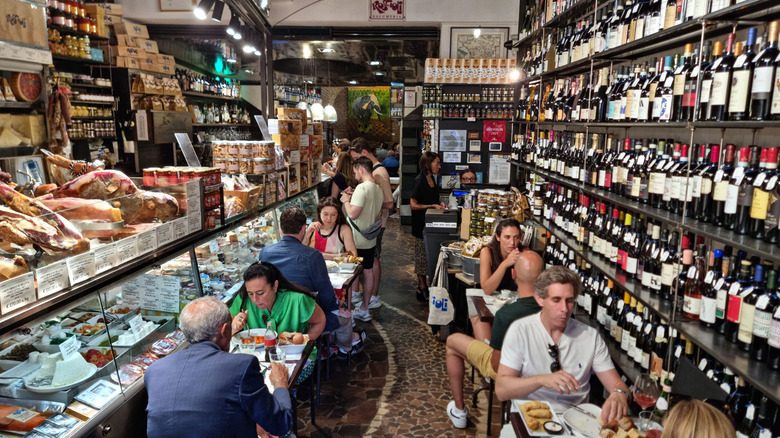
America is well-known for having a relatively relaxed approached to table manners, especially compared to the Europe, whose various cultures still consider them a centerpiece of dining and culture. In Italy, this is certainly the rule. Many things that are acceptable in the United States are considered rude or offensive there. Of course, conversely, many things that are considered off-limits in America are fine when eating "nel Bel Paese," or "in the Beautiful Country," as Italy is often called.
The main issue comes with mannerisms that might almost be second nature. For some Americans, it is almost reflexive to put one hand on their lap if not using it. But committing some offenses in Rome or Venice might get you a strong side-eye. Thus, tourists should have a general idea of how to comport themselves at the Italian table.
Obviously Italy is incredibly diverse, but these tips generally apply to most places in the country and will help you have a harmonious trip. Finally, these tips not only apply for tourists at restaurants — they are also for anyone traveling to Italy and having the honor of being invited into an Italian home. Even as a casual tourist or student studying abroad, you might get invited by a local you meet, and you certainly don't want to be unprepared.
Don't rush your meal

To those who live fast-paced lives in big American cities, the idea of slowing down at mealtime can seem counterproductive. In fact, among office workers, one study from Optimum Research for Little Leaf Farms found that 76% of American office workers ate their lunches at a desk for about half the days they spend at work (via Finance Buzz).
When you go to Italy, you need to jettison this mentality. Italian meals — even daily lunch on a work break — are long affairs, often with multiple courses. Honestly, if you are on vacation in a place like Levanzo, a secret Italian island that's perfect for a "slow life" vacation, you're obviously going to want to slow down. But even a working-day lunch can last around one to one and a half hours and it's not uncommon to see Italian office workers in local restaurants enjoying a multi-course meal before getting back to work. Among store owners, who often close between 1 p.m. and 4 p.m., this gives plenty of time to enjoy a long meal daily. When it comes to Sunday or holiday meals where the whole family is gathered, it is common for these to stretch out to at least three hours.
The best thing to do is slow down, enjoy every bite you take, and don't be afraid to take that extra drink with your food (in moderation, of course). If you do eat too quickly, however, you won't necessarily be accused of rudeness. More likely, the host will think you like the food so much and offer more while telling you to savor your meal.
Cappuccino is not an after‑lunch drink

Cappuccino is generally considered to be a breakfast drink, so asking for this common coffee order might earn you a side-eye after 11 a.m. This may seem strange, but it does make sense when you consider Italian breakfast culture and beliefs around proper digestion.
Cappuccino is a milk-heavy drink, and milk-heavy drinks are pretty filling. This is why many Italians only have a light breakfast — usually just a pastry with cappuccino. The milk is supposed to satisfy you until lunch, which is usually the main meal of the day. In addition, according to many Italians, if you're full of food from lunch or dinner, milk can cause digestive issues. For lots of people, this is because it's sitting on top of a whole bunch of other rich foods that your body needs to digest.
Thus, if you want to be traditionalist and not stand out like a tourist, get an espresso instead. Since it's a bitter drink, is said to aid digestion by releasing more stomach acid. There are also many bitter after-dinner drinks called "digestivi," whose bitterness, again, is said to help digestion, though studies around the use of digestive bitters is inconclusive. Regardless, they are just very good treats after a meal.
Hands on table, but elbows off

Naturally, given the history of British colonialism in the United States, the country has naturally adopted some British mannerisms instead of those on the continent. When it came to hands at the table, this meant leaving the idle hand — usually the non-dominant one — on your lap while you used your dominant one for your fork. While Americans historically observed the rule of keeping elbows off the table, it is less strict nowadays than in the past.
In Italy, both of these rules are observed in most dining environments with perhaps the exception of ultra-casual meetups, and both rules have become ingrained over centuries. In continental Europe, including Italy, the hands-on-table rule dates back to the Middle Ages. Centuries ago, putting your hands on your lap made it seem like you might be concealing a weapon, and thus, it was considered a sign you might be planning some nefarious acts.
Although it's probably less likely today, this still became part of etiquette over the years, losing its original purpose and just becoming what was considered "correct." As for keeping elbows off the table, there were a variety of issues, ranging from practical ones to just rules of politeness that also originated in different eras. Trestle tables were common in the Middle Ages. These were tables that were balanced on beams supported by sloping legs, so carelessly placing elbows could potentially knock them over. Furthermore, slouching was considered rude and elbows were also an invasion of fellow diners' personal space. So while the original problem isn't an issue anymore, the custom has nevertheless been passed down.
Serve the wine correctly
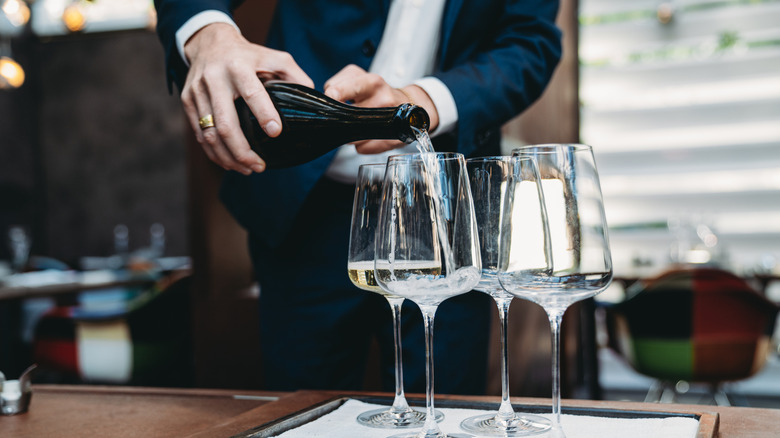
Serving wine in Italy is no haphazard affair — there's a right and a wrong way to do it. You, as the guest, are unlikely to be the one opening the bottle. However, if you are a business traveler or long-term visitor, you should know how to go about it just in case. First, use a good corkscrew that will not get bits of cork in the wine. Second, make sure that when cutting open the capsule (the wrapping at the mouth of the bottle), cut cleanly so the wine doesn't make contact with the wrapping when poured.
During the meal, you might have to refill a glass for a fellow diner, so make sure to pour it correctly. This means holding the wine bottle at the base, pouring into the glass, and slightly rotating the bottle once done to avoid dripping. The label should face away from you so the person knows what he's getting. Do not hold the wine bottle by the neck. This is considered particularly uncouth and in certain regions like Sicily and Puglia.
In addition, don't use your left hand. It may seem a bit superstitious, but this custom likely originated with stories from the Bible and beliefs that the left hand was associated with traitors and bad luck. Underhanded pouring is similarly unlucky because it was once how would-be-murderers would empty poison rings into their victims' drinks. Finally, make sure to respect the serving order in formal situations. Women come first from oldest to youngest, then the men. Once they all have their glass, you can pour your own.
You need to ask for the bill

If you're a tourist in Italy, even if you're staying with a family, you would be missing out if you didn't try a restaurant or two — particularly the small, family-owned ones that tourists generally overlook. The waiters at restaurants will expect you to observe Italian dining norms. This means unlike in America, where there is pressure to turn over tables quickly, waiters won't constantly be topping off your water, asking you if you're done, or bringing you the bill before you're ready. If you want to signal that you're done, you have to ask for the bill. In fact, if you are a tourist anywhere, really, it's one of the essential phrases you need to learn.
The idea behind this is that it would be rude of the waiter to rush your meal, since, as mentioned earlier, Italian meals are social affairs, not simply times to refuel. Bringing you the check in Italian culture would be like telling someone to hurry up and finish. Once you're done, just ask the waiter for the bill by saying "il conto, per favore" and they will bring it to you. Also, be aware of how Italian tipping works. It's not like in the U.S., where waiters generally expect around 20%. In general, you only need to leave around 10% for exceptional service, or you can opt to round up your bill to the nearest 10 or just leave a few euros. Most waiters, however, will not turn down an American-sized tip if you offer it. The one exception is in Southern Italy, where some workers might refuse tips altogether.
Don't eat until the host is ready

Italian meals begin whenever the host says so. That usually means either the head of the household, the cook, or in the case of extended family gatherings, the matriarch or patriarch of the family. Before meals, there might be some social time accompanied with some drinks, before everyone is called to sit at the table. Once you are called, don't dally. Wash your hands, take your seat, and wait for the host to announce the beginning of the meal. This will usually follow once everyone's first course has been plated.
It is considered very rude to start eating before the host says so. Many Italian meals are meant to be family affairs where everyone is supposed to enjoy each other's company while eating. Starting and finishing at different times can result in a disjointed dinner that loses that family feel. Fortunately, this one isn't hard to run afoul of. Just wait for the host to say "buon appetito" or something similar, and you can eat. You should learn to recognize it as it's one of the essential phrases you should know if traveling to Italy. If the host, however, says to go on ahead, then you may eat.
Don't cut pasta
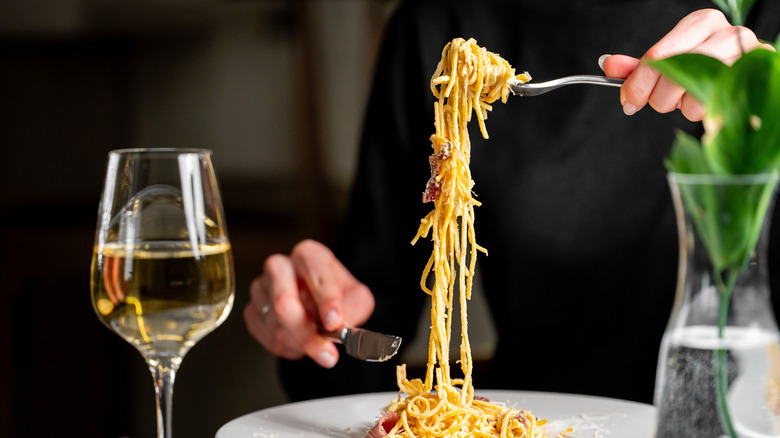
There are actually culinary reasons for why Italians don't cut or break pasta. According to RestoNYC, the biggest reasons are all related to food texture and presentation. Pasta, with its many shapes and attractive look when plated with a sauce in a nice dish, is more of an art presentation than just food.
Different pasta shapes serve different purposes. Pastas with crevices and pockets are considered best for absorbing sauce. If you cut them, suddenly you might be stuck with plain pasta without enough sauce. Spaghetti is meant to give you the entire flavor package, evenly distributed in a single bite, which is why you twirl it around your fork. Finally, if these reasons don't convince you, then accept the fact that it's just considered the proper, elegant, and refined way to eat the food. As the saying goes: "When in Rome..."
In local Italian culture, pasta is generally only cut for children who are still learning to handle utensils. And they usually use spoons to practice fine motor coordination before moving on to forks. Still, it seems like a pervasive misconception for American tourists that the proper way to twirl spaghetti is by using both a fork and spoon. Usually, if you see an adult using one on your trip to Rome or Venice, you can probably assume they are likely not Italian locals. So, if you use a spoon or cut pasta with a fork, you'll be immediately identified as a tourist.
No phones or tech at the table

To anyone raised with traditional table manners, this one is a no-brainer. However, there's the reason why things like TV dinners were a thing — people would watch television during dinner instead of talking. Today, it's phones that are increasingly visible at the American dinner table. In Italy, however, outside of uber-casual hangouts with friends, tech at the table is a no-go.
Phones should not be anywhere near the table. The best place for it is in your pocket, coat, or bag. If you truly want to unplug, it should be turned off so you can't check your notifications while eating. Know that checking your phone is practically considered a cardinal sin at the Italian dinner table because it's rude to your fellow diners and may even effect your own ability to enjoy the meal, according to the Journal of Experimental Social Psychology (via Non Sprecare). The exception to all of this, of course, is in an emergency. If you need to check to make sure everything is okay, excuse yourself from the table, and then promptly return to the table if there is no emergency.
Diners should therefore attempt to observe this rule in households as well as in restaurants. There is a phenomenon in Italy of restaurants marketing themselves as phone-free. While this may be just marketing rather than a hard rule, it testifies to the immense importance Italians place on table conversation. Otherwise, such marketing wouldn't be very effective.
Talk to people

It is expected, especially if you are dining with any local Italians who will want to know more about you and your life. The rules for conversation in Italy are as follows: There is nothing wrong with showing emotion — in fact, it's expected. Italians have plenty of words and hand gestures that communicate such things too. If you want to have fun, you can incorporate some of them yourself, even if speaking mostly in English. These include things like: "Ma dai," to indicate surprise, or "Figurati!" to say "No way!" Obviously, watch your tone and volume if you seem to be bothering people, but the easiest way is just to take cues from your fellow Italian diners.
Generally, Italian conversation, as long as weighty topics are not involved and it is not a formal event, is more relaxed. It's not abnormal for Italians to tease and gently poke fun at those they care about and feel close to. So, if you find your hosts (if you are eating with locals) doing this to you, they're not being rude. Chances are it means they like you, as otherwise, they wouldn't behave that way. In fact, being too serious at Italian mealtime (formal, business-like occasions excepted) if often a sign that you are trying to put some distance between yourself and your hosts — which can be taken as a sign of rudeness.
Get the cheek kiss right

When greeting locals, it helps to know some words. In informal situations, "Ciao" or "Come stai?" (Italian for "Hello" and "How are you?") plus a handshake will suffice. In more formal or polite environments, "Buon giorno/Buona sera" (good day/evening) is preferred. However, if you are making introductions in a social environment (meaning casual hangouts or family events), cheek kissing enters the equation. Cheek kisses can be one or two. It all depends on where you are and who you are interacting with, though.
When meeting a new acquaintance or friend, especially in Northern Italy, you will likely only shake hands, regardless of gender. In Central Italy, however, kissing is not uncommon, even when meeting someone for the first time. This is especially true if meeting a stranger through a close mutual friend. In Southern Italy, kisses might be accompanied by outward affection like a hug, especially if you are an honored guest. Naturally, the cheek kiss rule generally does not apply to talking to restaurant staff or retail employees since those aren't really social interactions.
Cheek kissing, including how many kisses or who to greet this way, can depend on the situation. An easy way to find out is offer the handshake first, and if your acquaintance insists on kissing, then go for it. When kissing, make sure that you don't actually kiss the other person — just touch your cheeks lightly, usually starting with the right cheek, while kissing the air. Anything more than that would be considered a breach of decorum and personal space and could make for some awkward moments. Usually, someone you're meeting for the first time would warrant just one cheek kiss.
Respect the elders

In Italy, respect for elders is paramount. When elders are present, you should pay special deference to them. For instance, if you encounter elders on the street, let them pass in front of you or hold doors for them. Always refer to them as "Signora" or "Signore" and if addressing them directly, use the formal "Lei" (meaning "you") rather than the informal "tu." Just these two things alone from a tourist show that you have gone out of your way to show proper respect and learn local customs and will avoid accusations of disrespect, even if unintended.
Longer-term visitors who might end up inside an Italian home should be aware of some additional expectations. Upon arrival to a lunch or a dinner at your host's house, you greet the elders first in the proper manner, using formal greetings, as a way of showing deference. These are likely the people who will be considered your hosts even if they are not technically the ones cooking.