
11 Airline Secrets They'd Rather You Didn't Discover
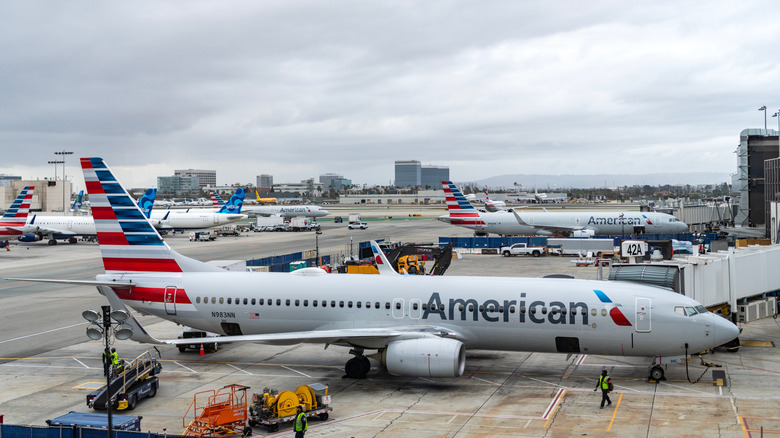
Passengers traveling by air only see a small part of the work that goes into running an aircraft. Behind the scenes, there is a lot more that passengers don't know about. All in all, most of these are guarded industry secrets — they are simply details that passengers don't really think to ask about, probably because they would rather not think about the safety implications or assume that everything works as it should.
Airlines probably like having the benefit of the doubt in these cases, and sometimes, a little secrecy makes for a smoother flight experience. For instance, if there is a bomb threat in midair, it is probably best the passengers not know, lest panic disrupt the flight crew's attempts to resolve it. Similarly, instances of flight attendants occasionally forgetting to carry out crucial safety procedures like arming doors can also cause some anxiety. Other things, however, like the relatively low standards for potable water and hygiene of blankets and pillows would certainly tarnish airlines' image (even if they don't pose an immediate safety risk).
Then of course, there are the "secrets" that cost airlines money. Most people know they're entitled to compensation for delays and cancelations, but are you aware that you must explicitly ask for the refund without unknowingly forfeiting rights to compensation? From health and safety risks to little things that airlines just don't openly talk about, there are many reasons to get the inside scoop about your airline. Here are some less-flattering details from the airlines industry many passengers don't know about and how to deal with them.
You might be entitled to compensation for cancelations
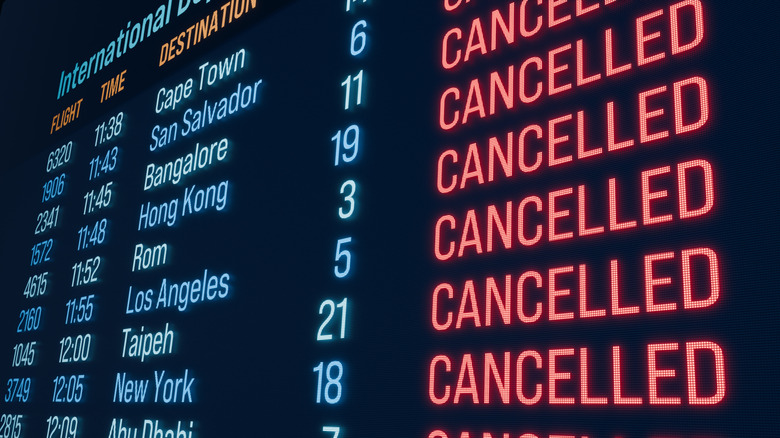
This one depends on which company you fly with, but if you face delays and cancelations that are the fault of the airline, you do not have to shell out your own money for food and lodging. In many cases, the airline actually owes you money.
According to the U.S. Department of Transportation, passengers are eligible for compensation, meals, and/or lodging vouchers under certain conditions. If a flight is canceled or delayed by three hours or more, most major U.S. carriers will pay for your food. All of these carriers will also rebook you for no additional cost. Then, if you suffer a cancelation that delays your departure until the next day, all airlines (with the exception of Frontier) will put you up in a hotel at their expense and pay for any transportation to and from the airport. Finally, you may also be entitled to a full cash refund if your flight is canceled or a significant change to the schedule is made and you choose not to travel — even on non-refundable tickets. This is forfeited, of course, if you end up accepting a rebooking or an airline credit.
In order to get compensation, you have to ask for it. Otherwise, airlines are under no obligation to offer it or give it. If the airline refuses compensation, you can file a complaint with the U.S. Department of Transportation or obtain it through your credit card issuer if the contract provides travel benefits, although this is dependent on the perks offered to the cardholder. For passengers flying within the EU, passengers are entitled to cash compensation between 250 and 600 euros depending on the flight length and delay length.
Flight attendants still use their phones during flights
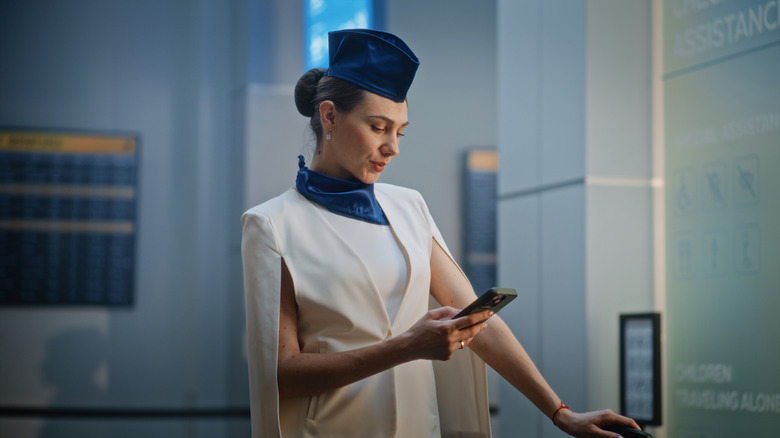
Before takeoff, passengers are always told to put their cell phones and other wireless devices in airplane mode or turn them off altogether. The logic behind this rule is to ensure that they do not interfere with radio or navigation instruments. However, it seems that this may be a case of "do as I say, not as I do" when it comes to flight attendants.
In 2024, the New York Post reported on a leaked United Airlines memo, which bemoaned commonplace cell phone use among crew members during flights. The major issues were twofold. First of all, United was concerned that flight attendants distracted by phones would not be able to provide attentive service to customers. The second was that a distracted flight attendant was far more likely to miss a safety lapse or remember to follow proper security protocol.
United threatened flight attendants who used their phone in flight with severe consequences, up to and including termination. Other airlines, such as Delta, have equipped their crews with phones that are to be used for accessing training materials and keeping track of plane inventory — not for personal use.
You won't know if there's a bomb threat
This one seems counterintuitive, but it makes sense why the airlines keep details about potential bombs and other terror-type threats secret from passengers. Take, for instance, Scoot Airlines (the low-cost arm of Singapore Airlines) Flight TR16. This flight received a bomb threat while in midair after leaving Singapore's Changi Airport for Perth. The plane was then diverted back to Singapore for an emergency landing. There, an Australian man was arrested for making the threats, but interestingly, the passengers were never specifically alerted as to what exactly was going on until after the arrest was made on the ground. In the same vein, Air France Flight 463 had a similar scare in 2015.
Simply put, the reasoning behind this is to prevent panic aboard the plane while the crew, national aviation authorities, and the military figure out whether to act on the threat. While airlines don't have uniform policies, this is usually what happens. This way, the crew doesn't have to deal with passengers panicking and can focus on landing and evacuating the plane. That said, this procedure is no longer so ironclad anymore since passengers connected to airplane WiFi can simply look up details of what is happening.
The tap water isn't the best choice
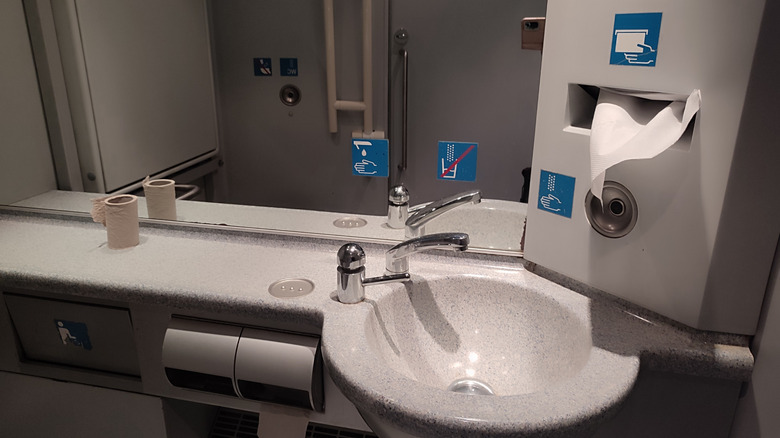
Officially, airline tap water is considered safe, even if it doesn't taste great. This is because, on paper, all airlines are supposed to follow the EPA's Aircraft Water Drinking Rule. This means that all water pumped into the plane's tanks must be potable. In reality, however, research suggests otherwise.
According to a 2019 study from Hunter College New York City Food Policy Center, airline water isn't uniformly good or bad, but it depends on a number of factors, including the sources for water (often multiple), the equipment used to pump it into the tanks, and the cleanliness of the tanks themselves. Considering airlines are only required to clean it four times a year, you can see where issues might come up in that regard. Furthermore, aircraft — especially those flying internationally — may pick up water in foreign countries where standards aren't as tight as those in the United States.
For this reason, the study recommends that passengers never drink any water or beverage that doesn't come out of a sealed bottle or can. They also recommend staying away from coffee and tea on your aircraft, as these are usually made with tap water. However, if you must drink tap water, you can at least hedge your bets. The study found that Allegiant and Alaska Airlines had the best quality water while Spirit and JetBlue had the worst.
Blankets and pillows aren't always washed
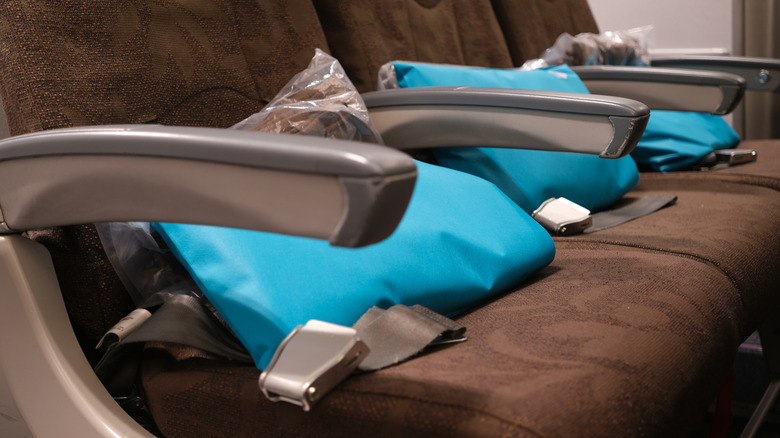
Should you use airplane blankets and pillows? From a purely hygienic standpoint, probably not. The reality is that people sometimes use them for gross purposes and airlines don't always wash them. Even when they do, they're probably not doing it after every usage. Flight attendant Cecily Anderson told Readers' Digest that these items are generally washed after international flights, but not necessarily on domestic ones.
Anderson said that on domestic flights, they might be washed every now and then, but if a plane has a short layover and is taking on a new throng of passengers, then there is no time to wash and replace everything. The new passengers will just have to use what's available. And while most of the time there isn't anything to really worry about (hopefully), Anderson said that she has seen people use them to "clean up spills, cover their cough, wipe their noses, hold food, throw up in and even to change their baby's diaper on."
All in all, if a blanket or pillow is wrapped in plastic, it's clean. If it's not, there might be some unpleasant stuff on it, which is why it is not recommended to put it anywhere near your face. Later flights and flights on U.S. domestic carriers all have a higher chance of being unlaundered, according to Reader's Digest.
Flight attendants aren't paid till the boarding doors close
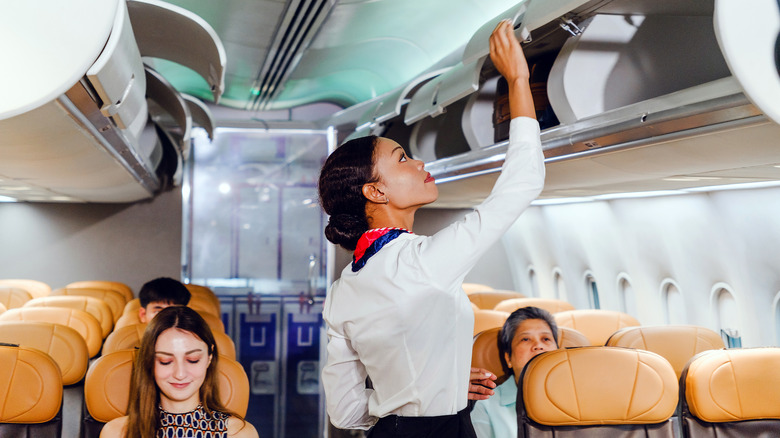
The 2020s have seen quite a few viral videos of passenger meltdowns, which observers have tied, in part, to declining in-flight service, delays, oversold flights, crammed aircraft, and more. None of this is really a surprise. Flight attendants are expected to do the hard, exhausting, and sometimes risky work of boarding passengers, helping with heavy luggage, and (once in a blue moon) breaking up fights — all off the clock. Flight attendants on many North American carriers are not paid until the doors close and the plane is moving. Flight attendants interviewed by Vox noted that due to this system, many have been unable to afford to do their jobs and have quit the industry.
Obviously, as any traveler can see, the incentives are all backwards. Dealing with unruly, entitled, or even potentially violent passengers is among the absolute worst parts of a flight attendant's job. To make matters worse, one flight attendant interviewed by the Los Angeles Times said that this entire system incentivizes the flight crew to delay flights even longer by finding some minor problem.
The reason? In order to trigger overtime to make up for missed pay during a delay. So remember, when you see seemingly curt or snappy flight attendants, remember to give them grace. Their demeanor is much more likely the result of these airline policies, not a character flaw on the crew's part. Fortunately, this has been changing. In 2022, Delta started giving flight attendants 50% of their hourly rate for time on the ground. After, American Airlines and Alaska Airlines followed suit.
How you dress is important, even if you can't get an upgrade
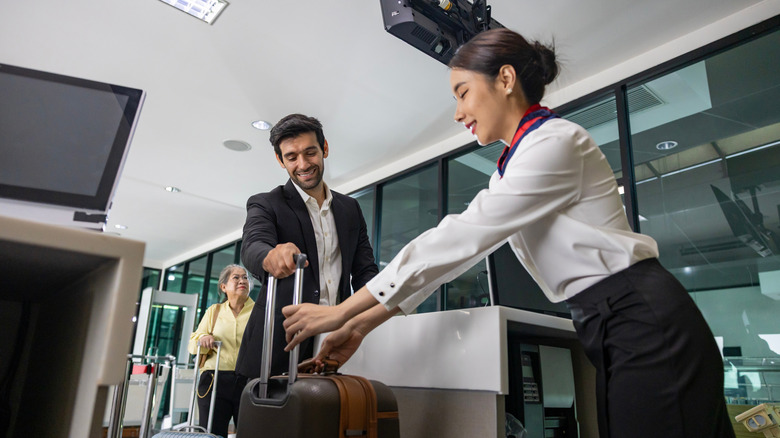
This one is a hotly-debated topic, but it deserves discussion to separate myth from reality. When people say the practice of upgrading passengers based on dress and demeanor is a myth, that is accurate. Airlines prioritize their frequent fliers, with the top tiers getting first dibs on upgrades, then everyone else in descending order of importance. This is often done by a computer. That is the official policy, and asking a flight attendant for an upgrade will get you shut down because they aren't allowed to bump you up at will.
Once the aircraft doors close, flight attendants have a little more leeway. One flight attendant whose anecdote was published in the Los Angeles Times said that when these extremely rare upgrades do happen, the well-dressed passengers are far more likely to be upgraded than more casually dressed ones. There are also stories of gate agents upgrading well-dressed passengers before boarding the plane, which the writer can attest to having experienced in Europe, where upgrades seemed more discretionary.
Even if you don't get upgraded, it still pays to dress well. Flight attendants notice it, as there is the perception that dress and proper, respectful behavior go hand-in-hand. Thus, you might still get better treatment if you're well dressed (even if no upgrade), especially if you pair it with respectful treatment of the flight crew.
Pets flying cargo aren't going to be treated like family
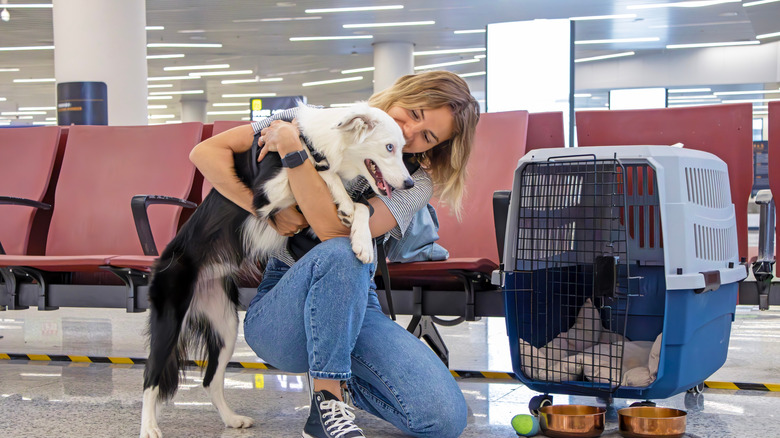
Pets traveling in the cargo hold are treated functionally as checked baggage. Although airlines make arrangements for them to wait in temperature-controlled areas to ensure the animals' comfort, the reality is there is only so much they can do once the animal has to be driven onto the tarmac.
When airport workers go onto the tarmac, they have to wear ear protection to protect themselves from jet engines sounds of up to 140 decibels (louder than a jackhammer). So, imagine how stressful it must be for a dog or a cat, whose ears are much more sensitive than human ones, to have to drive through the noisy tarmac and then stay there while bags are loaded. The animals are separated from their owners in a scary and utterly foreign environment, and we can assume that they don't understand why.
Under many airline policies, pets are generally loaded last onto the cargo hold so they can be the first unloaded upon arrival. However, the animal might end up on the noisy tarmac for some time, making this leg the riskiest part of the flight for the animal. For this reason, some airlines, like American, will not allow pets to travel in cargo during the summer months from certain destinations like Tucson, Phoenix, or Las Vegas. For dogs, sometimes there will be no choice, since medium breeds won't fit in a carrier. If you have a cat however, you can follow tips like getting a TSA-approved carrier to simplify travel with your pet and avoid the tarmac.
Oxygen masks are designed to run only 15-20 minutes
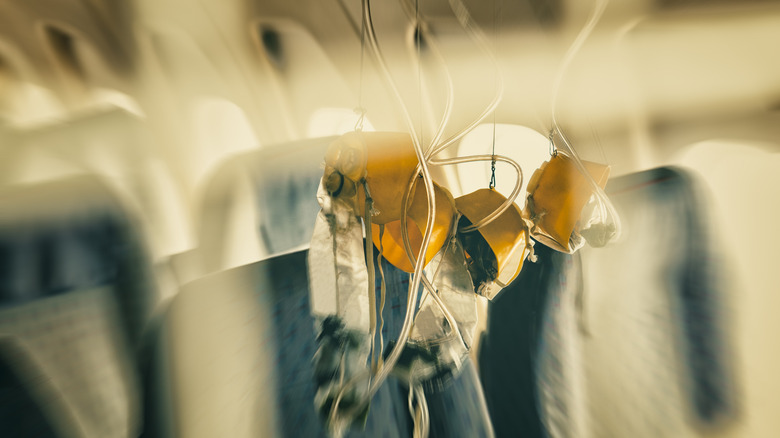
During the safety presentation before takeoff, passengers are assured that if cabin pressure is lost (aka air pressure in the plane fails to equalize with that outside the plane), then oxygen masks are available to ensure that passengers can breathe. However, what the flight attendants don't tell passengers is that they are often just a band-aid.
Plane oxygen masks only have enough gas to last, at most, 20 minutes. While this oxygen mask detail might seem nerve-wracking — a lack of oxygen at cruising altitude can result in hypoxia and brain damage within minutes of cabin pressure loss — the reality is that the plane does not need oxygen to last passengers the rest of the flight. It just needs enough until the plane can get back to a safe altidude.
Former American Airlines pilot Captain Richard Levy explained to the Ashland Chronicle, essentially, that when cabin pressure is lost, the pilot's first move after masking up is to initiate a rapid descent, which can feel to passengers like the plane if falling out of the sky. Within four or five minutes, the plane should be at an altitude where the air is thicker and passengers can breathe normally. When seen from that perspective, the plane carries anywhere from two to about four times as much oxygen as is needed to get passengers down to where they can breathe.
Flight attendants sometimes forget to arm the doors
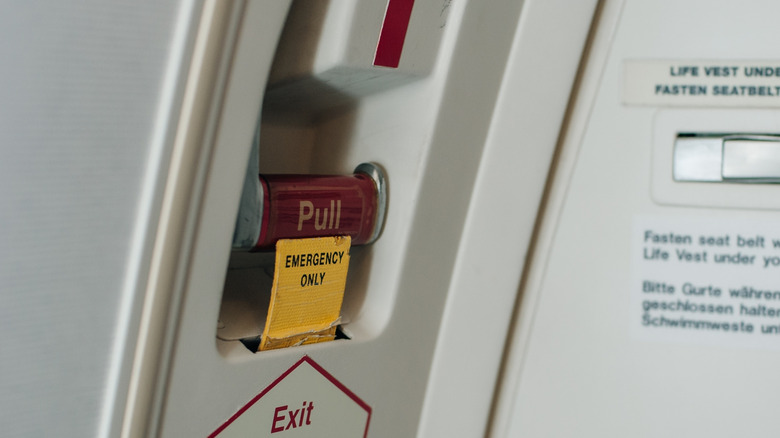
Given airline safety records, it is safe to assume most flight crew follow their pre-flight security procedures, but occasionally, mistakes do happen. According to flight attendants interviewed by the Los Angeles Times, sometimes they even forget to properly "arm the doors."
In crew-speak, this means the flight attendants are activating the doors to automatically deploy the emergency slides in case the airplane is forced to make a crash landing. Once the door is armed, the flight attendants do a cross-check to verify that their colleagues have armed their respective doors correctly. If a door is not armed, it means not only did one flight attendant forget, but that a colleague also failed to catch the mistake. This lapse can put passengers in danger in situations requiring a fast evacuation. Due to the seriousness of this lapse, flight attendants can be terminated for this error.
While arming mistakes before takeoff are the more serious concern, the opposite error — forgetting to disarm the door after landing — can also happen. This means that the slide will deploy as passengers are preparing to deplane. While it is generally not a safety issue, it can cost the airline tens of thousands of dollars to replace the slide.
There are still ashtrays in bathrooms
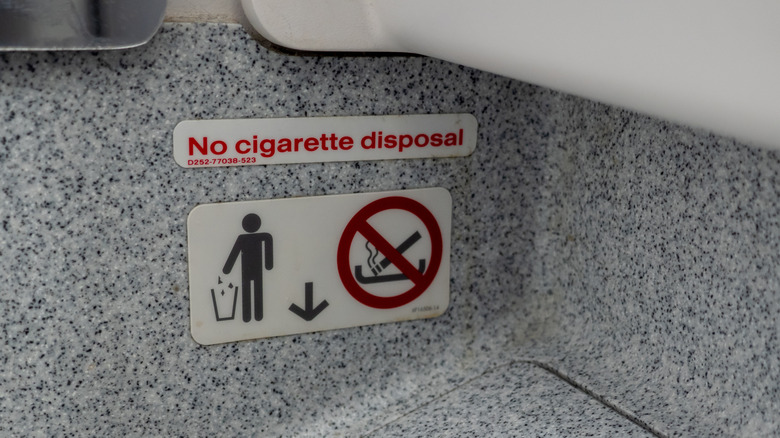
Every flight safety presentation, there is the stern warning that smoking on the plane or in the lavatories is strictly prohibited under federal law and FAA regulations. Doing so can result in civil and criminal penalties, depending on the severity of the offense, including, on paper, fines of up to $25,000 (in practice, much less). Nevertheless, airplane bathrooms still have ashtrays, which is something that may seem perplexing. Why have it if smoking is illegal?
This is to regulate against potentially dangerous scenarios. FAA regulation 14 CFR § 25.853 requires all aircraft, regardless of whether smoking is allowed, to have a removable ashtray. The assumption is that for every rule there is, someone will eventually break it. Thus, if someone does decide to light up in the bathroom, the passenger would at least be able to put out the cigarette or other paraphernalia in the ashtray safely. Otherwise, violators often toss them in the trash and risk starting a fire inside the cabin. Fires in the cabin can have fatal results, most famously Air Canada Flight 797 in 1983. Although a cigarette was not the cause in this case, a lavatory fire filled the cabin filled with smoke and caused 23 fatalities.