
Why Rick Steves Highly Recommends Touring What He Calls 'The Worst Of Europe'
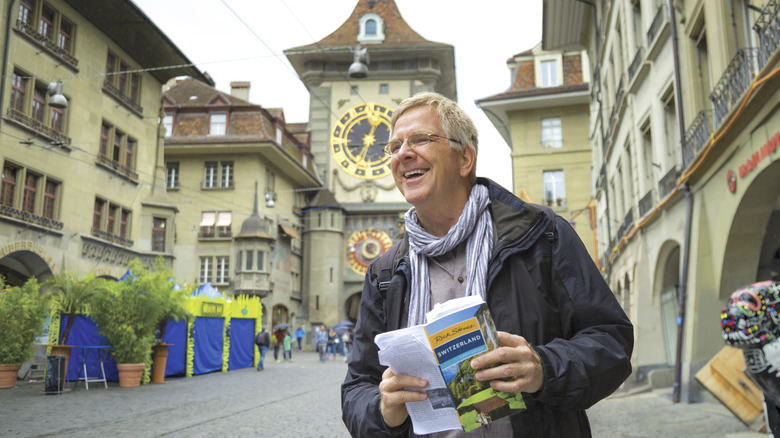
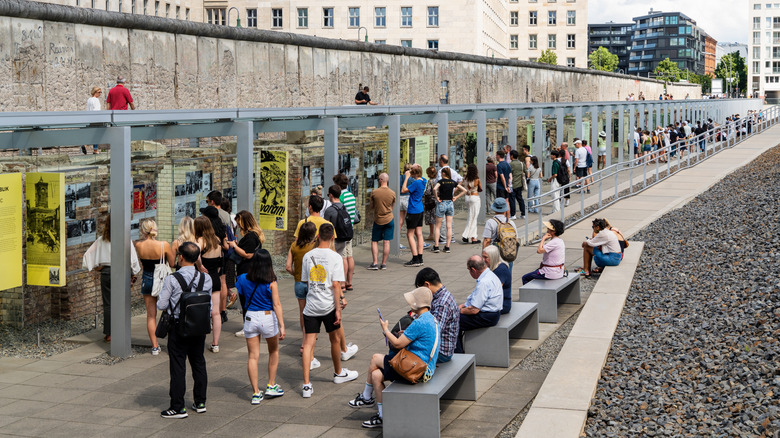
Walking through Berlin's popular Kreuzberg district, known for its trendy neighborhoods and cultural diversity, you'll spot a building that seems out of place: a minimalist, stark gray structure called Topography of Terror Documentation Centre. Inside, you'll find permanent and temporary exhibitions covering the rise of the Nationalist Socialist (Nazi) Party and its various institutions of terror, including the SS (Schutzstaffel, or protection squadrons) and the Gestapo (Geheime Staatspolizei, or political police). What's even more unsettling is that these exhibitions are located in the Nazis' former central command offices. A museum like this — and other harrowing places tourists visit — might not be on your list of attractions to check out, as reading about war crimes and mass murders is certainly not the most enjoyable way to spend a vacation. However, visiting these kinds of sites is exactly what Rick Steves, American travel expert and TV personality, suggests you do.
In an episode of his acclaimed travel show, Steves recommends touring what he refers to as "the worst of Europe" to take in "the hard lessons of fascism that [Germany] learned nearly a century ago" and understand why they matter. Airing in 2020, the 26-minute episode, entitled "Germany's Fascist Story," delves into this uncomfortable history and shares some of the memorials and museums that he thinks travelers should visit.
You can watch and learn along with Steves, as he takes viewers to important sites in Berlin, Berchtesgaden, Nuremberg, and Munich — the city where Hitler came to power, but that's much better known today for Oktoberfest and for housing the Bayerische Staatsoper, one of the world's most incredible opera houses.
The importance of keeping history alive in Germany
In the video, Rick Steves and his guest hosts provide a brief history of the rise of fascism within Germany, a movement that led to the deaths of 6 million Jews and individuals from other stigmatized groups. Through playing off of people's dissatisfaction with the government and economy, and using a combination of personal charisma and nationalist rhetoric, Adolf Hitler and his party were able to consolidate power quickly. The effectiveness of this rhetoric and propaganda cannot be overstated — it's even the unexpected reason most Christmas markets today are German-themed.
The hosts also share why it's important to continue learning about this history. As Steves explains, "Today Germany deals responsibly with the legacy of pain it brought Europe. Germany knows the importance of a well-informed electorate. Every school child learns of the Holocaust with a visit to a concentration camp." Additionally, there are museums, documentation centers and historic sites across German cities that work to educate visitors.
An interesting art project has arisen within Europe to further memorialize those who were killed — it is called Stolpersteine, which literally translates to "stumbling stones." These brass plates cast in concrete are laid in front of the last known homes of the victims, and as of 2024, more than 107,000 stolpersteine can be found all across Europe. It is meant to be a dedication to the person whose name is written on the plate, but it also serves as an interruption: As someone walks by and stumbles over the stone, they are forced to reflect upon the person whose life was taken. When in Europe, keep your eyes peeled for the golden glint of these stones — one small way to keep the memory of the victims alive and to, as Steves puts it, "travel thoughtfully."
Places where you can learn more
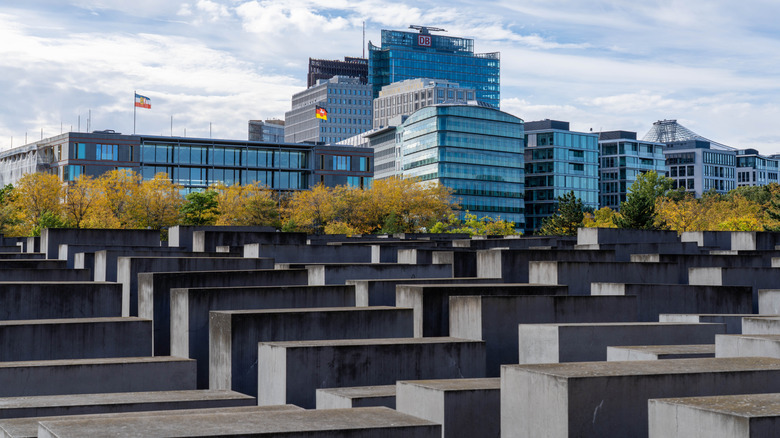
If you're planning a trip to Europe, there are several sites that Rick Steves recommends visiting. Beyond the aforementioned Topography of Terror, you'll find other places of education and remembrance in Berlin, the popular city best explored after dark. The somber Memorial to the Murdered Jews of Europe, also known as the Holocaust Memorial, is situated in the Mitte neighborhood close to the Brandenburg Gate. Designed by American architect Peter Eisenman, the monument contains an expansive field of stelae — vertical slabs used for commemoration. The 2,710 concrete structures are all different sizes and heights, and together they create a space "for loss and contemplation," in Eisenman's words, and a physical maze through which visitors can wander.
If you're heading to Nuremberg, the Documentation Center and Nazi Party Rally Grounds is worth a stop for its comprehensive exhibits covering the rise and evolution of National Socialism in the country. Meanwhile, outside of Germany, Auschwitz-Birkenau State Museum, located in Oświęcim in southern Poland, is a haunting place but well deserving of a day trip. Consisting of several camps and sub-camps, the massive complex of Auschwitz claimed the lives of 1.1 million people. It's both an authentic historical site and a memorial to those who perished at this concentration and extermination camp. Here, you can participate in a tour or walk through on your own. Learn about the history of these camps and what life was like for the incarcerated through photographs, documents, and personal items of the former prisoners.