
The Blue Ridge Mountains' 5 Best State Parks To Visit, According To Travelers
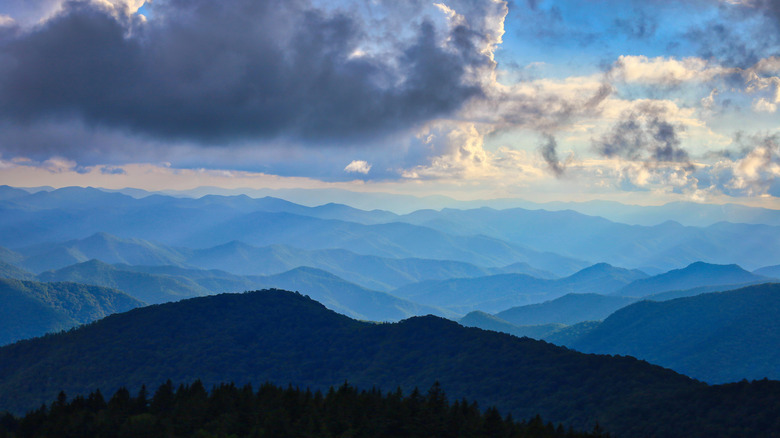
The ancient Blue Ridge Mountains are among the oldest mountain ranges in the world, dating back 270 million years. Despite their advanced age, the Blue Ridge Mountains remain one of the most beautiful natural features in the eastern United States, running through a particularly scenic stretch of the wider Appalachian Mountains as they extend north to south. Though they technically begin in Pennsylvania and Maryland, the Blue Ridge province really hits its scenic stride in Virginia, North Carolina, and Georgia. Along the way, the Blue Ridge Mountains serve as the backdrop for some of America's most famous national parks, from the scenic (yet accessible) Shenandoah National Park of Virginia to the iconic (and extremely popular) Great Smoky Mountains. And that's not even mentioning the famous Blue Ridge Parkway that stretches 469 miles through Virginia and North Carolina! Lost in the acclaim of these national parks, however, are the many amazing Blue Ridge Mountain state parks.
With such phenomenal Appalachian scenery, abundant water systems, and some of the East Coast's most beautiful forests, the Blue Ridge Mountains serve as fertile ground for premier state parks in every state they touch. To a certain extent, making a list of five "top" Blue Ridge Mountain state parks to visit is as easy as picking any five at random, as virtually all Blue Ridge state parks offer amazing scenery and unforgettable outdoor adventures. That being said, a few Blue Ridge Mountain state parks do stand out when it comes to popular acclaim. Going off of cumulative traveler reviews on popular sites like Tripadvisor, these five state parks in three different states may be the best state parks to visit in the Blue Ridge Mountains.
Grayson Highlands State Park
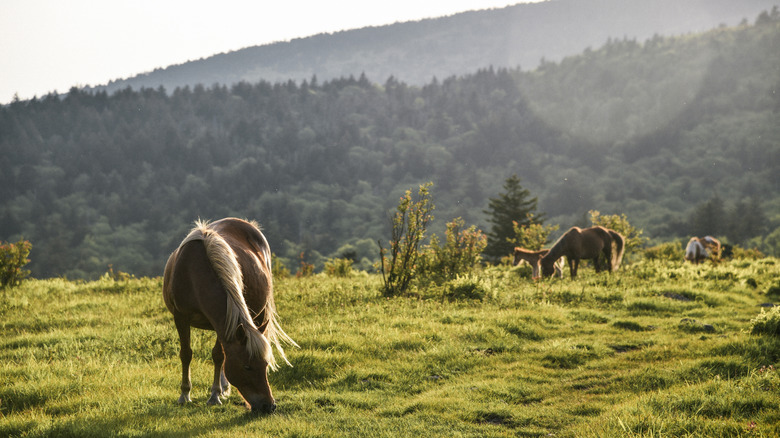
The stunning Grayson Highlands State Park is consistently rated by travelers as one of the top state parks in all of Virginia, with "gorgeous views," "great" trails, and a "friendly and nice" visitor center among the comments on Tripadvisor. The park's location in southwest Virginia — just north of the North Carolina border — puts it right next to the two highest points in Virginia, the 5,729-foot Mount Rogers and the 5,520-foot Whitetop Mountain. Suffice to say, Grayson Highlands State Park provides exceptional views of both mountains, plus ample panoramas of the broader Blue Ridge Range stretching across the horizon.
One unique feature you'll find in Grayson Highlands, compared to many other areas of the Blue Ridge Mountains (particularly in Virginia), is its striking collection of bare-faced mountains known as grassy balds. These "bald" mountains contrast against the rhododendron-rich forests and meadows around them in a distinctive and photogenic display of Blue Ridge Mountain beauty.
For more equine-minded visitors, Grayson Highlands State Park's biggest draw is not its mountains, but rather its ponies. Grayson Highlands's wild pony herds are often seen grazing amid cool mountain streams and vast grassy meadows, creating one of the most photogenic blends of flora and fauna you'll find in the Blue Ridge Mountains. Though these ponies roam freely in the park, visitors should be careful to "look but not touch," as they're not exactly the "riding" kind of ponies. Even without free pony rides, Grayson Highlands is still one of Virginia's best destinations for outdoor adventures. The park has miles upon miles of exceptional trails through magical Blue Ridge scenery, plus terrific spots for bouldering, fishing, and boating. For overnight stays, Grayson Highlands State Park has dozens of individual campsites in two developed campgrounds, a group bunkhouse, and even reservable yurts.
Mount Mitchell State Park
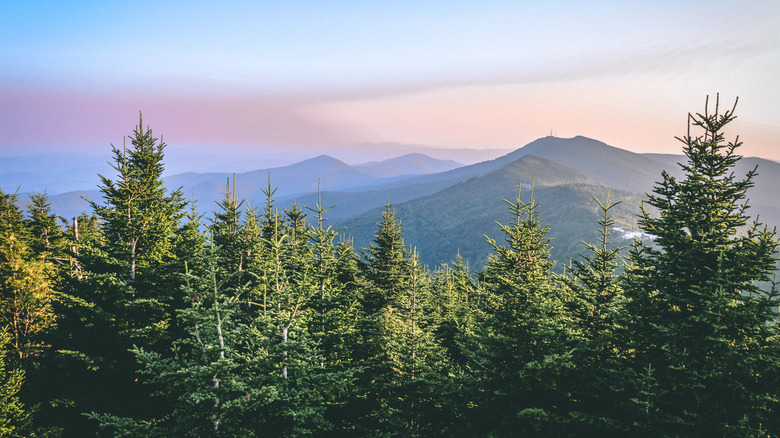
North Carolina's Mount Mitchell State Park is a no-brainer for a list of the top state parks in the Blue Ridge Mountains. Not only is its namesake feature the highest mountain in the Blue Ridge Range, but the 6,684-foot Mount Mitchell is the highest point anywhere in the United States east of the Mississippi River. And Mount Mitchell is so much more than just its superlative altitude. The mountain is a small but eye-catching section of the Blue Ridge Mountains called the Black Mountain Crest (keeping with the color theme). The Black Mountains get their name from the much darker-colored forests of coniferous red spruce and Fraser fir trees (rare in the Appalachians) that grow on their higher-elevation summits.
With such premium features, Mount Mitchell State Park draws rave Tripadvisor reviews for "unobstructed views out to the horizon" and "mystical and magical woodlands." However, the park is also rich in all of the acclaimed outdoor recreational opportunities that make North Carolina's Blue Ridge Mountains such a popular destination. Hiking is perhaps the best way to explore this remarkable mountain ecosystem, with a wealth of trails ranging from short and easy to long and strenuous.
Incredibly, the Mount Mitchell summit is actually accessible to drivers, as North Carolina's Highway 128 goes almost the entire way up to the top. From the parking area, the summit itself is just a quarter mile away via a paved and accessible trail and a convenient observation deck with the highest-altitude panoramic views in the Eastern United States. Mount Mitchell State Park also sits at Milepost 355.4 of the Blue Ridge Parkway, and is only 33 miles northeast of North Carolina's popular outdoor Mecca of Asheville.
Stone Mountain State Park
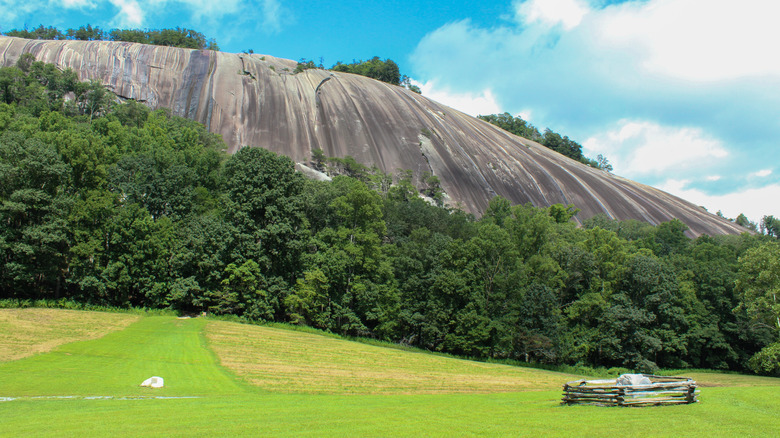
North Carolina's Stone Mountain is not the highest or the most topographically prominent mountain in the Blue Ridge Province, but it may very well be the most distinctive. In stark contrast to the colorful blue-tinged mountain forests that give the Blue Ridge Mountains their name, the equally self-descriptive 600-foot Stone Mountain presents a largely bare-faced stone facade in the middle of North Carolina's Blue Ridge. Technically speaking, this geological wonder is a type of isolated rocky prominence called a "monadnock," believed to be a whopping 300 million years old! While its sheer granite exterior largely conjures images of the barren American West, it does feature a few patches of greenery in the form of hardy endemic plants. This strange granite monolith and its surrounding Blue Ridge landscape serve as the centerpiece of North Carolina's unmissable Stone Mountain State Park.
While Stone Mountain itself is well worth a stop just for photo opportunities alone, the entire state park is rich in gorgeous forests, mountain streams, and even waterfalls. Visitors can experience all of these natural treasures, big and small, via a wide range of fun outdoor activities available in the park. Stone Mountain's extensive network of trails provides scenic hiking opportunities for visitors of all types and preferences. Alongside the trails within the state park itself, Stone Mountain also contains a segment of North Carolina's 1,175-mile Mountains-to-Sea Trail. Stone Mountain itself is arguably the best spot for rock climbing in North Carolina, while overnight visitors can enjoy the park's 90+ developed campsites, group camping facilities, and backcountry camping options. Both the park's "lovely" hikes and "great" campsites draw particular praise on Tripadvisor. Plus, Stone Mountain State Park's location along the Blue Ridge Parkway puts its scenic waterfalls and outdoor fun well within reach of drivers.
Gorges State Park
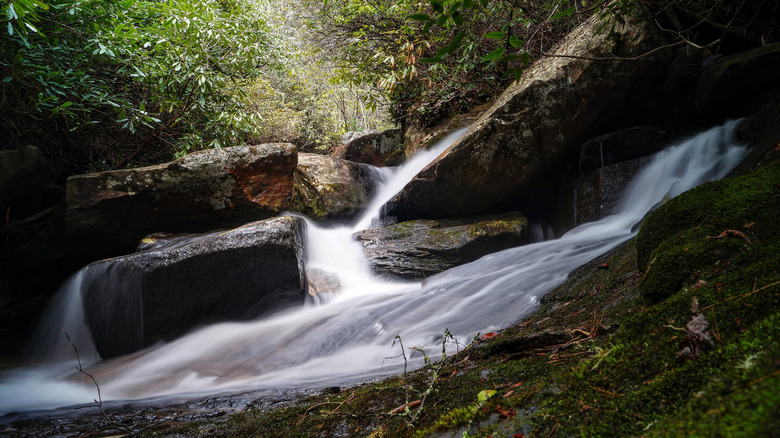
The Blue Ridge Mountains are most famous for their mountains, but they're also home to some of the best gorges on the East Coast. One of the best examples of these is found in North Carolina's creatively-titled, 8,000-acre Gorges State Park. Located near the tri-border area where North Carolina, South Carolina, and Georgia converge, this acclaimed park is within the heart of the most scenic areas of the southern Appalachians. Around this tripoint area, the Blue Ridge Mountains coalesce into a massive, vibrant "Blue Wall" known as the Blue Ridge Escarpment. Gorges State Park protects many of the most scenic and delicate elements within the Blue Ridge Escarpment ecosystem. This includes North Carolina's very own temperate rainforest, featuring the highest concentration of rare and unique plant species in the eastern United States.
Gorges State Park is just as much a geological wonderland as it is a natural greenhouse. With its high concentration of gorges and Blue Ridge peaks, the park's elevation rises by around 2,000 feet over only 4 miles. Add abundant annual rainfall, and you get some of the most beautiful waterfalls in North Carolina (a state already famous for its many waterfalls). Most notably, Gorges State Park provides convenient hiking access to two of the loveliest waterfalls in the Blue Ridge Mountains: the 150-foot Rainbow Falls and the smaller but no less stunning Turtleback Falls.
Gorges State Park's extraordinary temperate rainforest, magical waterfalls, and picturesque complex of natural gorges are all viewable on the park's many excellent trails (including both easy and more challenging trails) and developed family campgrounds. Many of the park's trails are also suitable for mountain biking and horseback riding. Reviewers on Tripadvisor rave that Gorges State Park has "beauty everywhere," and has "the cleanest and highly maintained" park facilities they've ever seen.
Tallulah Gorge State Park
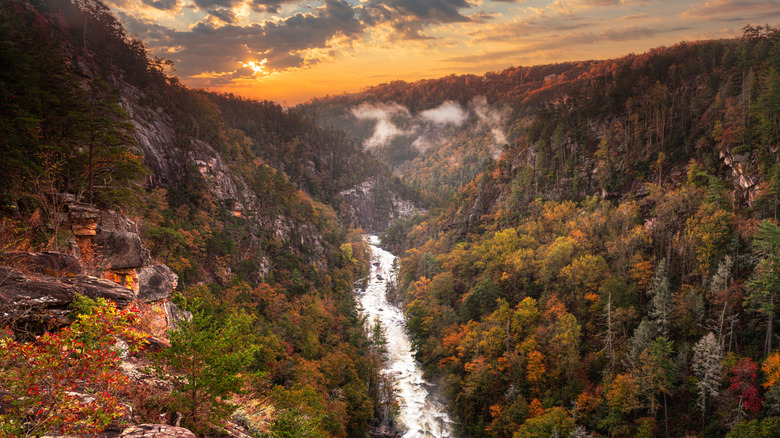
Beyond Virginia and North Carolina, the Blue Ridge Province actually extends into north Georgia at its southernmost terminus, where it provides many of the Peach State's most acclaimed public lands. Chief among these is the enchanting Tallulah Gorge State Park, a spectacular mountain escape that also happens to contain one of the most breathtaking canyons in the eastern U.S. Like North Carolina's Gorges State Park a bit further north, Tallulah Gorge State Park shows off the underrated canyon features of the Blue Ridge Mountains, forged by the region's abundant rainfall and natural waterways. While Gorges State Park stands out for its self-contained rainforests and unique ecosystems, Tallulah Gorge State Park stands out among travelers for its sheer spectacle.
Located about two hours north of Atlanta, Tallulah Gorge is a 2-mile-long and 1,000-foot-deep canyon carved into a striking foundation of quartzite rock by the scenic Tallulah River. As one of Georgia's "Seven Natural Wonders," Tallulah Gorge also protects a thriving forest ecosystem of hemlocks, pines, rhododendrons, mountain laurel, orchids, azaleas, and other lush types of vegetation (including the largest natural population of orchids in Georgia).
Although the park is free to enter, its delicate ecosystem does necessitate a limit of 100 entries per day to the gorge's floor. Visitors must obtain a free permit (available after a safety briefing) on a first-come, first-served basis. Since daily permits are limited, it's recommended that you get to the park early in the morning to avoid missing out. Reviewers on Tripadvisor rave about Tallulah Gorge State Park's "incredible" vistas and "highly recommended" attractions. These include the park's 80-foot high suspension bridge over the gorge, excellent hiking and rock climbing opportunities, and even superb paddling opportunities (particularly in early April during the thrilling Tallulah Gorge Whitewater Release event).
Methodology
The first issue we faced in compiling a list of the top five Blue Ridge Mountain state parks was answering the basic question of what constitutes the "Blue Ridge Mountain" region in the first place. The Blue Ridge Mountains are arguably the most famous region of the Appalachian Mountains, but they are still just one geographic region of several. Many acclaimed Appalachian state parks are actually in separate subranges or provinces of the Appalachians, thus disqualifying them from this list despite their obvious pedigrees. For example, many of North Carolina's highest-rated mountain state parks are not within the generally agreed-upon parameters of the "Blue Ridge Mountains" at all, but rather in an adjacent Appalachian subsection. The popular Pilot Mountain State Park is actually in a separate mountain chain called the Sauratown Mountains, while others are in another Appalachian province called the Piedmont Region.
To identify relevant state parks, we turned to the standard Blue Ridge Mountains map used by the National Park Service and other government agencies. Once we had a standardized collection of state parks that fall within these parameters, we ranked them based on cumulative user reviews on travel sites like Tripadvisor. Rather than just taking Tripadvisor's algorithmic ranking of "top state parks" in a given area, however, we looked for state parks with high user ratings over several hundred individual reviews, while also showcasing a diversity of qualities that reviewers praise. We particularly looked for parks with reviews that consistently praise both natural scenery and outdoor recreational opportunities. Finally, to prevent the list from becoming too North Carolina-centric, we specifically focused on state parks in other Blue Ridge Mountain states, most notably Virginia and Georgia.