
4 Ancient Artifacts Travelers Stole But Were Eventually Returned
It's only natural for humans to want a piece of their travels to take home. Memories slowly fade away with time, but a tangible object provides proof of the past. From postcards to T-shirts, magnets, and more, kitschy souvenirs are everywhere. This might be why some people are tempted to take items they shouldn't, including ancient artifacts and even valuable things from national parks.
According to Atlas Obscura, this is incredibly common. As archeologist Morag Kersel from DePaul University told the publication, visitors often take "something small, portable, and reminiscent of the trip so they can relate tales to friends and family when they return home."
What travelers may not realize is that getting caught swiping certain items can land them in legal hot water or cause irreversible damage. Once removed from or disturbed at a site, an ancient artifact's archeological value is, unfortunately, diminished and sometimes even destroyed. Nevertheless, there have been cases of people stealing and eventually returning relics, and some of reasons behind these situations may be hard to believe. With that in mind, we've done some digging and rounded up a couple of these instances for your reading pleasure.
Some people have pickpocketed pieces of Pompeii

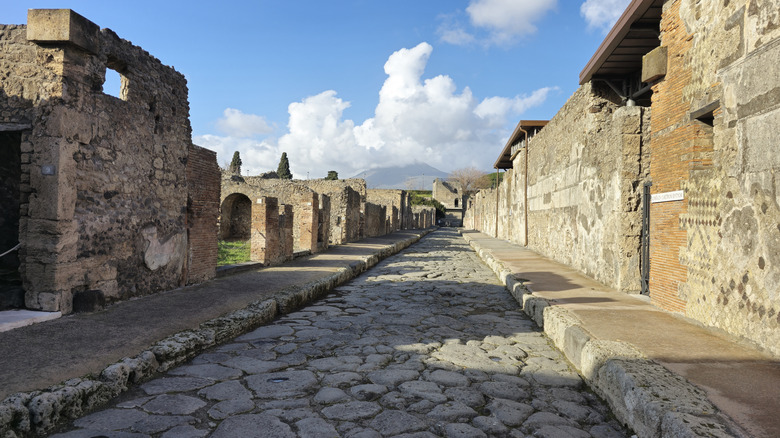
You're likely familiar with the story of Pompeii. Located just minutes away from Naples, Italy, it was destroyed and simultaneously preserved by the eruption of Mount Vesuvius. Now an archeological park, Pompeii has some wondering if it's a tourist trap or a must-see while vacationing in Italy. In any case, the BBC reports that this attraction receives thousands of visitors a day. Most come just to explore, but some steal from this ill-fated ancient city and its centuries-old structures. One of the people in that second group is a Canadian tourist who visited Pompeii in 2005.
CNN states that the woman "identified only as Nicole" took five items, including mosaic tiles and vase fragments. The world would perhaps be none the wiser to this theft if Nicole hadn't made the decision to send these ancient artifacts back to Pompeii in 2020. In a letter, she discussed enduring hardships, including battling cancer, since her Pompeii trip. She blamed her actions, as well as the stolen item's connection to tragedy, for these struggles. It seems that she hoped returning the items would break what she described as a "curse."
This alleged Pompeii curse is well-documented. In 2024, Pompeii archeological park's director Gabriel Zuchtriegel tweeted a photo of a letter from an individual who returned pumice stones removed from the site. In the letter, the "anonymous sender" noted they had also been hit with misfortune. Curse or not, if you steal from Pompeii, you could face serious penalties. In August 2025, The Independent reported that a Scottish tourist who took stones and a brick from the site could be fined €1,500 (over $1,770) for the indiscretion.
One tourist manhandled marble from the Hekatompedon

In some instances, travelers' family members have returned stolen artifacts. Take, for example, Enrico Tosti-Croce. For decades, the Chilean man believed he had a piece of marble from the Parthenon. According to The Art Newspaper, Tosti-Croce's Italian father, Gaetano, nabbed this nearly roughly 2.5-pound relic from the sunny destination of Athens, Greece. Although it had been in the Tosti-Croce family's possession since the 1930s and become an heirloom of sorts, Enrico decided to give the item back to Athens in 2025.
The 77-year-old contacted the Greek Embassy in Chile, which accepted the piece of marble. Speaking to El Pais about Enrico's actions, the Embassy's Deputy Chief of Mission Theodosios Theos stated, "This is very important to us, because it can be an example of honor and courage for other citizens in Chile or abroad to do the same." That said, Enrico was later informed that the marble fragment was not from the Parthenon after all. Instead, it was likely from the Hekatompedon, a bygone temple from 570 BC that was once situated at the Parthenon's current location.
Per Smithsonian Magazine, this means the piece is more than 2,000 years old. So, why did Enrico decide to part with it in the first place? In an interview with The Art Newspaper, he said Greece's efforts to get the famed Parthenon Marbles home inspired him. These sculptures are located at the British Museum in London, England. While Greece wants them back, the UK isn't ready to give them up; however, there have been discussions between the two countries.
A couple of tourists took fragments from Ayutthaya, Thailand

A little over an hour away from Bangkok, Thailand (a vibrant hub of street life and world-class eats), is Phra Nakhon Si Ayutthaya, aka Ayutthaya. The former city, established in 1350, is a UNESCO World Heritage Site that's brimming with intricate ruins. These remnants include Wat Mahathat, a Buddhist temple known for its distinct structures resembling corncobs. While Wat Mahathat can be described as a significant spiritual destination, that hasn't stopped travelers from stealing. In 2018, an unnamed tourist sent back brick fragments (reportedly from Wat Mahathat) via mail to Ayutthaya.
Why did they decide to return these ancient artifacts? According to The Nation, the package included a note that read, "The person who took these away could not live in peace. Please return them to the owner." Prior to this, The Himalayan Times reported that a German man, Michael Beil, had taken a stone from Ayutthaya in 2001, only to return it in 2005 for similar reasons.
Beil requested for it to be put back in its rightful place, writing: "I think the stone from Ayutthaya and my lack of respect for its sanctity has brought the bad luck to me." Needless to say, if you visit Ayutthaya, you should avoid taking anything, no matter how insignificant it may seem. That said, if you're eager to buy souvenirs in Wat Mahathat, there is an on-site gift shop called SAAN.
Two women helped themselves to terracotta from Ancient Rome

Aside from the possibility of being cursed, guilt is another reason why travelers return items. In 2009, a package arrived in Rome, Italy. The parcel contained a piece of terracotta with ancient origins and included a letter from an American woman asking forgiveness for taking the item as a souvenir during a trip to Rome with her husband. This individual was later identified as Janice Johnsen, who revealed (via The Repository), "Whenever I looked at it, I'd feel bad about it."
Johnsen held on to the terracotta for 25 years before sending it back to Rome, saying: "If we get in trouble, we get in trouble, but I need to return it." Similarly, another American woman by the name Jess, mailed a piece of marble to Rome in 2020. She had stolen it in 2017 and written on it. Jess expressed remorse for her actions, writing in a letter that (via The Guardian), "It was a big mistake on my part and only now, as an adult, do I realise just how thoughtless and despicable it was."
If these cases prove anything, it's that it's never too late to do the right thing. In both circumstances, officials were thankful for people making the decision to send back the ancient artifacts. Still, while not every former thief may face consequences, it's important to note that committing this tourist faux pas in Rome could get you sent to jail.