
5 Once-Thriving Water Parks That Are Now Abandoned
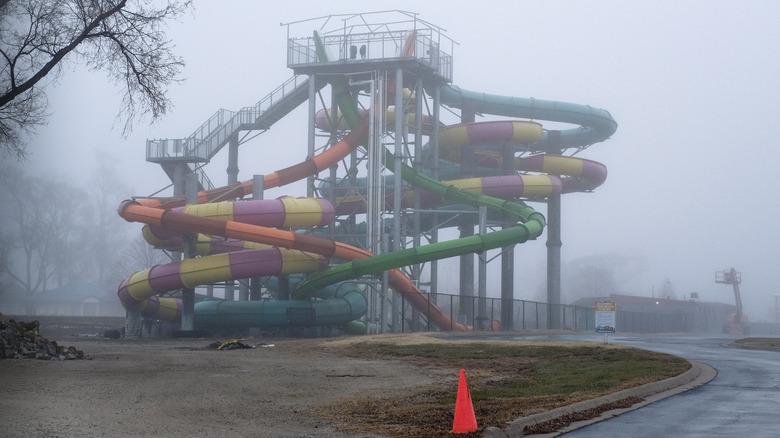
From water we were born, to water we return. Along the way, if we're lucky, we'll spend some quality time splishing and splashing at amusement parks powered by the good stuff. Water parks are the kings of summer, taking everything kids love about the neighborhood pool and bringing it up to the next level. But, as anyone who has ventured up one of the world's longest water slides will tell you, the higher you climb, the harder you fall.
Today, we'll look at five water-based amusement parks that flew too close to the sun. Whether it's because the parks were too difficult to maintain, the slides were too radical, or even because of something serious like a tragic health issue, not all water parks have withstood the test of time. As the saying goes, the best-laid plans of mice and men often go awry. Or, in the case of water parks, go from family-friendly local staples to graffiti-laced urban legends.
Lake Dolores Waterpark
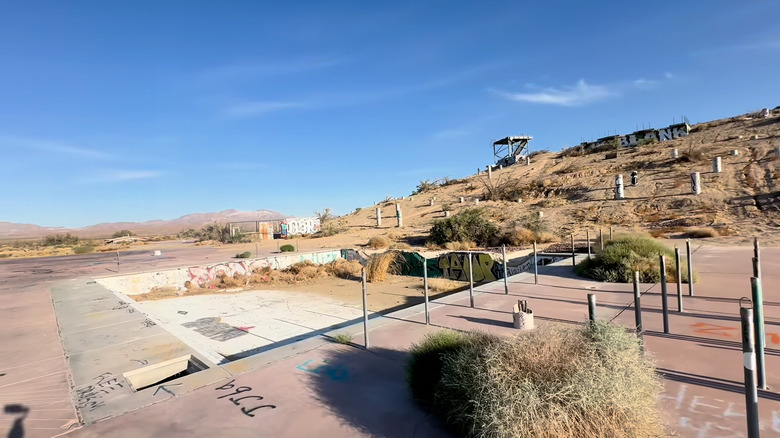
Lake Dolores slowly cooks in the desert sun, serving as a stark reminder that first is not always best. When this water park opened in 1962, it was one of the first water parks in the entire country, and it was bumping. In a video documenting the park at it's peak, manager Dennis Bender described it as "a place where girls can meet boys, and boys can meet girls."
The more you learn about the park's offerings, the less you'll be surprised to hear it couldn't compete with modern safety standards. Rides included a group of 150-foot "lay-down slides" that covered over 200 feet in speeds around 40 Miles per hour, "Stand-Up Slides" in hot aluminum troughs that sent visitors down standing on two feet, and zip lines that dropped guests into the pool, as long as they timed their exit right. If they didn't, you landed on a hard gravel hill. A visitor of the park at its peak said "the place had a raw, wild, even dangerous feel and reputation in those days. But that was kind of the appeal."
The park's appeal faded and it closed down by the end of the 1980s, before re-opening on July 4th, 1998, renamed the "Rock-a-Hoola water park." Two years after the re-opening, an employee was left paralyzed after riding the "Doo Wop Super Drop" Water Slide and sued park owners for over $4 million. They would never be able to financially recover from the incident. In the years since, the abandoned park has become a darling counter-culture space, appearing in Ke$ha music videos, skate videos, and online content. Several companies have dreamed of re-invigorating this lost oasis, but for now, it remains nothing more than an abandoned California desert attraction that offers a surreal sight.
Fort Rapids Indoor Water Park
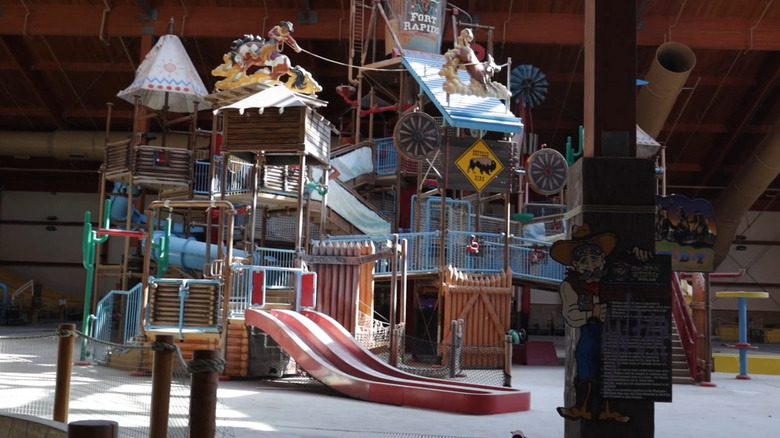
In the early 2000s, a group of investors converted a Holiday Inn into the Fort Rapids Hotel & Indoor Water Park, creating a 60,000 square foot indoor park that was the first of it's kind in Ohio. The park had it all: a wild west theme, a 1,000-gallon dumping bucket, 3,000 feet of water slides, and a whirlpool zone. Redditors lucky enough to live through the water park's peak described it as a "packed" place. But the brightest stars often burn the fastest, and Fort Rapids indoor waterpark quickly went from promising attraction to money pit.
According to the Columbus Dispatch, the park was purchased in 2004 and renovated for a whopping $45.6 million. In 2008, it was sold for $6 million. That second sale marks the beginning of a long and slow downfall that has resulted in what urban explorers call America's largest abandoned indoor waterpark. Perhaps the park's flaw was that it was a bit too popular. Soon after its opening, news outlets reported that police were frequently called in response to gang fights and break-ins. The park was officially forced to close by police in 2016, a month after an 8-year-old was robbed of his hoverboard at gunpoint in the waterpark parking lot.
Since then, the park has thrived as a legend amongst abandoned-site wanderers, and as a constant stain in the eyes of local city officials. News Station 10TV reports the park has "been the center of controversy, code violations and fines since its closure in 2016." While the legal status of the land is debated in court, intrepid explorers have illegally accessed the abandoned park and documented an amazing array of wild west-themed slides, structures, and signage sitting around and gathering dust.
Ebenezer Floppen Slopper's Wonderful Water Slides
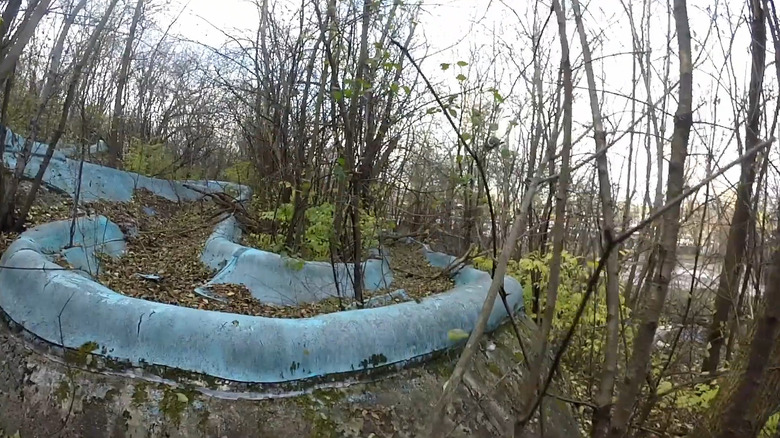
Ebenezer Floppen Slopper's Wonderful Water Slides was a dump, literally. It was built on a landfill locally known as Mt. Trashmore. Legend has it that local businessman Mark Coller was keen on creating a water park in Chicagoland, but the area doesn't have many hills. One community's trash became Coller's treasure, and he built two 800-foot concrete water slides on the mound and opened up Ebenezer Floppen Slopper's.
The Wonderful Water Slides were an instant hit. The park opened for business on July 5th, 1980, and The Chicago Tribune article explains it had paid for itself by that August. Over the next several years, business was booming. The Digital Research Library of Illinois History reported that the park became a major attraction for local communities, with young people flocking to line up and slide down. Eventually, Ebenezer Floppen Slopper's added five additional slides and a wave pool as it transitioned into a more bona fide water park, now called "Doc River's Roaring Rapids." However, just as quickly as a water park was planted on the peak of Mt. Trashmore, it all faded away.
The park closed for the season in 1989 and never reopened. To this day, nobody has an official reason for the park's closure. All that's left of Ebenezer and Doc River's summer wonderland are dilapidated slides and cement canals. If you drive down Route 83 in winter, you'll still see the slides through the leafless brush.
Aqualud
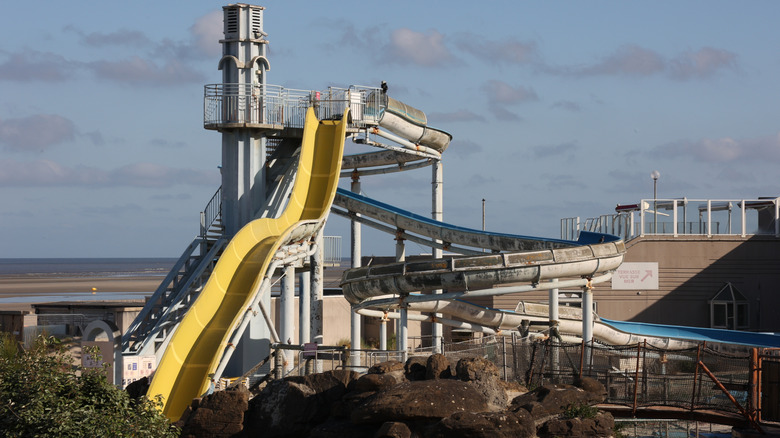
Aqualud was a combination indoor and outdoor water park in Pas-de-Calais, a French coastal region brimming with castles, sand dunes, and seafood. The park was a massive attraction on the beachfront of Le Touquet-Paris-Plage. It's a 25-meter-high glass pyramid enclosing 43,055 square feet (4,000 square meters) of heated indoor water attractions. Outside awaited another 43,055 square feet of pools, slides, and jacuzzis.
At its peak, over 200,000 visitors slid through the expansive park each year. You could drop at speeds of 44 miles per hour down The Kamikaze, spin around The Twister, or fly through darkness on The Black Hole ride. Eventually, cracks began to form in the park's operation that even Flex Tape couldn't handle. The park started nosediving noticeably in the 2010s, when visitor reviews increasingly cited deteriorating facilities, poorly maintained changing areas, and water temperatures cooler than advertised. One TripAdvisor reviewer even called it, "The level of hell Dante didn't get round to."
Aqualud was in dire straits, and COVID-19 turned out to be the final nail in the coffin. The park announced it wouldn't open in 2020 because it couldn't make a profit while operating at a reduced capacity, and Aqualud never turned on the jets again. In 2021, it was announced that the park would be demolished and replaced with a luxury hotel. Yet as recently as 2026, content makers are documenting trips inside the waterpark, where children's attractions, ice cream posters, and slides still stand, abandoned and deteriorating.
Atlantis and El Rollo
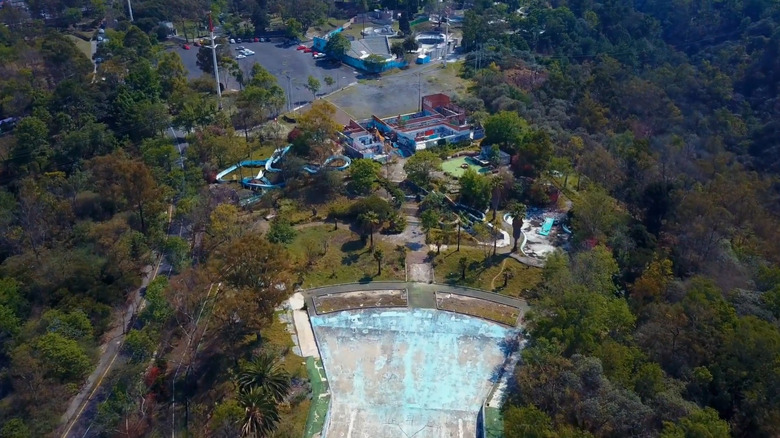
The only thing better than exploring the ruins of one once-thriving water park is checking out two abandoned parks on back-to-back plots. For a 2-for-1 abandoned water park, head to the Bosque del Chapultepec in Mexico City. The park is home to the remnants of Atlantis, once a Seaworld-style venue with dolphin shows and parrots teeter-tottering on soccer balls, and El Rollo, a defunct collection of water slides and a massive wave pool.
In their heyday, these parks were some of the most visited attractions in the entire Bosque del Chapultepec. Atlantis wowed guests with clapping sea lions, and El Rollo (then known as La Ola,) was making waves artificially that over 3,000 people enjoyed daily. But as the years went by, the area slowly went from "de parque infantil a bosque embrujado," according to El Universal, which translates to "from playground to haunted forest." El Rollo closed in 2007, and Atlantis closed in 2000 before briefly trying a second life as a dolphin therapy center in 2009. The captive-dolphins-as-therapists technique never really took off, and in the 2010s, the last dolphin left Atlantis, leaving behind naught but towering slides and rundown pools coated in graffiti and stagnant water.
Unlike the other stories we've looked at so far, this one has an inspiring ending. In 2022, artist Gabriel Orozco and the federal "Chapultepec: Nature and Culture" initiative re-imagined the space into the PARCUR (Urban Culture Park). The PARCUR planners made great use of the spaces, turning animal enclosures into skate bowls and graffiti areas to bring a sense of community to the abandoned water parks.