
The Midwest's 'Little Grand Canyon' Is A Breathtaking Hidden Ozark Wonder With Stunning Trails
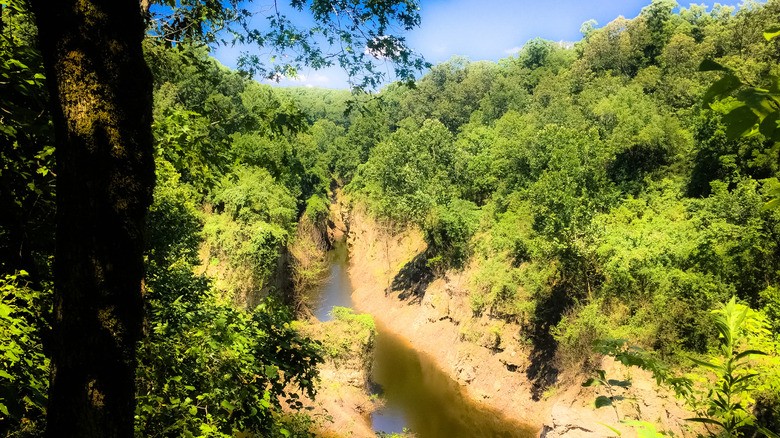
Missouri's highest-profile tourist attractions largely center around its two major cities. On the state's western side, Kansas City is a renowned food Mecca with one of the world's premier barbecue scenes. In the east, St. Louis hosts the only U.S. national park entirely within a city via the iconic Gateway Arch. Between these two cities, however, Missouri has a surprisingly extensive assemblage of natural wonders that are just as worth a visit as the state's urban attractions. In the south, the famously Midwestern Missouri even has its own "Little Grand Canyon" in the form of the eye-popping Grand Gulf State Park.
Though Missouri's Midwestern geography may support the stereotype of the state being flat, Grand Gulf State Park is part of southern Missouri's more topographically interesting Ozark region. Sitting just a few miles north of the Missouri-Arkansas border, Grand Gulf State Park exemplifies much of the unique geology of the Ozarks in miniature. More remarkably, the park's uncanny geological formations create phenomena you would hardly expect to find in a Midwestern state like Missouri, including a striking natural rock bridge that wouldn't look out of place in Utah! Such features would make any park a worthy destination on its own, but Grand Gulf State Park is also a gateway to one of the most underrated communities of geological, hydrological, and ecological wonders in the country's interior. And, with plenty of excellent trails and sightseeing spots, Grand Gulf State Park offers many of the best hiking opportunities anywhere between Appalachia and the Rocky Mountains.
Grand Gulf hides a mini Grand Canyon in the heart of the country
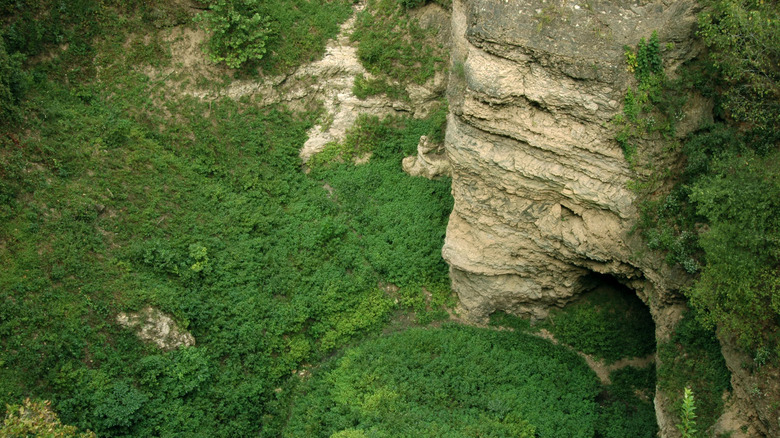
The "Grand Gulf" of Grand Gulf State Park owns the title of Missouri's "Little Grand Canyon." However, while the Grand Canyon formed from the Colorado River carving a course through layers of rock over millions of years, Missouri's Grand Gulf started from the collapse of what was once a large underground cavern system. The area's foundation of limestone and dolomite, and the acidity of the local groundwater, was an effective recipe for the creation of a large cavern. About 10,000 years ago, the roof of this massive cave system collapsed, exposing the cavern to the surface and creating the deep canyon awaiting at the site today.
Grand Gulf sports all of the precarious cliffs and stark canyon rims that you'd expect from a formidable canyon system. Yet its status as a collapsed cavern also creates some more unique formations. One of the most notable is Grand Gulf's remarkable natural rock bridge. Measuring about 250 feet long with a 75-foot opening, the Grand Gulf natural bridge rivals the dimensions of the longest natural rock bridges in the United States.
The rest of the Grand Gulf stretches for more than a mile through Missouri's gorgeous High Oak Prairies region, with lush forest greenery decorating the canyon's stark white limestone and dolomite cliffs. The Grand Gulf even has some unique geological features you won't see at even the famed Grand Canyon. For example, the Grand Gulf's internal stream performs a kind of geological magic trick, where it disappears into extant subterranean caverns and reappears in a different spot miles away. As a prime example of a karst landscape, Grand Gulf can also take on a sizeable lake after heavy rain.
Explore scenic trails at Grand Gulf State Park, Missouri
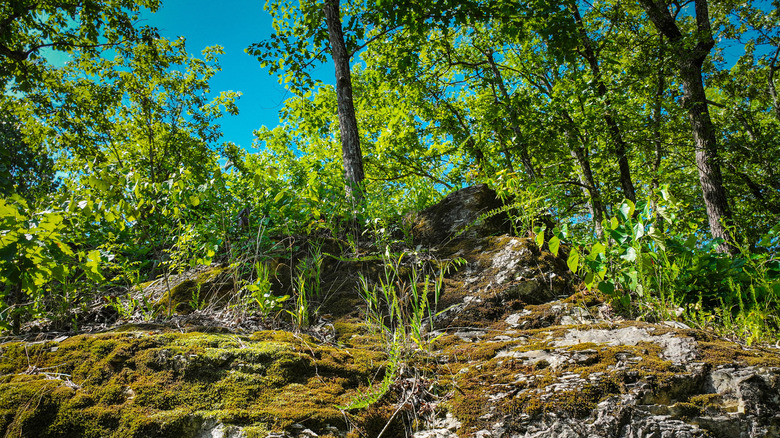
A collapsed cave turned 130-foot canyon may not seem like the most inviting place for hikes, but Grand Gulf State Park has extensive visitor-friendly infrastructure for both scenic views of the gorge and manageable hiking trails. Grand Gulf State Park actually operates via a joint agreement between the Missouri Department of Natural Resources and the L-A-D Foundation (a non-profit that manages several natural areas in Missouri). This public-private partnership has provided Grand Gulf State Park with amenities like an accessible picnic area and a prominent observation deck overlooking the canyon.
Grand Gulf State Park also has some terrific sightseeing trails. The short Interpretive Loop Trail provides convenient access to the park's main rim-side observation area with only moderately challenging terrain. The slightly longer and more challenging Natural Bridge Trail takes hikers on a scenic journey directly over the park's prominent natural bridge. Hikers can also combine these two trails in a single, 1-mile loop. Visitors can venture down to the bottom of the gulf, though none of the routes there are officially designated trails. As such, anyone attempting to reach the bottom should proceed with caution. Regardless of your hiking preferences, you can enjoy Grand Gulf State Park's free admission (at the time of writing).
Grand Gulf State Park is open daily from 8 a.m. to dusk, though facilities may close on certain public holidays. As the park sits just north of the Missouri-Arkansas border, Grand Gulf is only 8 miles north of Arkansas' equally worthwhile city of Mammoth Springs. Not only does the town's Mammoth Springs State Park feature one of the world's largest natural springs, but its acclaimed spring serves as the outlet for the very waters of Grand Gulf as they emerge from their secret underground rivers!