
Michigan's Under-The-Radar State Park Offers Beautiful Lake Huron Views, Hiking, And Fishing
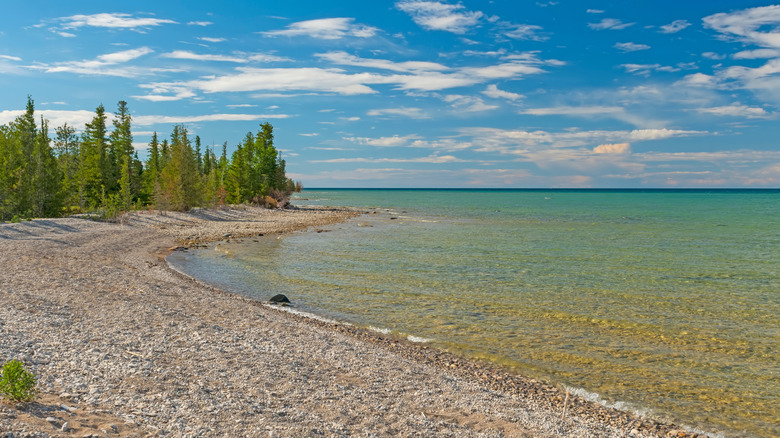
If you want to experience the Great Lakes as if they've never seen a single tourist, Thompson's Harbor State Park will comfort your soul. Situated a 25-minute drive from Michigan's Rogers City on the northern edges of the Lower Peninsula, the park welcomes visitors with 7.5 miles of shoreline. This white sand and cobblestone expanse is perfect for strolling, beachcombing, and soaking in views of Lake Huron's bright blue waters. As you walk, the chances of seeing another soul are slim, but that's part of the park's charm.
When visitors say Thompson's Harbor is rustic, they don't mean a lodge-like visitor center surrounded by canvas glamping tents and strings of bistro lights. The park's only developed features are its trail system, vault toilets, and two cabins tucked deep in the woods. However, it's this untouched state that has visitors returning year after year. "Stunning display of nature," shared one past visitor on Google Reviews. "It has it all with the woods, water, rocks, etc. Eight miles flew by today. We had sun, wind, rain, snow, greens, flowers, pines, and cedars. We found some Petoskey stones and many others along with beach glass."
The state created the park due, in part, to the generosity of Genevieve Gillette, a conservationist who spent much of her life championing the creation of parks as a way to preserve for the future Michigan's "heritage of natural beauty". While her efforts led to the creation of numerous preserves, Thompson's Harbor exemplifies Michigan's natural beauty in its raw form.
What to do at Thompson's Harbor State Park
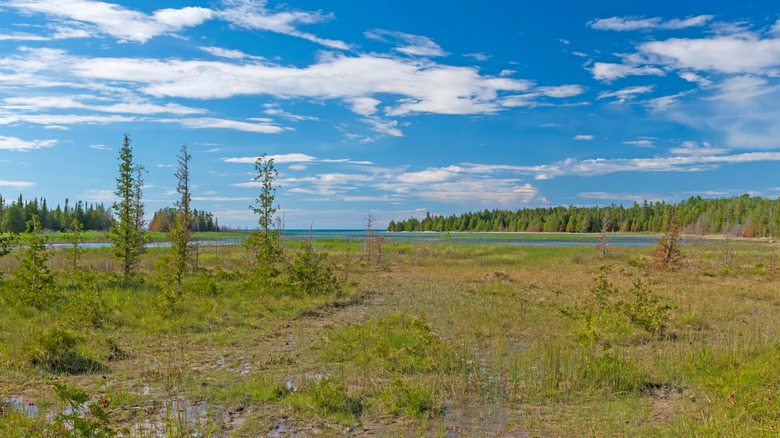
Some visitors complain that the park lacks information or posted signage to fully take advantage of the area, but that's part of the adventure. Besides walking on the beach, visitors can hike 6 miles of barely developed trails that wander through grassy meadows and forests left to grow wild. The system includes three trail loops, aptly named Loop 1, 2, and 3, that can be combined to create longer excursions. When winter snow arrives, these same paths turn into cross-country skiing routes. You can find the trail map here.
During spring, wildflowers burst from the woods, creating pops of pink, white, yellow, and blue. In particular, visitors note the profusion of Dwarf Lake Irises, Michigan's state flower. Wildflowers attract the most visitors, but anglers also use the trails to access fishing spots along the Lake Huron shoreline. Although you never know what you'll reel in, trout, perch, and salmon call these waters home.
After spending the day hiking and wandering through untouched lands, take in the park's equally pristine night sky. In recent years, Michigan has undergone a tourism transformation, attracting a growing number of visitors to its dark skies. In 2016, the park was designated an official Dark Sky Preserve, a distinction only given to places dedicated to protecting their skies from light pollution. Safe from city lights, the constellations appear crisper even without a telescope.
When to visit Thompson's Harbor State Park
Unlike nearby Hoeft State Park's secluded campground, Thompson's Harbor State Park offers two cabins for visitors to rent out — the Cedar Haven Cabin and the Stone Path Cabin — instead of traditional camping. Neither cabin comes with indoor plumbing, but there's a vault toilet and a hand pump for water outside.
However, it's the rustic setting that has visitors enthralled. "We took a four-day vacation at the stone path cabin," shared an overnight guest on Google Reviews. "The cabin is outstanding. It is so nice to not deal with ORVs and all the stuff that comes with developed parks and campgrounds."
Past visitors recommend planning a trip in the narrow window between mid to late June for impressive wildflower displays and relatively fewer mosquitoes. However, wildflowers stick to their own schedules, so sometimes May offers better blooms. If you visit during the winter, expect snow and freezing temperatures. Plan to finish your outdoor activities well before sundown, which leads to a significant drop off in temperatures, an important rule for winter camping and hiking.