
Where Is The 'Bermuda Triangle Of The Great Lakes,' And Is There Any Truth To The Mystery?
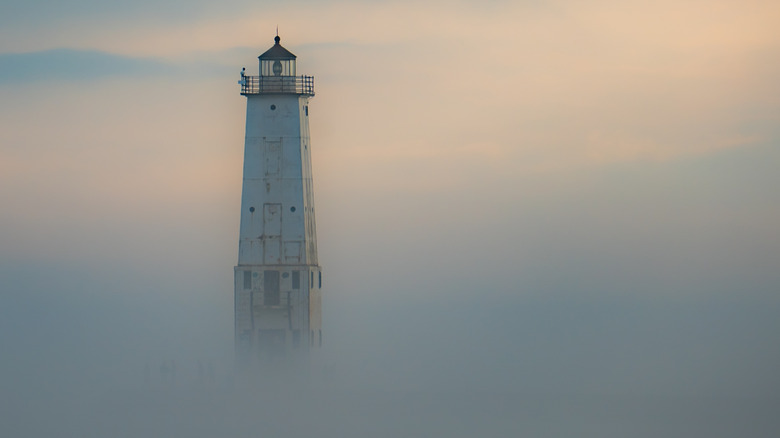
Travelers drawn to the unknown might be tempted to chart a course across Lake Michigan, where the so-called Michigan Triangle has long been tied to disappearances and shipwrecks. It's a tract of water that's been nicknamed the "Bermuda Triangle of the Great Lakes" by the Great Lakes Museum for its extensive history, full of strange stories, going back to the 1600s. While Lake Michigan certainly has peaceful segments, like the unforgettable Great Lakes kayak trail around Beaver Island, visitors to the Michigan Triangle will wade through a more eerie side of the lake. You can even sail or take a historic ferry across the Triangle.
The boundaries of the Michigan Triangle are basically the lines connecting three cities: Ludington, Michigan, on the eastern side; Benton Harbor, Michigan, to the south; and Manitowoc, Wisconsin, on the west. According to the Milwaukee Journal Sentinel, the triangle's notoriety was cemented with a book called "The Great Lakes Triangle" in 1977. One of the first documented incidents of unexplained phenomena in the zone was the case of a commercial ship called Le Griffon, which was thought to have been shipwrecked in a storm on Lake Michigan in 1679, though its remains were never found.
There were several other disappearances of ships and individual people who were headed for the Michigan Triangle in the centuries to follow, as the Great Lakes Museum outlines. One of the more recent cases was a student who disappeared in 1978 walking the lake when frozen. His footprints on the frozen lake stopped in the middle of the triangle. When he later turned up at his father's house, he had no memory of what had happened to him.
How true are the mysteries of the Michigan Triangle?
Theories of aliens, energy vortexes, and phantom ships have been posited to try to explain the supposed disappearances in the Michigan Triangle. There was even a fascinating landmark hailed as "Michigan's Stonehenge" found in the lake, which only adds to the lore's mystique. There's a major hole in most of the superstitious theories about the Michigan Triangle mystery, though, which is, quite simply, that most of the "disappearances" are actually accounted for, according to Discover Magazine. "We can plot where all these missing ships are in the Great Lakes," Brendon Baillod, president of the Wisconsin Underwater Archeological Association, told the magazine. He added that, of the small portion of shipwrecks not accounted for, most of them aren't even in the triangle zone.
One thing that is true, however, is that Lake Michigan is a shipwreck hotspot. According to data collected by Baillod and his team, as reported in Milwaukee Journal Sentinel, 26.5% of shipwrecks across the Great Lakes occurred in Lake Michigan, the most of any of the lakes. There are perfectly logical explanations for these losses, not the least of which is simply how much ship traffic the lake gets. There's also the dangerous weather that the lake gets seasonally. "We don't need to craft aliens or supernatural things," said Michigan-based author and explorer Valerie van Heest in Detroit Free Press. "These lakes are dangerous bodies of water, and that's why they're called the inland seas."
How to explore the Michigan Triangle by boat or from shore
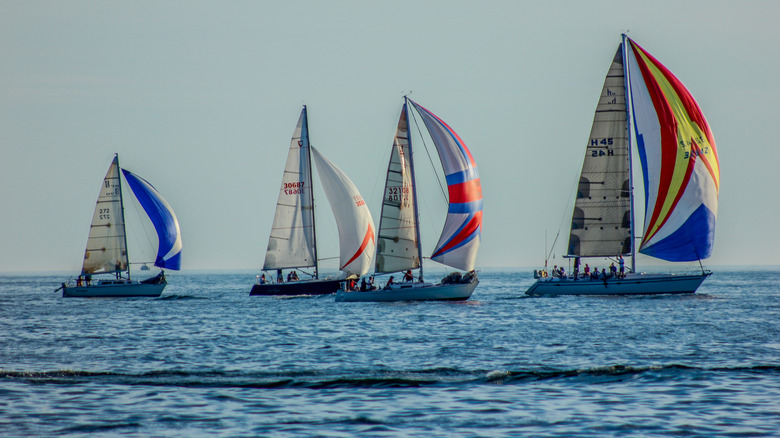
If you want to go out onto the waters and challenge the supernatural claims of the Michigan Triangle, you could easily take a boat out from one of the triangle's point cities. In particular, Ludington is a cozy city on the shoreline full of beach charm, where you can take advantage of its cross-lake ferry if you're not keen on steering the boat yourself. Its SS Badger debuted in the 1950s and is the last operating coal-powered steamship in the country, crossing at the triangle's northern edge from Ludington to Manitowoc. Sailors might be better off heading to Benton Harbor. There, you'll find the Tall Ship MJ, a sailboat charter with some fun experiences like sunset sails and good reviews.
Travelers who are hesitant about going out onto waters tied to morbid legends can still get some interesting insight about the Michigan Triangle and its shipwrecks from ashore. If that's more your speed, you might want to plan a trip to the Great Lakes Shipwreck Museum, located in Paradise, Michigan, and open from May through October. Consider the trip not only for the museum but also to explore Paradise's forest trails and thundering falls.