
Data Says These Are America's 5 Busiest Highways
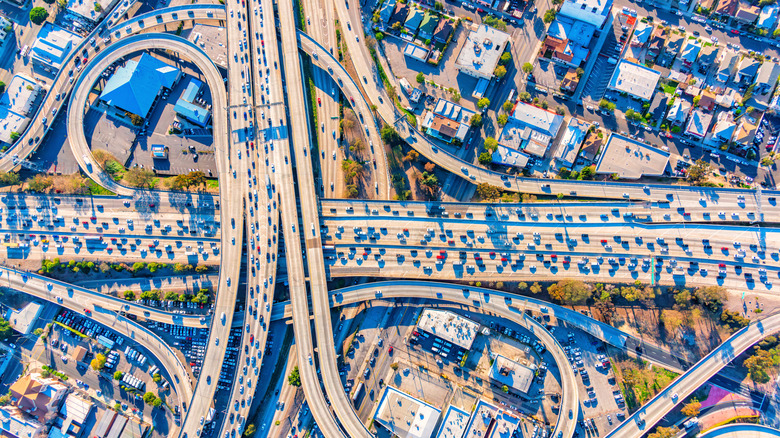
In 2025, Forbes reported that over 60% of Americans had plans to take a road trip that summer. The Hilton Hotels 2026 Trends Report shows a similar trajectory for 2026, claiming that 71% of Americans will take a car on their next vacation. In large part, this reliance on cars is chalked up to cities prioritizing car-friendly infrastructure, Americans' long commutes, and a lack of investment in public transport. Of course, the wrong route can easily derail your trip by trapping you on congested highways with slow-moving traffic. Luckily, for those planning to head out on the ultimate historic cross-country road trip, the Federal Highway Administration (FHWA) has released a list of the busiest highways to avoid.
The list is based on a metric called Annual Average Daily Traffic (AADT), which measures the average number of daily trips taken across each highway in a given year. California dominates the list, with 12 of the top 25 busiest highways. Texas comes in a somewhat distant second, with five highways on the list, although none are in the top five. The five busiest highways on this list carry anywhere between 350,000 and 500,000 vehicles per day, on average.
Whether you're planning to visit the cities mentioned here, or are just passing through while road-tripping, the last thing you need is for traffic to ruin your plans. If you're keen to know which are the routes you should avoid on your next scenic road trip through America's states and national parks, here are the five busiest highways in the U.S.
Interstate 5 - Los Angeles, California
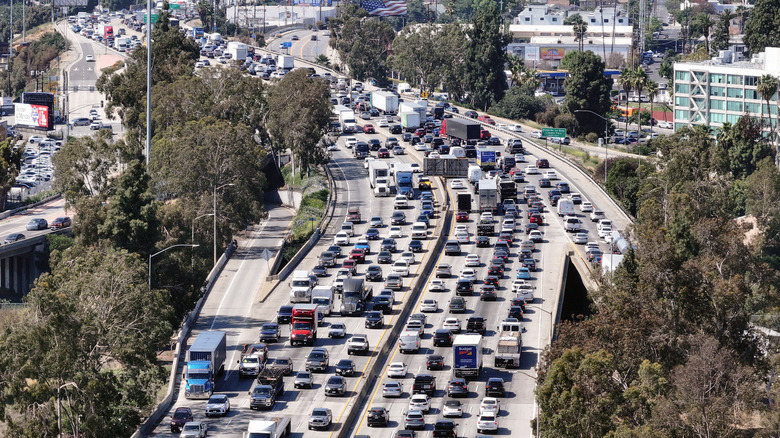
Los Angeles is known for its glitzy, glamorous image and star-studded hotspots. Nearly 50 million tourists visit the City of Angels every year, but this puts an extra burden on the city's already strained network of highways, leading to massive bottlenecks and traffic jams lasting several hours. The I-5 in Los Angeles suffers from the combined traffic of daily commuters and eager tourists. It carries 504,000 vehicles every day, according to the report by the FHWA.
The I-5 is one of the most important interstate highways along the West Coast. It stretches from the U.S.-Mexico border in California to the U.S.-Canada border up north in Washington. Along the way, it connects major West Coast cities like Los Angeles, San Diego, Sacramento, Portland, Seattle, and more. It also acts as the most accessible route to popular attractions like Six Flags Magic Mountain, the Los Angeles Zoo, and Disneyland. The section within Los Angeles is particularly crowded due to a higher number of daily commuters using the highway to get to work and back. Traffic peaks in the morning during the office rush and the evening when commuters head home.
While avoiding the I-5 entirely isn't feasible, you can arrange your trip around peak traffic hours or use surface roads to avoid busy freeways. You can also use the LA Metro buses for popular spots like Downtown LA or Disneyland. Additionally, there are alternative routes, like the 101, for Universal Studios Hollywood or Griffith Park. If you have to take the I-5, aim to travel mid-morning or late evening.
Interstate 75 - Atlanta, Georgia
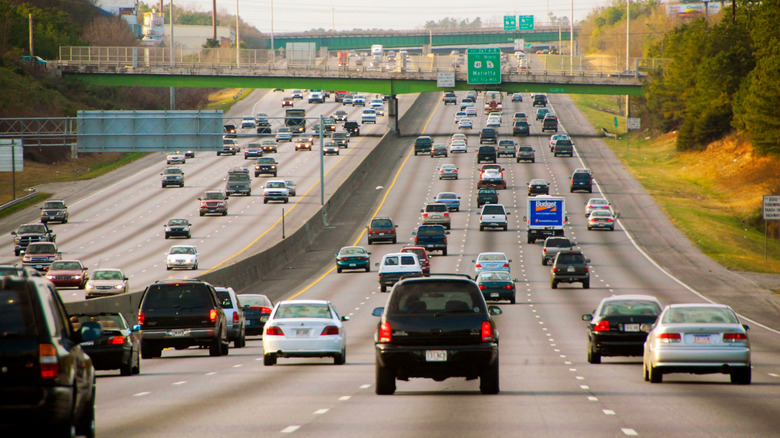
The only non-Californian part of this list is none other than Atlanta, known for being the birthplace of Martin Luther King Jr. and home to the largest aquarium in the United States. Like many other metropolitan areas of the U.S., Atlanta is a rapidly growing city, which puts pressure on its roads to keep up with the increasing population. According to the FHWA, the I-75 in Atlanta comes second on the list of the busiest highways in the U.S., carrying 419,000 vehicles every day on average. The I-75 isn't just one of the main arteries through Atlanta; it's also an important north-south corridor from the Canadian border in Michigan down to Florida. Within Atlanta, the I-75 connects several tourist destinations, like the Hartsfield-Jackson Atlanta International Airport, Downtown Atlanta (including the aforementioned Georgia Aquarium), and the Atlanta Botanical Garden.
The I-75 is known for being a traffic bottleneck for several reasons. It's a major freight route, passes through some of the most important parts of town, and merges with other busy highways in some areas. This results in sudden lane changes, slower-moving traffic, and major bottlenecks at interchanges. For example, the second-most traffic-heavy road in Atlanta, the I-85, merges with the I-75 in Downtown Atlanta, leading to a 7.4-mile section called the Downtown Connector.
To avoid the I-75 traffic in Atlanta, try to time your travel for off-peak hours, between 9:30 a.m. and 4:30 p.m., or after 6:30 p.m. Weekends and holidays are also usually less busy, as you won't have to contend with office traffic. While other routes, like I-285, exist, these are often crowded and can be more dangerous than the I-75.
Interstate 5 - Mission Viejo, California
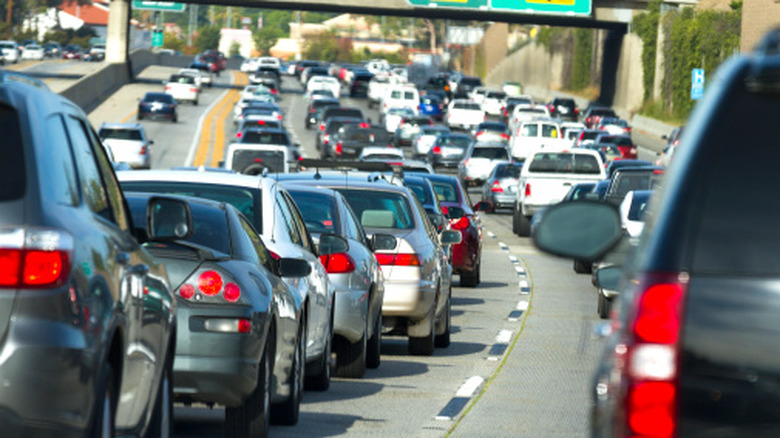
If you thought getting out of Los Angeles would free up the I-5, think again. While the I-5 does widen to a whopping 22 lanes in some parts, that doesn't always do much to reduce the traffic. In fact, one of the busiest highways in the country is another part of the I-5, this time south of LA, in Orange County. According to the FHWA, the Mission Viejo stretch of the I-5 carries an average of 415,000 vehicles every day.
The congestion in Mission Viejo is one of the biggest problems locals face. Despite its high number of lanes, the freeway still isn't enough to serve the millions of people living in Orange County and nearby Los Angeles. Mission Viejo's two main exits off I-5 are often considered some of the most dangerous routes in the city. It isn't uncommon for traffic on the I-5 to suddenly slow down near these spots, as drivers switch lanes in preparation to exit the highway.
If you're exploring the city of Mission Viejo, you can use local surface roads to avoid the I-5. However, if you're just passing through Orange County, you can time your travel for off-peak hours (early morning, mid-morning, or late evening). If you're willing to pay the toll, you can also switch to the 73 Freeway to avoid the traffic along the I-5.
Interstate 405 - Los Angeles, California
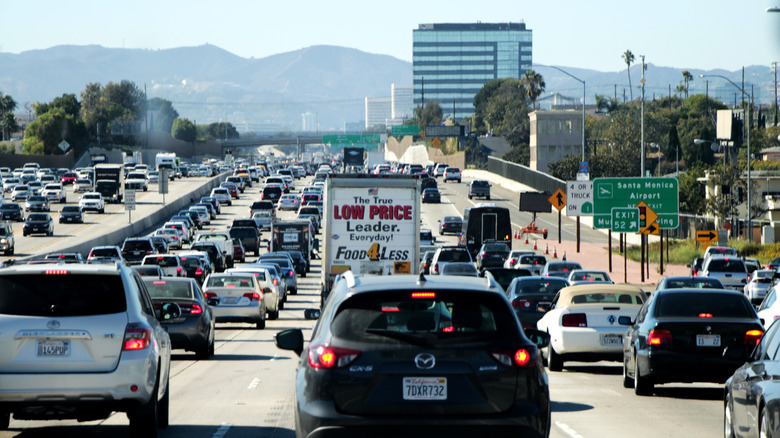
Another Los Angeles classic, the I-405, is also a known bottleneck. Known locally as "the 405 (four-oh-five)," this route runs along the western edge of Los Angeles, close to the beaches, Beverly Hills, and — most importantly — the Los Angeles Airport (LAX). As a result, visitors to Los Angeles are almost immediately acquainted with the highly congested route as soon as they step out of the airport. The I-405 is also the main freeway serving the LA coast, and it's one of the few routes to LA available to those living in Irvine. The result? 383,000 vehicles traverse the I-405 every day on average, according to the report from the FHWA.
Despite having multiple lanes, the I-405 is notoriously busy at all times of the day. A video on Reddit captures the high volume of traffic characteristic of the I-405, with cars going either way stuck in bumper-to-bumper traffic. Traffic is at its worst during the office rush in the morning and evening (after 7 in the morning and before 7:30 in the evening), but sudden closures and construction make traffic an evergreen experience along the I-405. As one Redditor put it, "Welcome to [SoCal]. There is a reason why 405 is known as a parking lot."
If you're visiting Los Angeles and only plan on using the I-405 to get to and from the airport, you could instead use the LA Metro, which connects to LAX through the C and K Lines. Every 10 minutes, the LAX/Metro Transit Center offers free shuttles to all terminals at the airport. Otherwise, use Google Maps or Waze to plan out alternative routes in real time.
Interstate 210 - Los Angeles, California
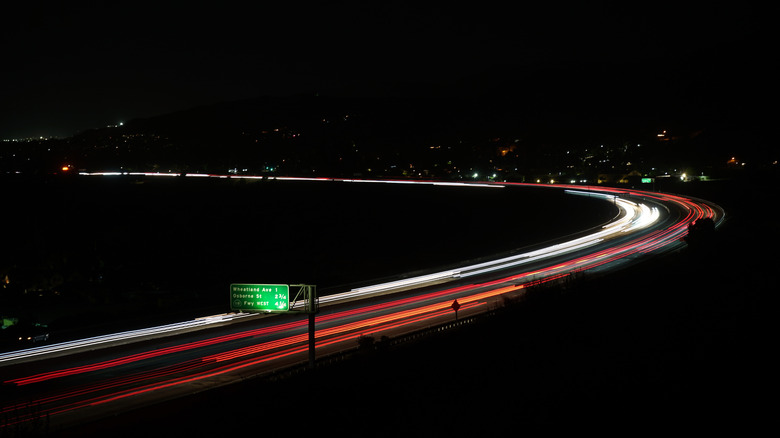
The last highway on this list is also, unsurprisingly, in Los Angeles. Interstate 210, colloquially known as the 210, runs from the east to the west. It splits off from the I-10 in Redlands and runs west past the San Fernando and San Gabriel valleys, until it merges with the I-5 in Sylmar, LA. Along the way, it passes by California's historic "Old Money" city of Pasadena, known for its famous Tournament of Roses and old-world architecture. Unfortunately, the section of the I-210 through Pasadena is also considered one of the worst for bottlenecks. According to the FHWA report, the I-210 carries an around 358,000 vehicles per day.
Like the other Los Angeles entries on this list, the I-210 is busy because of the sheer volume of daily travelers using it. However, there are two more elements complicating travel along the I-210: freight traffic and poor maintenance. The I-210 is a popular freight route in and out of Los Angeles, and things can slow to a standstill when truck traffic is at its height. The constant onslaught of heavy vehicle traffic also erodes the roads frequently, resulting in potholes and ditches that are either ignored or hurriedly covered up, according to a post on Reddit.
Alternative routes to the I-210 depend on where you want to go. If you're heading to Glendale or Pasadena, you can use the SR-134 instead. The I-10 can be an alternative to the I-210 for west-to-east travel, but don't count on a massive difference in traffic — the I-10 falls just below the I-210 in terms of traffic volume in the FHWA's report. In general, try to time your travel for early morning or late evening to avoid the worst of the traffic.
Methodology
The highways mentioned on this list were obtained from a report by the Federal Highway Administration (FHWA). In their report, the FHWA uses a metric called Annual Average Daily Traffic (AADT) to calculate the average number of vehicles traveling each road on a daily basis, based on data taken throughout the year. While the report mentions 25 highways, we decided to highlight only the top five for the sake of brevity.
By combing through blog articles, guides, and local experiences on forums like Reddit, Quora, or TripAdvisor, we tried to paint an accurate picture of why these highways are so crowded. We also used these sources, plus Google Maps, to provide potential alternatives to these busy roads, based on your destination. However, we cannot guarantee these alternatives will always work, as they can be affected by unexpected road closures, construction, or accidents. Always use real-time maps like Google Maps or Waze to see the best potential routes.