
The Prime Camping Locations You Should Always Choose If You Want To Avoid Snakes
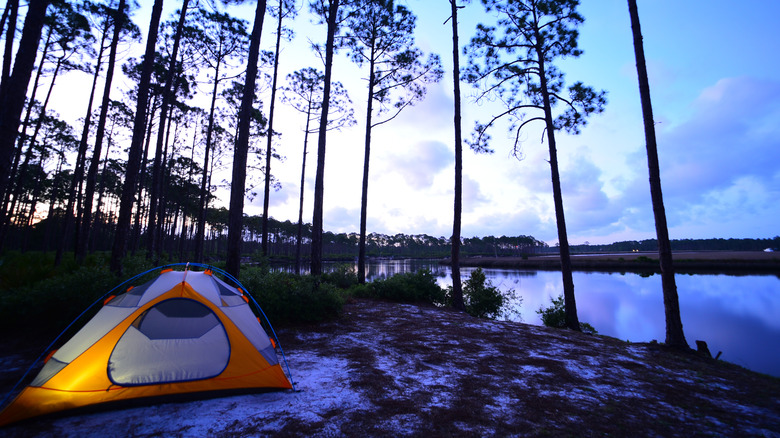
"But snakes are so cute!" "Most snakes are harmless!" "Snakes are more afraid of you than you are of them!" We can hear these folksy refrains all day, but the fact remains: If you have a natural fear of slithering reptiles, you want them to stay away, period. Nothing in the world will comfort you around these scaly, limbless predators — and one of the most nightmarish things you can imagine is setting up a tent and spotting a snake nearby. About 10% of people are believed to experience ophidiophobia (severe fear of snakes), and as many as half feel anxiety in a snake's presence. This feeling isn't exactly conducive to sleeping outside in the summer.
Your best strategy is to avoid camping near snakes altogether. But where do you find a campsite that has no snakes? Can you only go backpacking in Hawaii or Ireland? How can you even tell that they're not around?
For starters, most snake species prefer warmer climates, and their numbers decline as the air cools. If you're hiking in the northern U.S. or Canada, for example, you don't have to worry about snakes for much of the year, because they enter a state of brumation (the reptilian equivalent of hibernating). There are at least five American states with conspicuously low numbers of snakes, and two states in the Lower 48 that have no native venomous snakes to worry about (Maine and Rhode Island). Setting up your tent in these locations will reduce your odds significantly, and sightings of, say, pit vipers or rattlesnakes get increasingly rare the farther north you choose to camp. But what if you are staying in a snake habitat? What should you do then?
Where to set up your tent to avoid snakes
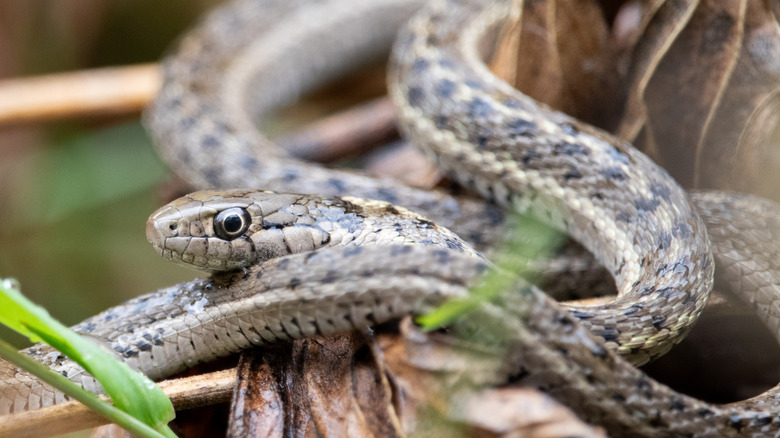
Most snakes are skilled at hiding, but to do so, they generally need some kind of cover. Snakes love to coil up in wood piles, jumbles of rocks, and tall grass. Cool and sheltered places are ideal, beyond the sight of the predatory birds that love to hunt them. When humans spot snakes, the encounter is usually a surprise; that's a small concern when the species you uncover is a harmless garter or rat snake, but a startled diamondback, cottonmouth, or coral snake is a very serious threat.
When camping in a region with higher populations of venomous snakes — we're looking at you, Texas, Florida, and Arizona — you're wise to camp in the opposite environment: short (or no) grass, and no piles of wood, rocks, or debris. Pitching your tent in a flat, open area will give you more visible space to see an approaching snake. Serpents are extremely sensitive to ground vibrations (such as human footsteps), so unprotected specimens will probably move away before you even spot them.
One final precaution is to avoid sleeping right on the edge of a pond, lake, or stream, especially in areas known for their water snakes. You'll definitely want to avoid the most snake-infested lakes in America and Florida's snake-packed waters. Even outside those areas, species like the northern water snake are basically harmless, but few campers want to open their tent just to step on a sunning reptile. If you wake up and have any doubts, make some noise and shake your tent a little. One adage is true: They really are more afraid of you than vice versa.