
Chicago's Once-Thriving Quarry Turned Landfill Is Now A Vibrant Haven For Trails, Fishing, And Birdwatching
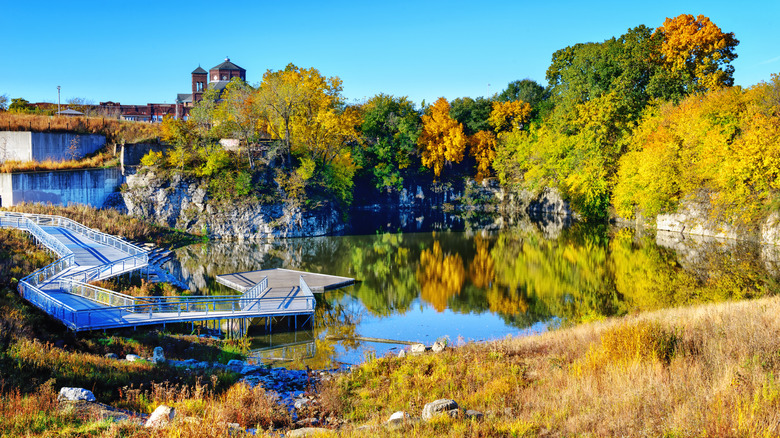
The 19th century saw Chicago grow from a frontier outpost of just 200 people into an industrial powerhouse of more than 2 million. By the 1930s, Chicago was America's second-largest manufacturing hub and the heart of the nation's heavy industry, a status it held until the deindustrialization of the late 20th century. But while many industrial jobs vanished starting in the 1970s, the places where those people worked didn't fade away so quickly. In recent years, the city has brought new life to many of these abandoned industrial spaces, and the 26-acre Palmisano Park in the Bridgeport neighborhood is a prime example of how these would-be eyesores have been repurposed into community hubs.
Palmisano Park's history starts well before Chicago's industrial boom. About 400 million years ago, it began as a coral reef. Over the millennia, the remains of those ancient lifeforms transformed into dolomite limestone. Some were preserved as fossils, many of which were collected and can be viewed today at institutions like the Field Museum of Natural History. For Chicago's 19th-century entrepreneurs, the limestone itself was the more valuable find. They began extracting it in the 1830s to use in buildings and infrastructure like the Illinois & Michigan Canal. The site, known as Stearns Quarry, operated through 1970, at which point it was used as a landfill until 1999, when the Chicago Parks Department bought it, cleaned it up, and turned it into Palmisano Park.
Palmisano Park is especially popular during the winter, when its 33-foot artificial hill, Mount Bridgeport, is a top sledding destination with skyline views. But you don't need to wait for a snowfall to enjoy the outdoors here. With its trails, fishing pond, and terraced wetlands, Palmisano Park is an urban oasis for nature lovers to enjoy in any season.
Things to do at Palmisano Park
Similar to Steelworkers Park, the abandoned South Works steel plant that's now a tranquil haven on South Chicago's lakefront, the remnants of Palmisano Park's former industrial life have been integrated into its natural landscape. The quarry once reached a depth of 380 feet, and visitors can still see evidence of its remains in the park's north-west corner, creating the basin for the current fishing pond. The pond is fed by a small stream that captures rainwater and runs through the wetlands to its east.
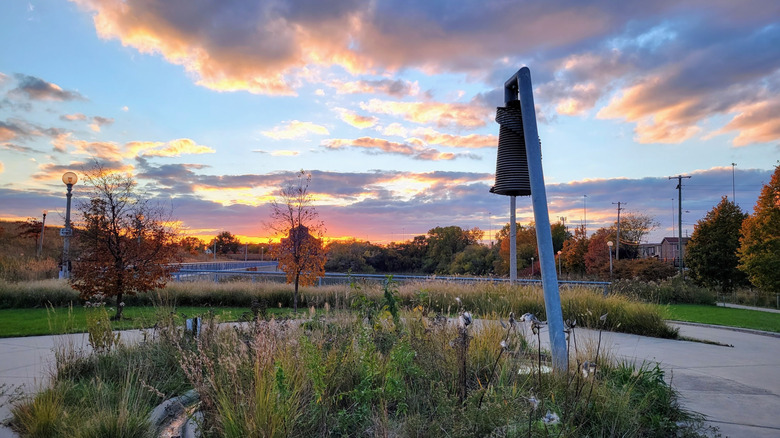
The secluded feel of Palmisano Park is what makes it one of Chicago's best under-the-radar gems. Aside from Mount Bridgeport, most of the park's land is below street level, and the city noises fade out quickly once you enter. At the north entrance, you're greeted by the sound of water trickling through the statue designed by landscape architect Ernest Wong, who also designed the park. The 10-foot galvanized metal statue was inspired by the cranes that once worked in the quarry, and it cycles reclaimed water through the wetland environment.
The 1.7 miles of trails that wind through Palmisano Park include a mix of crushed stone paths, paved walkways, and boardwalks made of recycled timber around the pond, where there's also a pier for fishing. Following the paths gives you an up-close view of the native wetland plants as well as the prairie grasses leading up the slope of Mount Bridgeport. If you want to learn more about the park, the Chicago Park District has a free self-guided audio tour that you can listen to while you explore. Make sure to climb the stone steps to the top of Mount Bridgeport, where you'll find breathtaking scenery of downtown Chicago in the distance.
Wildlife at Palmisano Park
Palmisano Park is named for local bait shop owner, Henry Palmisano. While he passed away before the park officially opened, the pond is stocked with bluegill, channel catfish, and largemouth bass in his honor. Fishing is catch-and-release only, and while you can't keep anything you reel in, it does allow the fish to grow fairly large. People regularly catch bass that weigh over 5 pounds and are upwards of 20 inches in length.
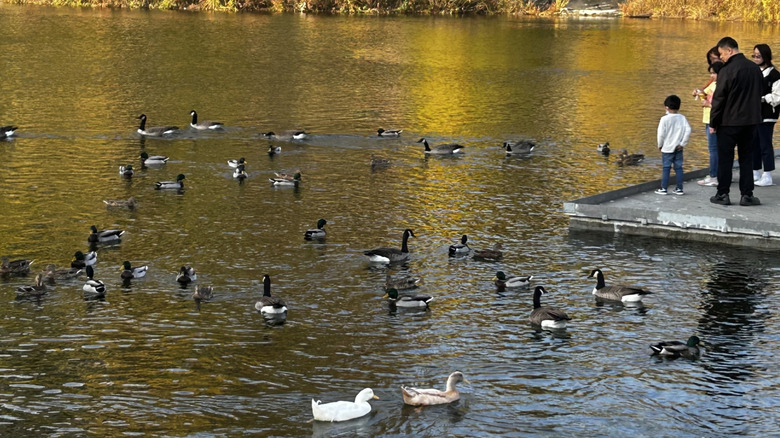
The fishing pier in Palmisano Park is also an excellent place for birdwatchers to spot wading waterfowl like black-crowned night herons and sandhill cranes, as well as other species like teals, mergansers, and swans. Over 140 distinct species have been spotted since the park opened, ranging from common urban birds like starlings and downy woodpeckers to seasonal visitors like chimney swifts and nighthawks. Songbirds like red-winged blackbirds, purple martins, cedar waxwings, and various species of warbler, wren, and vireo also call the park home for at least part of the year. You'll likely see the most songbird species if you visit in May during the spring migration, while spring and summer are the best seasons for seeing waterbirds.
Part of the appeal of Palmisano Park is that it's undeveloped around the paths, without the sports courts or other infrastructure common in most city parks. This also means there aren't any restrooms within the park, but visitors can use the facilities in McGuane Park, which is just across W. 29th Street to the south.