
Utah's Wildly Underrated Historic Monument Is A Stunning Sandstone Monolith With Millennia-Old Art
Long before the World Wide Web or the printing press made sharing stories a matter of pushing a button or lever, the landscape itself served as a canvas for the first storytellers. From the famed Lascaux Caves in France to lesser-known cliff faces, humans have illustrated and etched their lived experiences in stone for eons. One petroglyph site that has remained relatively undiscovered by tourists is Newspaper Rock State Historical Monument, about an hour south of Moab, Utah.
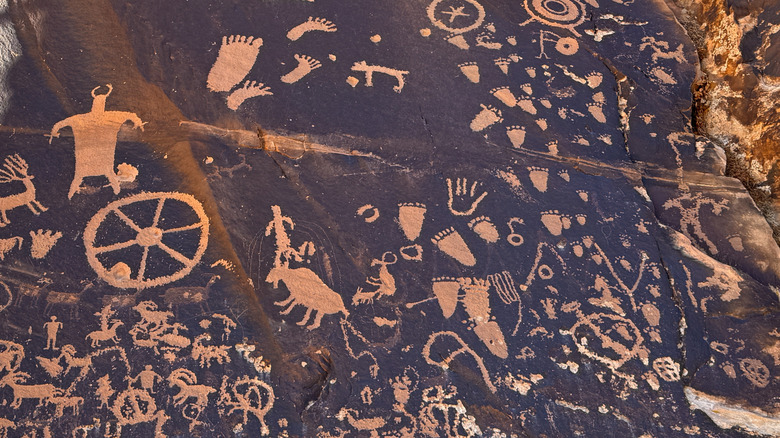
From the moment you see the 200-square-foot sandstone canvas, you'll understand how this monument got its name. A collection of over 650 animals, human figures, footprints, and patterns is etched into a giant sandstone rock face. While some of the art looks like it could have been carved yesterday, some of the petroglyphs date back 1,500 years. "The older art is attributed to the Basketmaker and Ancestral Puebloan people who inhabited this region from approximately 500 B.C. to 1350 A.D. The more recent petroglyphs (lighter in color) are attributed to the Ute people who still live in the Four Corners area," reads the Bureau of Land Management (BLM) website.
As one of the most photographed petroglyph collections in the U.S., you've likely seen pictures of the main panel. Despite its beauty, many visitors pass by Newspaper Rock on their way to the more famous buttes at Canyonlands National Park. For comparison, the national park boasts 9,100 Google Reviews, while Newspaper Rock has collected just over 1,000.
Newspaper Rock is a record of human history
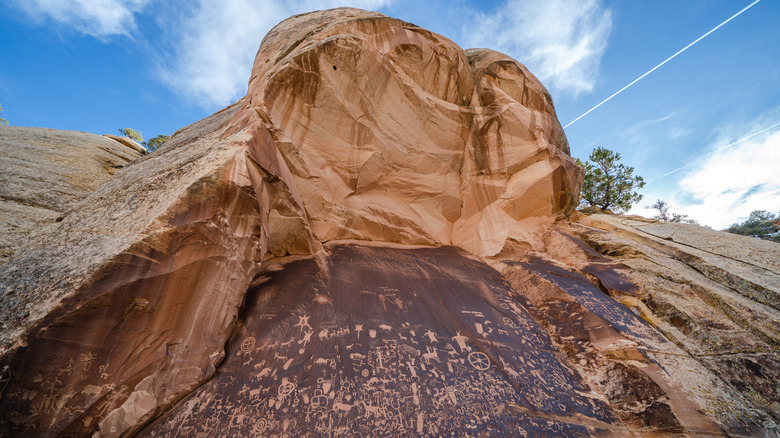
The carvings etched into the rust-colored sandstone are considered one of the largest petroglyph collections in the U.S., though their meanings are debated. However, it's the open-ended nature of the art that fascinates visitors. "Were they trying to tell a story? Warn others about invaders," asked an intrigued visitor on Google Reviews. "We'll never know the full meaning behind the drawings, but it is fascinating to take a few minutes to look and wonder."
Ancient artists created these symbols by scraping off the layer of desert varnish coating the sandstone. In geological terms, this coating is made of oxidized minerals, forming a much darker crust than the stone beneath. The contrast between the dark brown varnish and the beige carvings makes it easy to spot the six-toed feet and horned figures that intrigue alien hunters. Other images include hunters, snakes, bighorn sheep, elk, deer, other animals, and geometric shapes.
Due to its cultural significance, Newspaper Rock became a Utah State Historical Monument in 1961, joining the ranks of Rainbow Bridge, one of America's five longest natural bridges. These petroglyphs are so well-preserved that some visitors can't believe they're genuine. However, because the site is so accessible from the highway, acts of vandalism have occurred.
Planning your visit to Newspaper Rock
Situated in southeastern Utah, Newspaper Rock can be found within the bounds of the greater Bears Ears National Monument, which is part of the Indian Creek Special Recreation Management area. For anyone planning to experience Canyonlands National Park's unsung Southwest views, it's just off the 19-mile Indian Creek Corridor Scenic Byway, about half an hour from the Needles District Entrance.
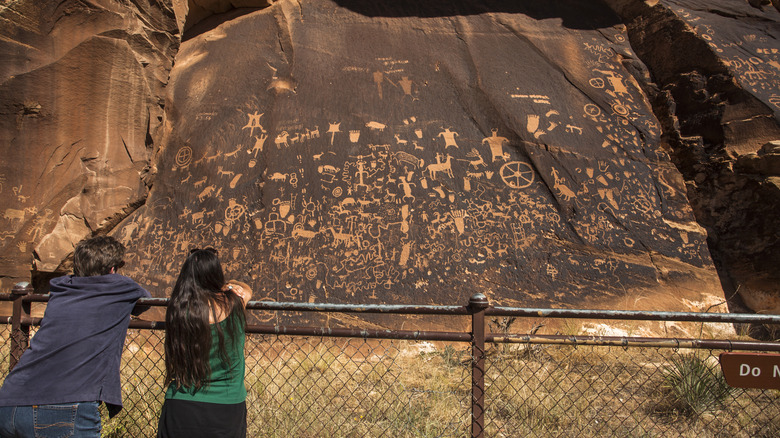
Visitors warn that the exit comes up quickly and is literally just off the highway. After parking in the paved lot, follow the signs for "Newspaper Rock Petroglyphs" until you find the short, flat path leading to the rock face. A small fence separates visitors from the panel, but you'll still be able to see the details clearly.
Like other BLM properties, such as the free campsites near Utah's "Mighty 5" national parks, the monument is free to enter. It's open year-round; however, the best time to visit is in the spring when Badlands mule-ears, Colorado four o'clock, prickly pears, and other wildflowers bloom across Bear Ears National Monument. Besides the bathroom (non-flush toilets only), Newspaper Rock has zero facilities, so you'll need to bring your own water — an essential during summer when temperatures can reach over 100 degrees Fahrenheit.