
Yellowstone's Geysers Are Doing A Lot More Than Just Attracting Tourists
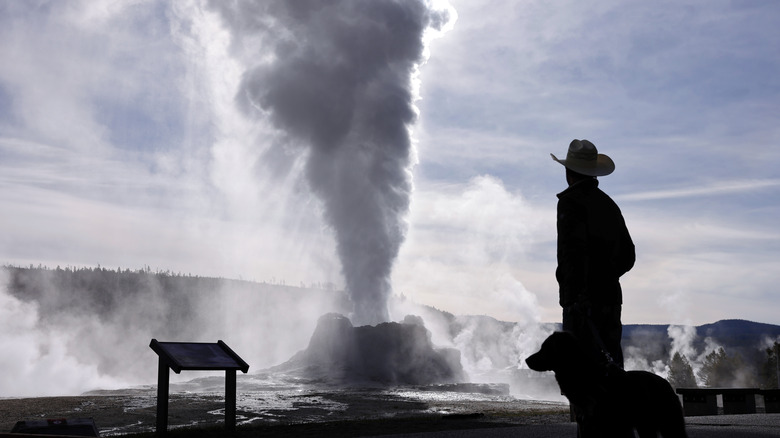
Yellowstone National Park is considered a national treasure. Not only is it the first national park ever established anywhere in the world, but it's also filled with an amazing array of natural features. Since opening in 1872, Yellowstone has drawn millions of visitors annually. Its attraction has not waned over the years, either. In fact, Yellowstone, boasting stunning natural beauty and roaming bison, was named among the best to visit in 2026. One of Yellowstone's more unique features is its many geysers, one of the park's biggest draws. However, Yellowstone's geysers don't just attract tourists. These hot water spouts also shape the landscape, contribute to the ecosystem, and, most importantly, keep the park itself from erupting.
The landscape of Yellowstone is strewn with over 10,000 hydrothermal features. Because of their explosive eruptions, geysers are the most dramatic of these elements, which also include hot springs and mud pots. There are more than 500 active geysers in Yellowstone, which is the highest concentration on Earth. The geysers in the park range from small, unnamed spouts to Steamboat Geyser, which is the world's largest, capable of spewing hot water as high as 400 feet in the air.
The fact that geysers are generally rare, yet are found in such abundance in Yellowstone, makes the park a particularly popular destination to witness such activity. The predictability and regularity with which some of Yellowstone's geysers erupt is also appealing to tourists. The famous Old Faithful is just one example of a regularly erupting geyser in the park. Regardless of size or regularity, all geysers in Yellowstone serve purposes beyond putting on a show for tourists.
Why geysers help keep Yellowstone National Park safe
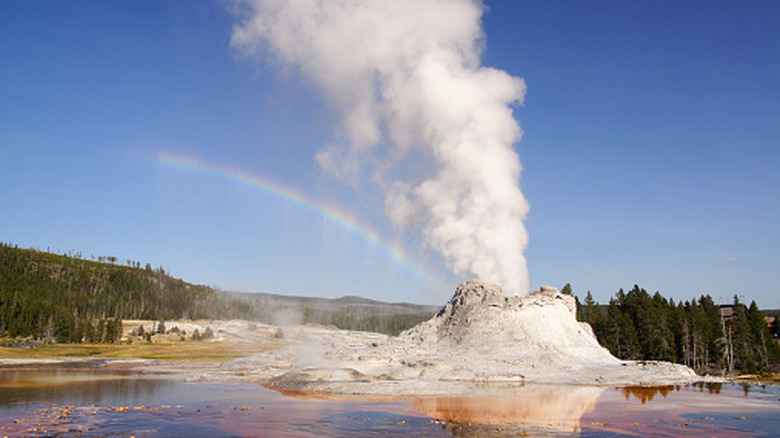
As impressive as geysers are to watch, the eruption of one is simply a visual indication the geyser is performing one of its most important tasks, which is to relieve heat and pressure from deep underground. The source of this heat is the magma flow of the Yellowstone volcano, which lies far beneath the Earth's surface. Dual magma chambers exist beneath Yellowstone Park. The smaller of the two, which is about 55 miles long, is located just 3 miles beneath the surface at its shallowest point. A second, much larger chamber, lies below it.
In this sense, geysers perform the task of a safety valve, allowing the heat and pressure to escape harmlessly into the air. All of the park's hydrothermal features work in conjunction with one another to perform this function. Water helps cool the layers of Earth between the magma flow and the surface. However, as the water becomes super heated, pressure begins to build. Steam vents, hot springs, mud pots, and geysers allow the heat and pressure to escape. Without these hydrothermal features, Yellowstone may more resemble Hawaii's Volcanoes National Park, with frequent eruptions and lava flows.
While all of these hydrothermal features play a role in releasing heat and pressure from beneath the surface, geysers do it in a more dramatic fashion. In fact, they have eruptions that are not unlike those of volcanoes. This is a result of a constriction in the channel leading to the geyser's vent. The size of the constriction as well as its location will determine the type of spray pattern a geyser expels. This can range from a narrow stream to a wide, misty spray and result in a geyser being classified as either a cone or fountain.
Why Yellowstone's geysers play an important ecological role
All plants and animals need water to survive. However, the water from Yellowstone's geysers is too hot and toxic to be suitable for drinking water. In fact, this water can actually be deadly to animals, including people, who come in contact with it. This is why avoiding caution around these geothermal features is one of the most upsetting tourist mistakes people make while visiting Yellowstone and an unwritten rule about Yellowstone that has cost some visitors their lives. Nonetheless, although it's not a source of hydration, the water from Yellowstone's geysers plays an important ecological role.
For starters, while the heat and toxicity are lethal to many larger animals, it's the perfect temperature for an entire array of microbes in these thermal pools. Classified as thermophiles, these microbes require the intensely heated conditions of this water, while extremophiles look for the acidic levels found here. Moving one step up the food chain, these microbes provide nutrition for a handful of insects that have adapted to the extreme environment of Yellowstone's geysers.
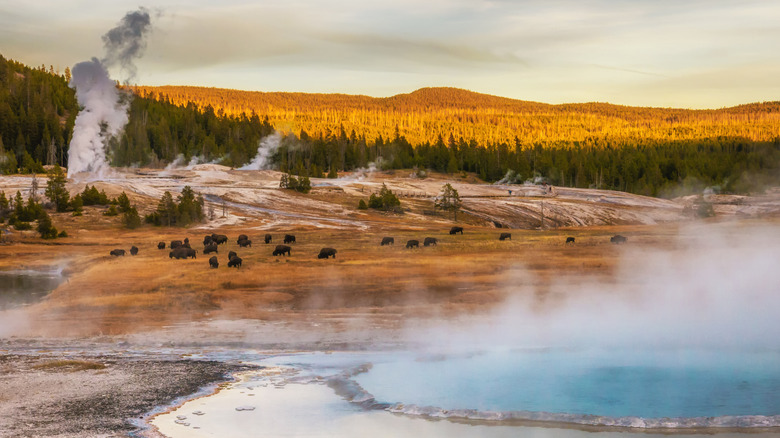
Larger creatures also benefit from the heated water spouting from Yellowstone's geysers. Some cold-blooded reptiles, such as garter snakes, utilize the hot water that flows from the geysers into nearby creeks and streams to regulate their body temperatures. Additionally, the geysers and other geothermal features allow for a number of grasses and plants to grow here that otherwise would not survive in a cold climate region. Because the hot water from geysers melts away snow, this vegetation remains exposed in the area around geysers and hot springs even during the winter months, allowing animals to graze and feed without having to root through deep snow drifts.