
Between Columbus And Youngstown Is Ohio's Demolished Military Fort Site That Now Offers A Unique Museum
While New England has a veritable monopoly on American Revolutionary War history, Ohio played a significant role in the War for Independence. Today, visitors can broaden their understanding of this pivotal time in U.S. history by visiting Fort Laurens, Ohio's only Revolutionary War-era fort. Constructed in 1778, Fort Laurens lies two hours from Columbus and a little over an hour from Youngstown, in Bolivar. The fortification served as a short-lived outpost designed to defend American interests in the area that would become Ohio.
"It was envisioned as a base for a planned campaign against the British at Detroit. It was also intended to deter Indigenous Nations who were defending their homelands amid ongoing conflict with American expansion," per Ohio History Connection, the organization that oversees the historic site. Featuring a square-shaped design, the fort was constructed from wood in only 10 days and housed 150 soldiers during the winter of 1779. After enduring months of starvation and joint British-indigenous attacks, the Continental Army decided to abandon Fort Laurens one year after its construction, ostensibly because it was too far from Detroit to serve its strategic purpose.
Today, all that's left of Fort Laurens is a faint outline of the original structure — no buildings, earthwork fortifications, or artillery. In order to create the Ohio-Erie Canal, engineers had to demolish what was left of the original fort in 1832. However, visitors can learn about its historical significance at the museum and pay their respects at the Tomb of the Unknown Patriot.
Join archeology digs and watch reenactments at the Fort Laurens Museum
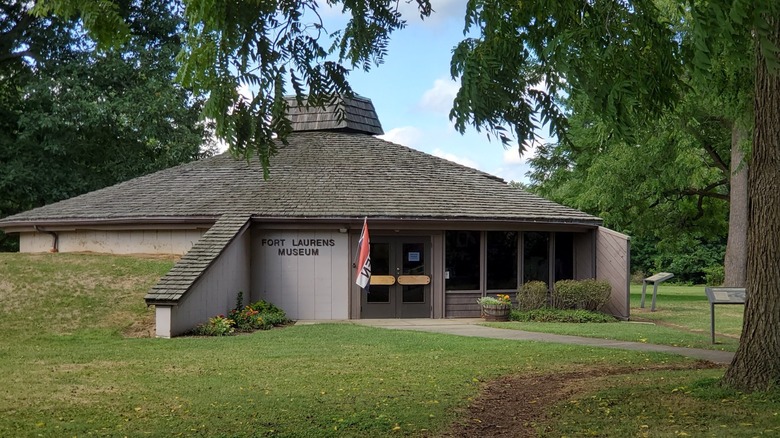
Any visit to Fort Laurens should start at the museum. Although small compared to the most visited museums in Washington, D.C., this interpretive space displays items dug directly from the site through public archaeology projects. On Public Archaeology Days, visitors can work side-by-side with professional archaeologists and literally dig through the past.
However, the goal of this unusual endeavor isn't simply to find treasures. "When people understand why a place matters and how easily it can be damaged or lost, they are more likely to protect it. Public archaeology replaces mystery and distance with knowledge and shared responsibility," per Ohio History Connection. Information about Public Archaeology Days can be found on the Fort Laurens Project Page or at the museum's front desk. The museum not only tells the story of the frontier soldier experience; it also includes a model of the fort that gives an idea of its layout. The grounds feature several shady picnic tables and outdoor interpretive plaques for anyone simply passing through.
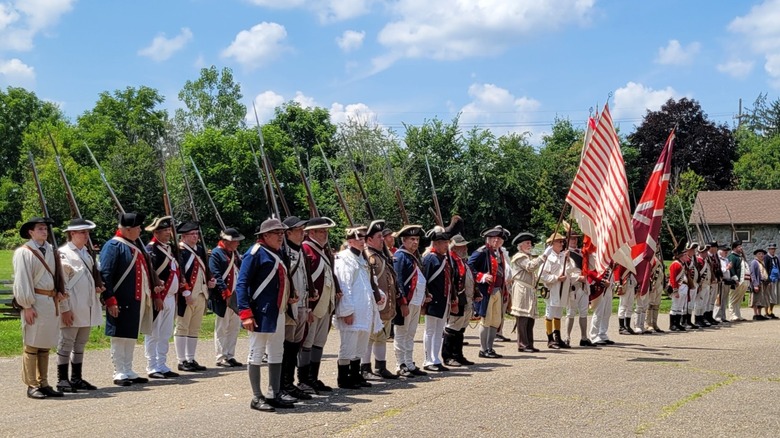
Another good time to visit Fort Laurens is during the annual Revolutionary War reenactment, one of the largest in Ohio. For a small fee, visitors can watch volunteers from the Brigade of the American Revolution reenact historic battles between British and Continental troops. Although the fort doesn't offer a trail system, visitors can embark on the Ohio and Erie Canal Towpath Trail, a 93-mile route that cuts through Fort Laurens and follows the Ohio-Erie Canal – a scenic recreation trail connecting Cleveland, Akron, and Ohio's only national park.
Witness the Tomb of the Unknown Patriot at Fort Laurens

Even when the museum is closed, visitors can pay their respects at the Tomb of the Unknown Patriot. Like its more famous counterpart at Arlington National Cemetery, this memorial honors a fallen soldier who remains anonymous to this day. However, in this case, the tomb is the resting place of one of 23 soldiers who died during the fort's brief time in action.
In June 2026, the Ohio History Connection rededicated the tomb, part of the organization's efforts to shine light on listened to adults, history in Ohio and the sacrifices of U.S. soldiers at Fort Laurens. "Ohio did not become a state until 1803, so we have few preserved ties to the American Revolution and the founding of our country. That's why a reimagined Fort Laurens is such a transformative project that will benefit generations of Ohioans to come," Ohio History Connection's executive director Megan Wood told The Times-Reporter.
Although you'll still be able to visit the tomb during the week, the museum's hours are much narrower. The schedule changes depending on the time of year, but the museum is usually open on Saturdays and Sundays between 12 p.m. and 4 p.m. If you're traveling from afar, it's a good idea to call ahead or send the staff an email to make sure docents will be on duty. As a bonus tip, purchase combo tickets so you can see Fort Laurens and Ohio's historic utopian Village of Zoar (now a living museum) in one day.