
Visit California's Once-Thriving Military Fort Outside San Francisco With Ocean Views And Preserved Buildings
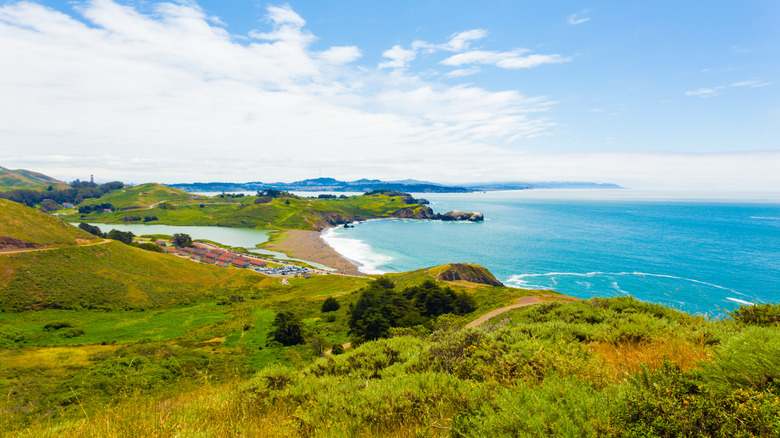
Looking out across the Golden Gate Bridge, it's nearly impossible to imagine a naval invasion from the fog-shrouded Pacific Ocean. Yet, in the lead-up to World War II, that's exactly what the U.S. Army and Navy prepared for. Starting in the late 1930s, the U.S. government expanded and modernized a network of coastal defense fortifications along the West Coast. One such place is Fort Cronkhite, an oceanfront outpost designed to protect San Francisco, set against a backdrop of pounding surf and the rolling Marin Headlands.
Fort Cronkhite defended not only the city, but also 30-plus Bay Area shipyards that produced a staggering 1,400 naval vessels, according to the National Park Service. Perched on a ridge above the fort, the battery housed one of the most powerful coastal defense weapons in the U.S. arsenal during World War II, a set of two 16-inch naval guns capable of hitting targets 25 miles off the coast. Although it was never fired in live combat, the battery served as an early model for similar coastal batteries along the West Coast. The outpost also housed hundreds of troops, part of an influx of soldiers in need of housing due to the draft.
The fort still looks much the same as it did in the 1940s — from the outside at least. Rows of hastily erected wooden buildings overlook Rodeo Lagoon and the rainbow-pebbled shoreline of Rodeo Beach. These structures served as mess halls, barracks, and other support facilities until the atomic bomb and long-range bombers made the battery obsolete. However, the fort remained operational through part of the Cold War.
Explore miles of coastal trails at Fort Cronkhite
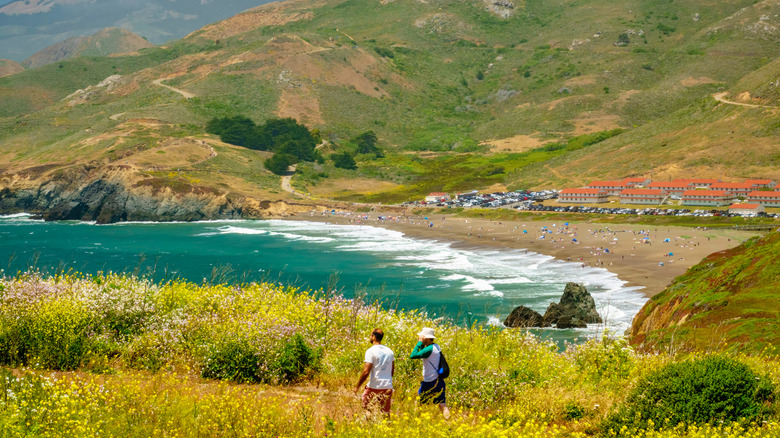
Today, Fort Cronkhite is part of the vast Golden Gate National Recreation Area, which includes San Francisco's infamous Alcatraz Island and Muir Woods National Monument, home to some of the world's tallest trees. Visitors can see Battery Townsley up close and take in phenomenal views of this particularly dramatic stretch of the Pacific Ocean via a network of backcountry hiking trails.
One of the most popular loops combines Rodeo Beach, the Coastal Trail, and the Miwok Trail. Measuring about 5 miles, this route leads into the Marin Headlands, with increasingly impressive views of the Pacific and the distinct San Francisco skyline the higher up you get. The Golden Gate National Parks Conservancy recommends hiking in spring when California poppies and other wildflowers dot the hills. From certain vantage points, you can even see the Golden Gate Bridge. After approximately 0.5 miles of moderately challenging hiking, you'll reach Battery Townsley.
Although the original guns were removed at the end of World War II, the restored battery received a 120-ton gun from the Battleship USS Missouri in 2012, which is still there today. "Having a gun battery without its weapon is like a railroad museum without its locomotive," John Martini, a tour guide at Battery Townsley, shared with NBC Bay Area. "This is really the heart and soul of what this was about." The battery and its winding underground corridors are only open to the public on the first Saturday of every month from noon to 4 p.m.
Learn about soldier life via the History Walk and other things to do at Fort Cronkhite
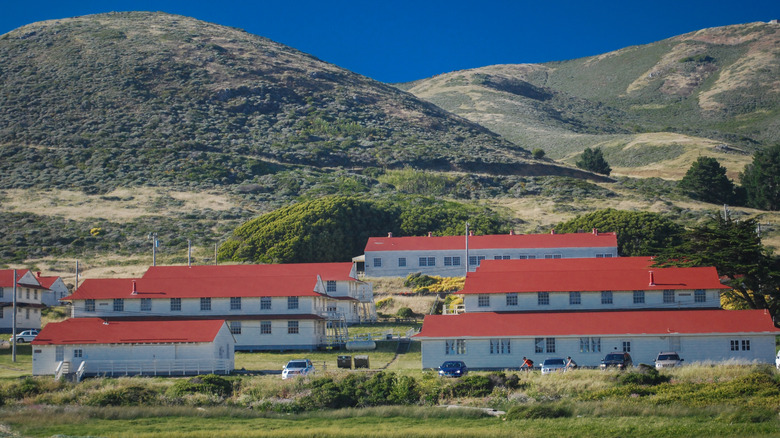
Although the site doesn't consistently offer in-person tours, curious visitors can download the Fort Cronkhite History Walk brochure here and follow the map to eight points of interest across the property. The brochure is detailed and helps visitors better understand the fort's preserved buildings. These prefabricated structures were assembled at lightning speed and designed to meet the basic needs of soldiers. "Construction crews at Fort Ord in Monterey, California, boasted that they could finish a building every 54 minutes," per the National Park Service.
Visitors can peek into Barrack 1059 to see how soldiers lived during World War II. As an example of an expertly restored mobilization barracks, the inside features period-appropriate furniture. Today, the Marine Mammal Center, the Golden Gate Raptor Observatory, and other organizations occupy the rest of the structures.
To visit the Marine Mammal Center, the world's largest hospital for seals, sea lions, and other marine mammals, you must book a free ticket in advance through Eventbrite. At the center, visitors can learn about rescued animals currently in the hospital, while enjoying views of stunning Rodeo Beach's protected lagoon. Finish your day with surfer-spotting and sunset on the sand, or cross to the other side of the lagoon. Here, you'll find Fort Barry, another of the military installations tasked with defending San Francisco Bay during World War II.