
6 German Beer Garden Rules American Tourists Break Within The First 10 Minutes
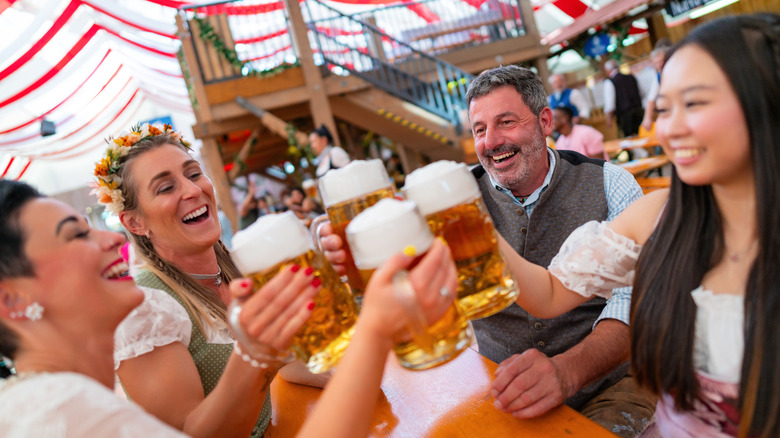
Germany is home to some truly stunning scenery, castles perched high above picturesque villages, world-class vehicles, and, of course, that golden nectar brewed with pride and precision: beer. When it comes to beer, Germans certainly know a thing or two. Not only are they experts when it comes to drinking it, but they're also pretty darn good at brewing it. And what better way to experience authentic Deutschland beer than at a traditional biergarten? As tourists, we all want to make sure we don't commit any cultural faux pas, but there are six beer garden rules that American tourists typically break within 10 minutes of entering.
Whether you enjoy a crisp pilsner, a malty dunkel, or an aromatic hefeweizen, Germany checks all the boxes when it comes to producing beers to suit anyone's palate. Steeped in tradition, most German brewing follows a method known as Reinheitsgebot, also known as the German or Bavarian Purity Law of 1516. This law stated that beer could be made with just three ingredients: hops, barley malt, and water (prior to allowing yeast) in order for it to be labeled a "pure" German beer. And just as precision-based as the production of beer is, so too are the rules surrounding drinking it, especially when it comes to public beer gardens.
Having been to Germany myself, I've frequented my fair share of beer gardens (let's call it market research). During my visits, I've seen plenty of rules being broken — enough to send a shiver down a German's spine. I may, or may not, have broken a few of them myself. From forgetting to return a beer mug and avoiding eye contact when clinking glasses, to seriously underestimating the powerful alcohol content of an über-strong doppelbock, I've learned a thing or two along the way. Prost!
Not knowing the difference between the self-service and full-service areas
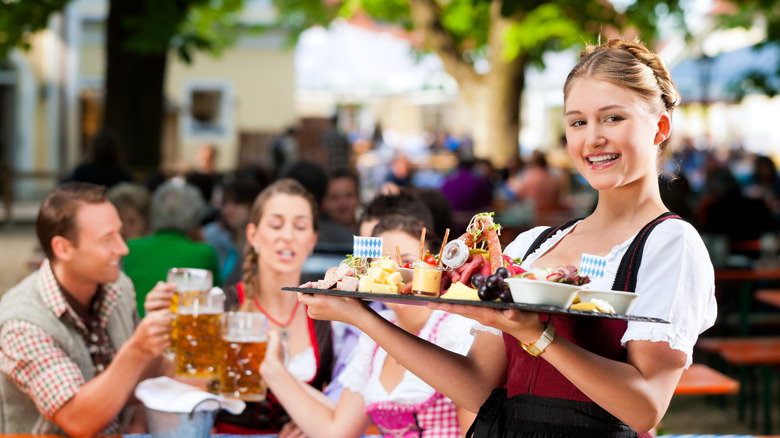
Some of the best destinations you can't skip on a trip to Germany boast beer gardens, and no trip is complete without visiting at least one. Among the rules that Americans tend to break, one is not knowing the difference between the full-service area of the beer garden and the self-service area. Both have beer, yet expectations surrounding the rules are vastly different. In the self-service area, patrons approach a stall, get the beer, and carry it back to their table. In Bavaria (the largest state in southern Germany), it's common for visitors to rinse out their mug with cold water before walking to the stall to fill their glass. This is especially true at Munich's iconic Hirschgarten, where you'll fill your maß (pronounced as "mahs") — a German stein holding 1 liter of beer.
In the full-service section, a member of the waitstaff will make their rounds to the table to ask for your order, then bring the drinks directly to you. Full-service also comes with higher prices, as well as tables sporting tablecloths, so keep those tips in your back pocket before deciding where to sit to enjoy your cold beer.
Not making eye contact when clinking glasses
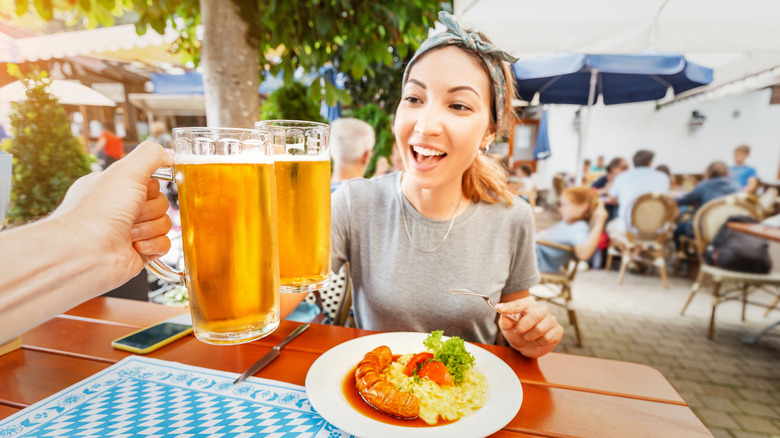
Speaking of German beer garden faux pas, this next one comes with some superstition. While we'd never want to spill a drop of beer when clinking glasses, there's another big no-no when raising a glass with your friend, or more importantly, a German. Whatever you do, don't skip eye contact while saying "cheers" or "prost." Legend has it that failing to make eye contact can bring bad luck, or worse, seven years of bad sex, confirmed by the Radeberger Gruppe, a leading German beer importer. Beyond the superstition, though, Germans consider it downright rude not to make eye contact before taking that first sip.
According to a blog post from Lingoda, the proper order of operations is: make eye contact, say "prost," take a sip. However, if you're drinking weissbier (wheat beer), the same protocol occurs, but with a final step of placing your beer down before taking a sip — the additional step is said to distribute any settled yeast in the beer. Seems simple enough, and the consequences are probably worth the two seconds of eye contact, just in case. However, if you've ordered a mug, it's also said that 10 clinks are needed for every liter, so if you've ordered a large beer, be prepared for a healthy dose of eye contact.
Getting way too drunk and causing a scene
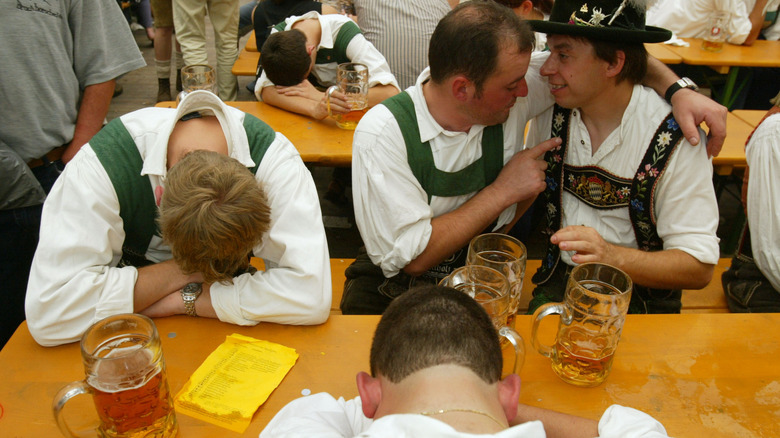
The alcohol content packed into those oversized German beer mugs can quickly lead to a red-faced moment — or, worse, public sickness. When comparing German beer with its American counterpart, the liquid gold from Deutschland often packs a much stronger punch, something many American visitors don't take into account.
Typically, beers served at German beer gardens range in variety and strength (as well as the season in some cases). For instance, a helles, served in many beer gardens, carries an alcohol by volume (ABV) content around 5%, whereas a beer garden serving festbier in the autumn, an ABV between 5.8% and 6.3% can be expected. A single maß is roughly the same as four standard American beers, so having more than one can quickly make its effects apparent. During Oktoberfest, many Americans (as well as other foreign tourists) have been known to pass out after overindulging. According to an article from The Guardian, local Germans even have a name for them: bierleichen, or beer corpses.
And while American visitors are sometimes associated with treating Oktoberfest like a rowdy, frat-party-style celebration, they aren't the only ones contributing to scenes of public drunkenness. The heavy drinking has led to numerous tourists requiring emergency medical attention for alcohol poisoning. Maybe instead of overindulging in beer, tourists should reach for more water, even though the habit often screams "American tourist" to Europeans. In this case, though, staying hydrated might not be such a bad idea.
Not understanding the concept of communal seating
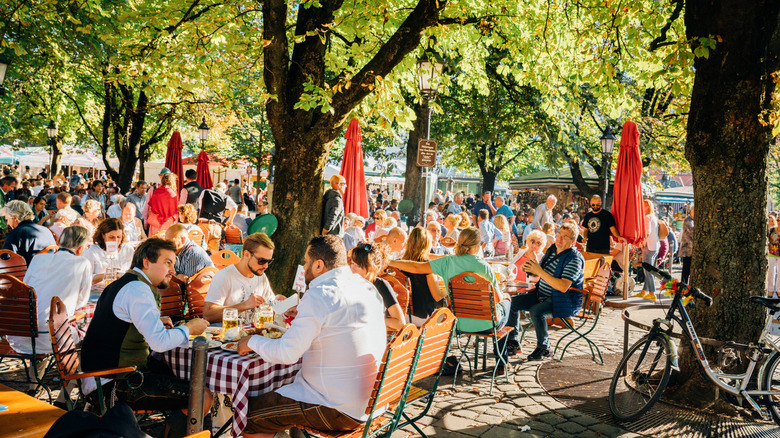
One of the greatest things I found about drinking in a Bavarian beer garden was the sense of friendliness shared by everyone gathered around. While you would typically be seated with only your family, friends, or even alone in the U.S., this doesn't happen at a German beer garden. Long wooden tables and chairs are meticulously lined side-by-side within the garden with locals mingling effortlessly with tourists all while enjoying a cold glass of beer. The atmosphere gives off a true sense of "gemütlichkeit," which represents the concept of coziness, friendliness, or warmth, and can be felt throughout Bavarian beer garden culture.
Many Americans might feel it could be rude to interrupt a group at a table, but coming from my personal experience, it's actually quite a nice way to interact with locals. Although you can experience your first authentic German beer garden experience at the airport, where's the fun in that? The next time you see a free seat, kindly ask, "Ist hier noch frei?" By asking if the seat is free, it opens up the opportunity to share stories, and perhaps get the locals' insider tips on where to find the best schnitzel in town. Beer gardens are meant to be social and interactive public places, and what better way to enjoy them than with locals.
Accidentally taking a seat at a reserved table
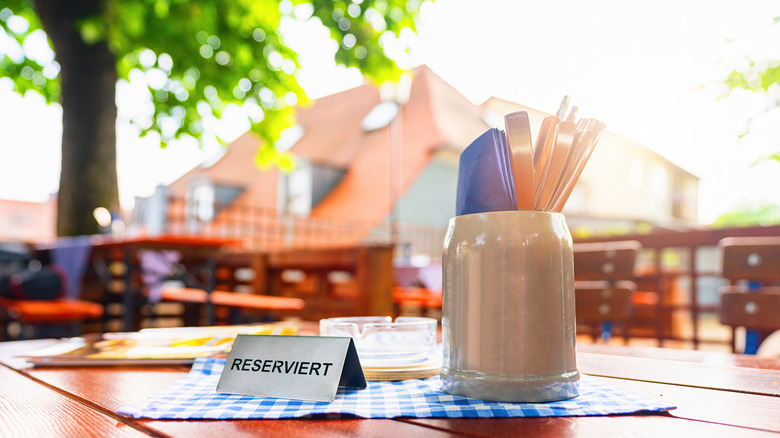
When it comes to my own beer garden faux pas, this next one happened to me almost immediately. As mentioned earlier, communal tables are a staple of Bavarian beer gardens, but I quickly learned that accidentally sitting at a reserved table is an easy mistake for tourists to make. During my time in Munich, I headed to a beer garden hoping to enjoy some local beer and immerse myself in Bavarian culture. When I arrived at the beer garden, I spotted an empty table and sat down, only to wonder why I wasn't being served.
It turns out I had unknowingly taken a seat at a reserved table, completely missing the small "reserviert" sign. The waiter kindly pointed out my mistake and directed me to a communal table instead. Although it was an innocent mistake, it is a common one that can be made by tourists within minutes of entering a beer garden. In some cases, tables with signs saying, "stammtisch," are typically reserved for local regulars or clubs that frequent the beer garden or establishment. Now that's dedication to the German beer-drinking tradition if we've heard of one.
Not knowing if outside food is permitted in the beer garden
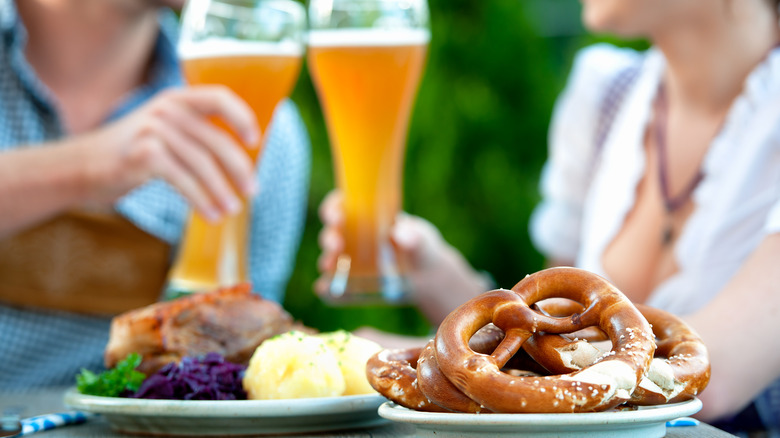
When it comes down to food inside the beer garden, choices are hearty, tasty, and traditional. From pretzels and bratwurst to crispy pork knuckle and savory potato salad, you definitely won't go hungry in a German beer garden. In Bavarian beer gardens specifically, there is a rule called the Bayerische Biergartenverordnung (a mouthful in itself) or the Bavarian Beer Garden Ordinance. Within the self-service area of the beer garden only, traditionally speaking, outside food can join you in your German beer-drinking quest. One Redditor further clarifies, "If you notice servers, menus, and tables with napkins and cutlery, then that's a Wirtshaus and you cannot bring [food]."
In the full-service area, outdoor food is strictly prohibited, and don't even think about ordering any food to bring in, as it could have you removed from the establishment entirely. Keep in mind that bringing your own food isn't permitted in every beer garden in the country. If you're ever unsure of what is and isn't allowed, most beer gardens typically post "house rules" for patrons to read before entering. This way you'll avoid committing a German beer garden mistake.