
Tucked Away In Crater Lake National Park Is A Scenic Drive Highlighting Some Of Oregon's Highest Mountain Peaks
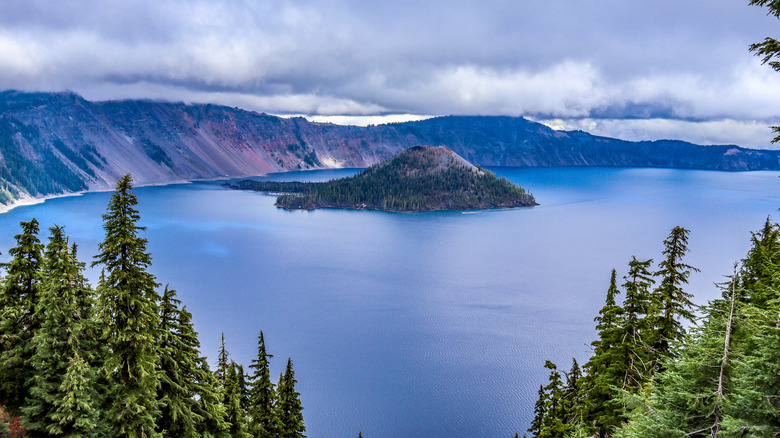
The United States has no shortage of gorgeous national parks, but Crater Lake National Park is easily one of the most striking. Located in southern Oregon, the park's starring attraction is Crater Lake, a massive body of water cradled in the tip of a collapsed volcano. Plunging to a depth of 1,943 feet, it's the United States' deepest lake, as well as the world's seventh-deepest lake. Sheer slopes and cliffs ring a circular lake of dazzling sky-blue, which comes with its own private islands. While visitors can easily admire the vista from scenic viewpoints and hiking trails, the Scenic Rim Drive is the best way to fully take in this marvel.
The Scenic Rim Drive runs around the rim of Crater Lake in a 33-mile loop, linking 30 different viewpoints around the caldera, as well as accessing trailheads, picnic areas, parking, and other points of interest. In order not to detract from the views, the road — which is part of the Volcanic Legacy Scenic Byway — was specifically designed to blend in with the surroundings by flowing with the terrain instead of cutting through it. Not only does this mean the views feel untouched by human hands, but there's also less disruption to local habitats.
There are two main ways to access the Rim Drive: the North Entrance and the southern entrance from Highway 62. Since this two-way road runs in a circle, either entry point works fine; however, arriving from Highway 62 gives you the chance to stop at the park visitor center before setting off. The entire drive takes around two hours, but you'll likely want to devote more time for pausing at overlooks or trying hikes. Making time for hikes is an especially good idea, as trails leading up hills and mountains around the lake offer views of some of the tallest peaks in Oregon.
Scenic views and mountain peaks await along Crater Lake's Rim Drive
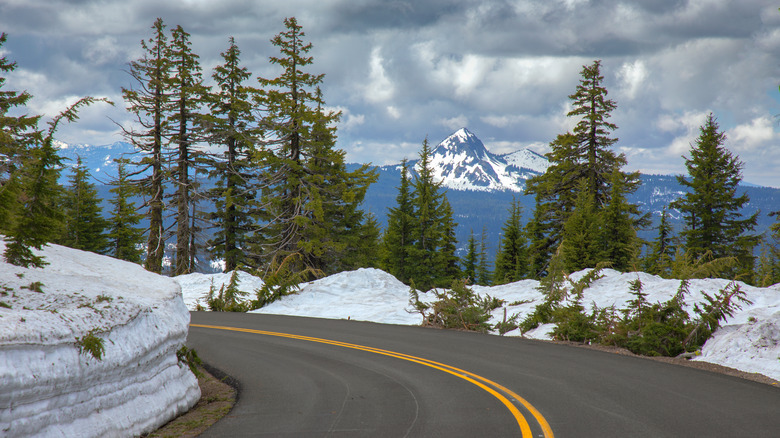
By circumnavigating the lake, the Scenic Rim Drive allows drivers to appreciate Crater Lake's various landmarks from different angles. Viewpoints along the southern and western rim offer closer looks at the lake's islands, while the northern and eastern sides have more long-range perspectives.
The Watchman stop on the western rim is an especially popular spot thanks to its observation tower atop Watchman Peak. From panoramic windows and outdoor terraces, visitors are treated to unobstructed lake and wood vistas. Here, you'll also get a front-row view of Wizard Island, a cinder cone that is one of Crater Lake's most recognizable landmarks. The Phantom Ship Overlook is another popular one, as it looks out over the tiny, spire-covered Phantom Ship island, which contains an over-400,000-year-old rock that's the oldest in the basin. Cloudcap Overlook, the Sinnott Memorial, the Rim Village, and the Crater Lake Lodge area are also noteworthy photo-op stops. Keep your eyes peeled for the Old Man, an over-450-year-old floating mountain hemlock log that bobs around the lake.
When your eyes aren't glued to the glassy lake surface below, look up at the horizon to see some of the state's highest peaks. At nearly 9,000 feet, Mount Scott is the park's tallest peak, and the 10th highest in the Oregon Cascades. A challenging 4.4-mile out-and-back trail heads up the summit, which delivers one of the best views across the lake. On clear days, you can also catch glimpses of Mount Shasta in California and other Cascade peaks like Mount McLoughlin — which is the tallest peak in southern Oregon at 9,493 feet —as well as the 9,182-foot Mount Thielsen. With its steepled peak, Thielsen is often referred to as the "lightning rod of the Cascades," making it easy to pick out along the skyline. Garfield Peak is another lofty summit at 8,060 feet, as are the 8,126-foot Applegate Peak and the 8,156-foot Hillman Peak.
What to know before driving Crater Lake's Scenic Rim Drive
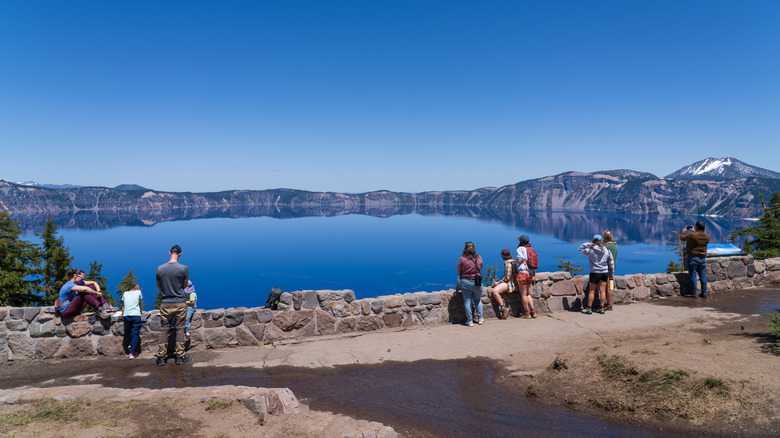
Getting to the Scenic Rim Drive is a lengthy drive in and of itself, requiring a two-hour trip from the artsy city of Medford or driving 2 hours, 45 minutes from Eugene, one of the Pacific Northwest's coolest college towns. Both cities have regional airports — the Rogue Valley International Medford Airport (MFR) and the Eugene Airport (EUG), respectively — which are accessible from bigger hubs like Portland. An entry fee or national park pass is needed to enter the park. Once on the Rim Drive, follow the posted speed limit of 35 miles per hour or less. This is for your own safety, as well as that of cyclists and pedestrians, as the route has no shoulders and is quite narrow. If you don't want to drive, trolley tours are available. If you plan on hiking, be sure to pack proper attire; using the correct outdoor gear is an essential rule for visiting the Pacific Northwest.
While Crater Lake National Park is open year-round, that isn't true of the Rim Drive. Crater Lake gets an average snowfall of 41 feet, so the East and West portions of the Rim Drive, as well as the North Entrance Road, close to cars during the winter. The closure starts on November 1 or when the first big snow comes. However, you can still get into the park via the plowed Highway 62 entrance. Exact reopening dates vary based on snowmelt, but sections generally start reopening in May. Additionally, sections may also close due to inclement weather, maintenance work, the annual Ride the Rim cycling event, or debris like rockfalls. For the most up-to-date details on openings and closures along the Rim Drive, check the National Park Service Alerts and Conditions page before visiting.