
This Popular Electronic Charging Device Will Get New Restrictions On Airplanes Starting In 2027
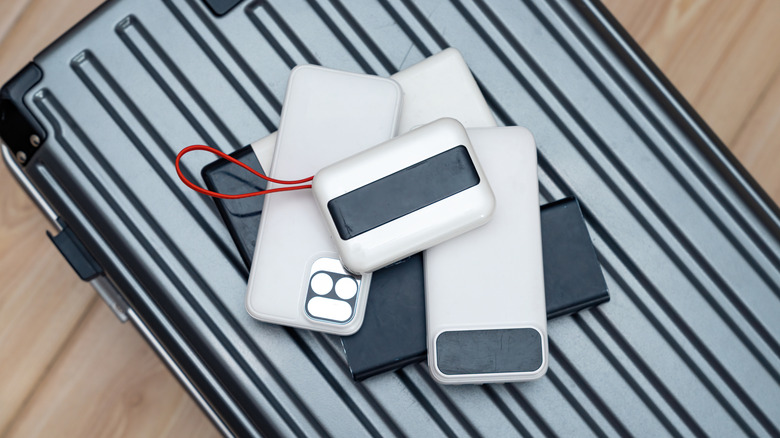
To help keep everyone safe, there are limits to what you can do and bring on a plane. To that end, there is new guidance when it comes to power banks and portable chargers with lithium-ion batteries, which will likely lead to airlines restricting use of the devices. The International Air Transport Association (IATA) has issued an update for its annual Dangerous Goods Regulations (DGR) in regards to lithium-ion battery chargers. Some of the new guidance, which is to go into effect January 1, 2027, will "limit passengers (and crew) to two power banks for personal use" and "prohibit passengers [from] recharging the power bank in flight." Most airlines already have these power bank restrictions in place, but the biggest change for travelers is the new IATA recommendation that power banks "should not be used to recharge a portable electronic device while onboard the aircraft."
Airlines are not required to follow IATA guidelines, but most create restrictions based on the association's recommendations. Some airlines, like Delta, have asked passengers not to charge devices with a power bank during taxi, takeoff, and landing. However, there hasn't yet been a ban on using them to charge once you've received cruising altitude, like the one the IATA is recommending.
Lithium-ion batteries may seem fine, and that's true when they're working properly. However, they can experience "thermal runaway," which is when the device becomes uncontrollably hot. This can happen because of manufacturing problems, extreme temperatures, external damage, or overcharging. A fire can break out incredibly quickly during a thermal runaway event, and there have been theories that TSA could ban lithium-ion battery powered items for this reason. In 2025, there were, on average, more than two thermal runaway incidents per week on a plane, according to a UL Standards & Engagement report.
Rules about power banks depend on the airline
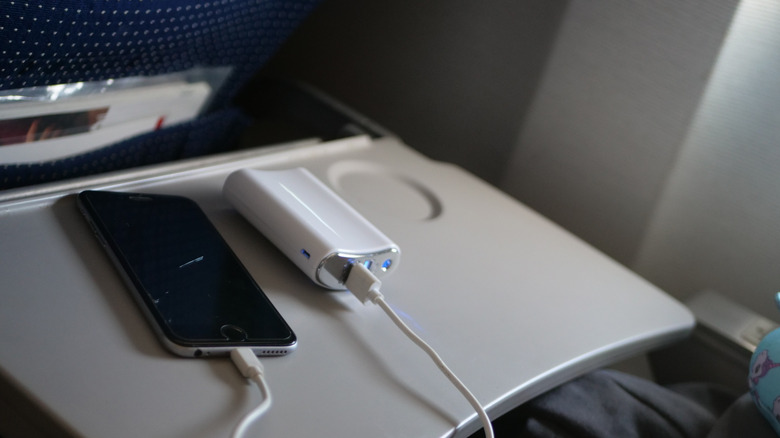
Officially, the updated IATA guidance against using power banks to charge other devices in flight hasn't been fully adopted yet. But it may just be a matter of time, considering many airlines have policies in place that match other IATA guidelines. However, it's likely that passengers may not know about all the policies already in place.
IATA data from 2025 (via Focus on Travel News) confirmed that 45% of passengers didn't realize that power banks are one of the things that you can't pack in your checked bag. Beyond keeping them in your carry-on, most U.S. airlines, like United, Southwest, American Airlines, and Delta, ask that passengers keep them accessible by their seat or in their personal item and not in the overhead bin. IATA also discovered that only 33% of passengers knew that there were capacity limits to power banks that could be on board — 100Wh. If you have multiple chargers, the total cannot exceed this limit either. American Airlines, Delta, and United only allow two power banks per passenger, while Southwest Airlines limits them to one. Plus, portable chargers shouldn't be stored together or loose at the bottom of your bag. Put them in individual cases or bags to help prevent them from short-circuiting.
If you're someone who likes "raw dogging" a flight, a trend where you literally don't do anything on board to entertain yourself, not being able to charge a device with your power bank probably won't impact you that much. But for many of us, we'll have to hope we're on a plane with built-in charging ports at the seats if or when airlines adopt this IATA guidance.