
5 Popular Kids' Toys That Could Be Confiscated Before Boarding A Plane
Flying with kids in tow is already a stressful situation for most parents. There's food and essentials like wet wipes and sanitizer to pack, and you have to herd easily distracted kids through security and somehow keep them entertained for hours in a cramped tin in the sky. Naturally, most parents turn to toys and other forms of entertainment to mitigate the constant stream of "Are we there yet?" and "I'm bored." However, those very toys could be confiscated before you even reach your gate.
Travelers have long bemoaned the TSA's sometimes arbitrary implementation of its own rules. You could have taken hundreds of flights with no issue, and then suddenly you'll get pulled aside for extra screening for an item you've always carried. Because the decision to prohibit certain items rests with the TSA officer on duty, it can be difficult to determine which of your kids' toys will be allowed on board and which ones won't. Some toys could land you in trouble because the TSA has hard rules against carrying them, while others are technically allowed but could subject you to extra scrutiny.
To create an accurate list of toys that could be confiscated before you board the plane, we've looked through news stories and firsthand accounts on social media or forums, and drawn on personal experience to provide real instances in which kids' toys have been taken away or subjected the family to extra security screenings. We also looked through the TSA's "What Can I Bring?" page to find out which toys are explicitly banned and which ones may require additional security screening. Keep this list handy so you know what to pack and what to leave behind for a stress-free trip with your kids!
Toys that resemble weapons
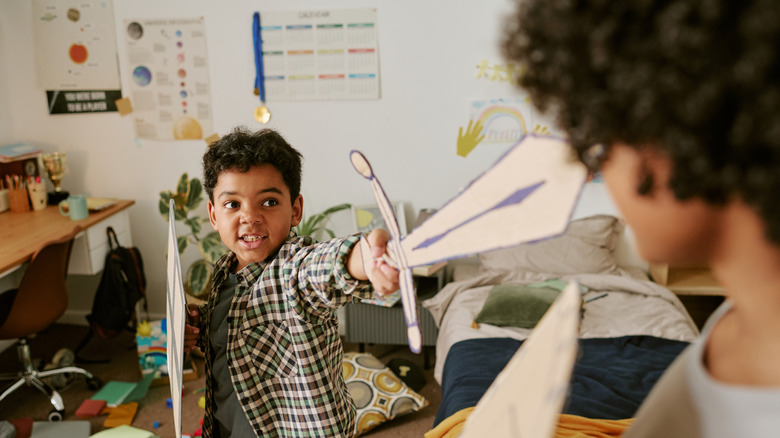
With the TSA coming into existence because of threats to national security, it's understandable that the agency takes the presence of weapons very seriously — even when they're not actual weapons. Multiple confirmed instances show passengers having completely harmless toys confiscated because they resembled weapons, even though closer inspection proved they were just playthings. In 2013, a woman carrying a sock monkey outfitted with a fake, 2-inch gun was shocked when the TSA agent insisted on disarming the toy before allowing her through security (via NBC News). When the passenger pointed out that it was clearly a toy, the TSA agent said that toy guns could be threatening, and the agency reportedly echoed this in a statement. Two years later, a Pennsylvania family faced an even more bizarre situation when their 5-year-old's Buzz Lightyear flip grip — a plastic toy with a claw at the end – was seized by the TSA for resembling a weapon (via CBS News).
Toy guns and foam swords are generally allowed in checked luggage but not in carry-ons, although very realistic toy weapons may be subject to extra security screenings, even if checked in. In the Pennsylvania family's case, the agent reportedly suggested they check in the toy, but the family couldn't take that option because they had only packed carry-on luggage. Realistic replicas of explosives are not allowed on the plane, full stop. On its website, the TSA suggests checking in toy weapons to avoid issues and reminds passengers that "TSA officers have the discretion to prohibit any item through the screening checkpoint if they believe it poses a security threat."
Liquid- or gel-filled toys
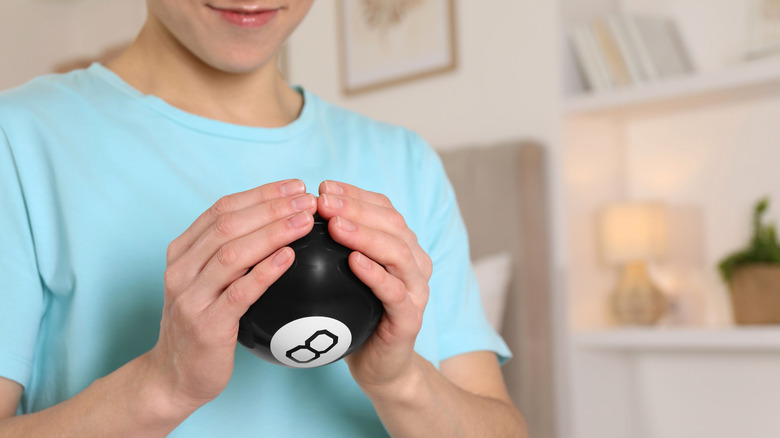
The TSA's 3-1-1 liquids rule is notorious for tripping up travelers, and unfortunately, some people have had to learn the hard way that the TSA's new, and somewhat funny, list of prohibited items also includes a few popular kids' toys. A Redditor recalls having their Magic 8 Ball confiscated, while a post shared on Instagram humorously details a similar incident. Apparently, liquid-filled toys like Magic 8 Balls, snow globes, and glow sticks aren't on the list of exemptions for TSA's 3-1-1 rule.
But that's not all. The TSA also routinely confiscates popular NeeDoh toys from carry-on luggage. These squishy sensory toys are available in an array of colors, filled with a high-viscosity gel that squeezes and stretches when you apply pressure to it. Despite the gel's thickness, it still falls under the TSA's liquid restrictions, so toys that exceed the limit are likely to be confiscated. According to a post on the TSA's Facebook page, the agency also classifies slime — another popular kids' toy category — as a liquid and reminds parents that it's only allowed in carry-on luggage if in containers of 3.4 ounces or less.
The TSA's 3-1-1 liquids rule only applies to carry-on luggage, so these issues have a simple fix: Pack the toys in your checked luggage. If your children use items like NeeDoh and slime as more of a therapeutic tool, check if they're comfortable with fidget spinners or regular stuffed toys instead, as both items are allowed in carry-on luggage.
Remote-controlled toys
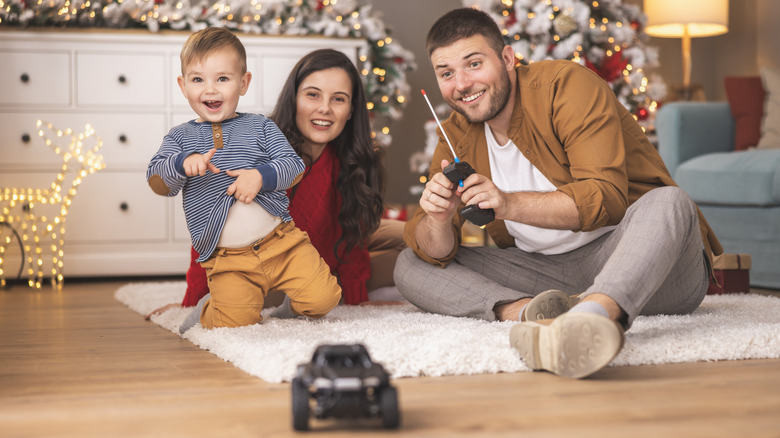
Remote-controlled cars, planes, and helicopters have always been a favorite among kids. They've also seen a resurgence among adult hobbyists, with entire communities built around high-quality remote-controlled cars and car races. According to Market Reports World, about 180 million to 220 million such toys are shipped each year, and at least 62% of American households with children aged between 3 and 12 years buy at least one remote-controlled toy every year.
With remote-controlled toys like cars and drones, you never know how the TSA will react. In its "What Can I Bring?" resource, the agency explicitly allows remote-controlled cars in either checked or carry-on luggage, although it advises travelers to pack fragile electronic items in carry-on luggage. However, the agency has ramped up security for remote-controlled toys before, such as when it started scrutinizing these toys in 2007 following "credible specific information" that the toys could potentially be used in terror plots, according to the Los Angeles Daily News. While toy cars are rarely subjected to additional scrutiny now, flight-based remote-controlled toys may require extra screening. Additionally, if your kids play with drones, the TSA advises checking with the airline for its specific policies before packing.
Because these toys sit in somewhat of an iffy gray area, it can be difficult to know how to pack. However, we recommend placing everything that might require extra screening in one bag to make it easier to go through TSA as a family. This makes navigating the airport's long security lines with children, multiple bags, and potential extra screenings a much simpler affair.
Toys with lithium batteries
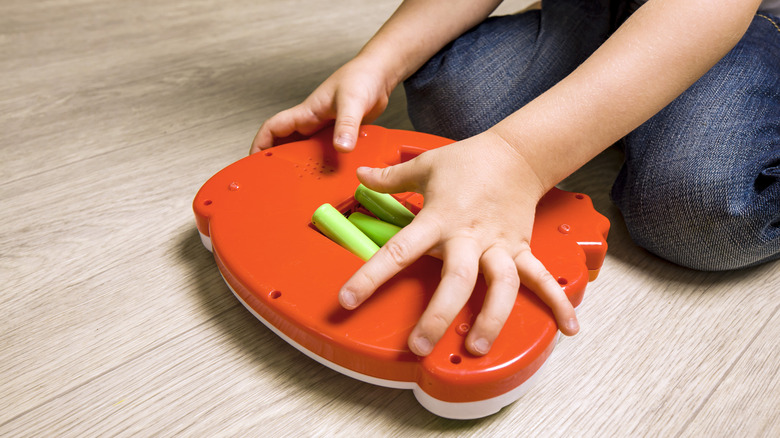
In 2025, I was traveling with family for my nephew's birthday. I picked up one of those rechargeable, portable karaoke mic-and-speaker toys for his birthday gift, and realized only at the airport check-in counter that I'd completely forgotten to identify the type of battery in the toy. After a brief discussion with the check-in staff, they told me to put it in my carry-on, and I had to go through an additional bag check at security.
Lithium-ion and lithium metal batteries are prone to overheating and catching fire, which is why the TSA and FAA strictly prohibit checking in items with uninstalled (aka loose) batteries, like power banks. While carrying them with you doesn't exactly reduce the risk of battery fires, flight attendants are trained to handle these fires. So, if the electronic device in question is in the cabin, they can respond before it becomes a full-fledged fire, while checked-in batteries could smolder away in the luggage compartment unnoticed. Following several instances of lithium batteries catching fire on board, airlines are also introducing new restrictions on power banks, and many popular carriers — like Delta and United Airlines — now prohibit passengers from stowing power banks in overhead compartments. Although it isn't explicitly stated, similar restrictions could apply to toys with lithium batteries.
So, before you pack a handheld game to distract your kids during the flight or toys to gift your family, check whether they have installed or uninstalled lithium batteries. If they're uninstalled, they must go in carry-on luggage, and the bag must go on your lap or under the seat in front of you. In my case, I later learned that the karaoke toy contained installed lithium batteries, which are allowed in checked luggage if the device is completely powered off.
Weighted stuffed animals
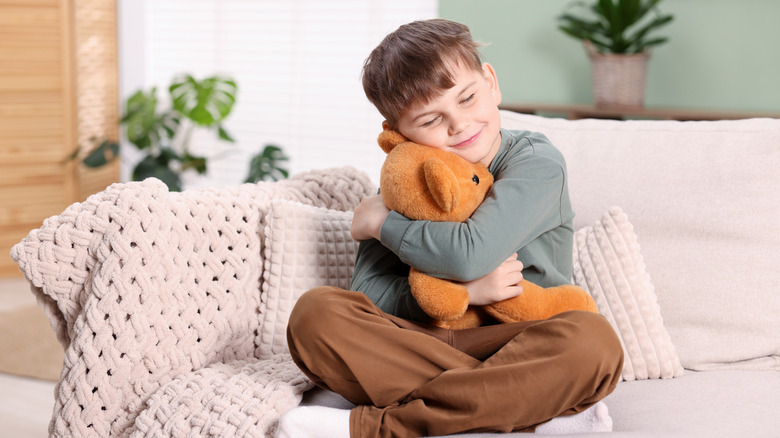
While the TSA allows regular stuffed animals in checked or carry-on luggage, the "What Can I Bring?" page doesn't have any guidelines specifically concerning weighted stuffed toys. However, as a Florida family found out the hard way, TSA may confiscate weighted stuffed animals if agents are unsure of which materials are used in the toy.
Weighted stuffed animals have gained popularity thanks to increased awareness of therapeutic tools for children and adults with autism or sensory processing disorders. According to Dataintelo, the weighted stuffed animal market was valued at $1.4 billion in 2025 and is expected to double by 2034. For parents traveling with anxious or restless children, these toys could be a game-changer. However, the problem lies in the stuffing. Many weighted toys use heavier beads — usually made of steel, glass, or a dense plastic — to provide that comforting weight. TSA agents have reported that the beads can look unusual under an X-ray, and if they're not satisfied with a visual inspection, they may either confiscate the toy or cut it open to examine the inside.
The biggest problem is the uncertainty, as there doesn't seem to be a universally applied standard regarding these toys. If your kids don't need weighted toys for emotional support, then the easy fix is to check the stuffed animals and take them back out at your destination. However, one Redditor says they were able to make multiple flights with their weighted stuffed bear by putting the toy in a separate bin for the X-ray and giving the agents a heads-up that the toy is weighted. They also recommend telling the agents what material the beads are and where they can open the toy to inspect it (if it has an opening).