
Forget California, Canada's Breathtaking Island Park Has Ancient Groves Of Show-Stopping Trees
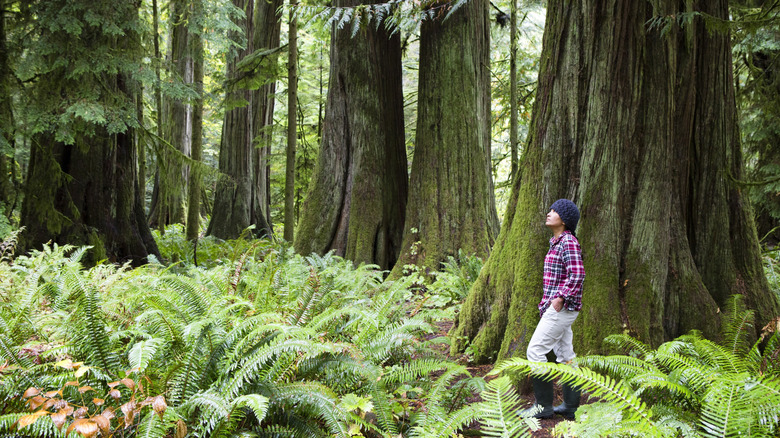
California's forests are the stuff of legends and fantasy novels. Giant sequoias stand sentry above the Sierra Nevada Mountains' canopy, while coastal redwoods form fairy rings and vast stretches of ethereal woods along the Northern California coast. And, while there's no denying the wonder inspired by these giants, an ancient forest of an entirely different kind can be found within a roadside park on Vancouver Island, in British Columbia, Canada.
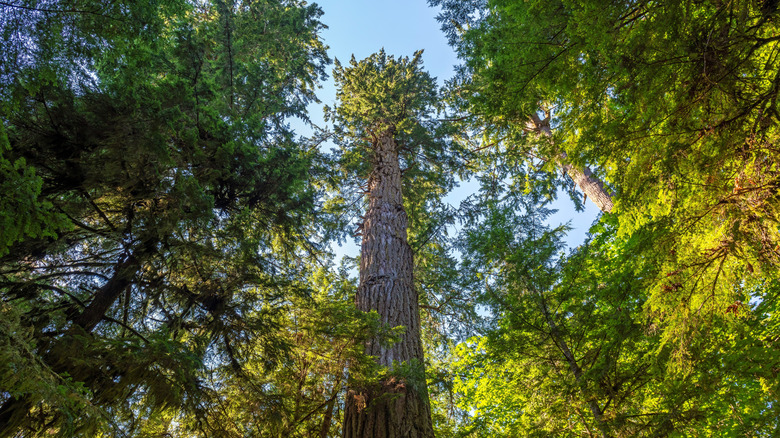
MacMillan Provincial Park hides Cathedral Grove, a stand of old-growth coastal Douglas firs that have been climbing to the sky for over 800 years. These coastal evergreens are one of two types of Douglas firs and grow from California into Canada. From the moment you enter the park, it's easy to see why provincial governors called this place a cathedral. Moss-covered giants tower over the walking trails, their duff a carpet for ferns and other lush plants that give the forest a primordial feel. Many of these trees reach over 250 feet, and the widest trunk measures almost 30 feet around. Here, visitors can stroll, take photographs, look for birds and other wildlife, or simply soak up the grove's beauty.
MacMillan Provincial Park is located on central Vancouver Island and has been voted B.C.'s best roadside attraction by CBC News thanks to its location just off Highway 4. It's about 2.5 hours from Victoria, making it a destination for a long day trip. However, if you're coming from another province or the U.S., you'll likely fly into Vancouver International Airport (YVR), which is several hours from the park.
Get to know MacMillan Provincial Park's ancient trees
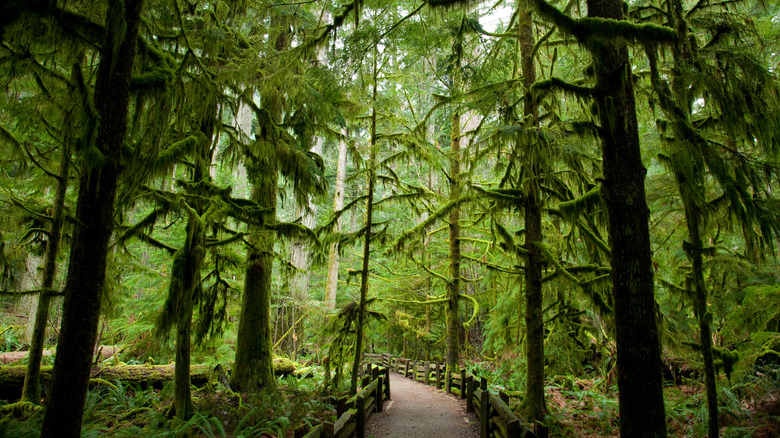
MacMillan Provincial Park features a collection of walking trails that loop through the trees. Most are flat, so you can soak in the atmosphere while pushing a stroller or walking with a multi-generational family. The highway cuts right through the old-growth forest, making it a convenient stop for anyone heading to Port Alberni, Canada's "ultimate fishing town." Visitors don't consider the highway hum particularly disruptive, but warn fellow hikers to be very careful crossing from one side of the park to the other.
On the south side, the gravel trails lead through the Douglas firs, including a tree so massive a small family wouldn't be able to link arms around it. The north side boasts a wooden boardwalk through a western red cedar forest, and passes by Cameron Lake's calm waters. The northern area is usually the quieter of the two, but you should expect a fair amount of tree admirers on both sides. Visitors say you should plan to spend at least 45 minutes in the park or possibly longer, depending on how often you stop to take photos.
These trees are just a small portion of the huge old-growth forests that once covered much of British Columbia. The Ancient Forest Alliance estimates that only 0.3% of British Columbia's forests are made up of the type of massive, truly old trees found at Cathedral Grove. Although not guaranteed, visitors have the chance to spot owls, woodpeckers, deer, and other animals that call these forests home.
When to visit Cathedral Grove at MacMillan Provincial Park
There is no bad time to experience MacMillan Provincial Park, but each season offers a different experience. Cathedral Grove is part of a temperate rainforest, which means temperatures remain mild and up to 200 inches of rain drench the land every year. As can be expected, the winters are especially wet at MacMillan, draping the canopies in mist and covering the forest in sound-dampening moss. Visitors need to wear water-resistant shoes that they don't mind getting muddy and prepare for possibly snowy conditions on Highway 4.
When temperatures are warm in summer, explorers come in droves to cool off beneath the trees and experience the canopy with less mud. Visitors recommend coming early in the morning to find a parking spot, but warn others to still expect crowds. This is also a great time of year to extend your road trip with a stop at one of Canada's little-known coastline getaways like the Parksville Qualicum Beach area.
Many visitors consider spring and fall the best times to visit because the forest is still impossibly vibrant while the summer crowds haven't arrived. Between September and November, non-evergreens in the forest canopy put on a show of fall colors, while wildflowers start to bloom between March and May. Looking for your next forest adventure? Stand in awe of the Cheewhat Giant, Canada's largest tree, nestled in Pacific Rim National Park Reserve.