
Congaree National Park's Scenic Boardwalk Through An Old-Growth Forest
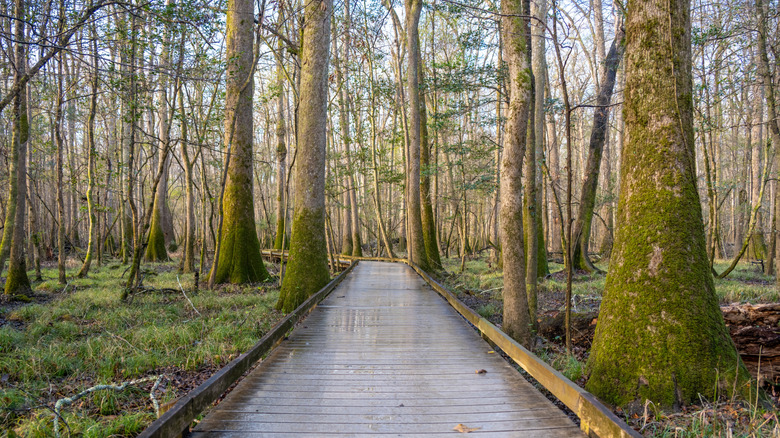
Not every national park in the United States will have the immediately awe-inspiring scenery of the Grand Canyon or Yosemite. Though America's most monumental parks tend to dominate calendars and social media, the National Park Service protects several sites with more subtle qualities. Take, for example, South Carolina's Congaree National Park. As a superficially humble forest and wetland system 18 miles outside of Columbia, Congaree sometimes draws criticism for being America's worst national park. While opinions are subjective, its unique forest ecosystem is an ecological treasure more than worth preserving. And although the park's environmental characteristics aren't quite in line with ideal visitor experiences, you can explore its astounding tree canopies on a convenient, hiker-friendly boardwalk.
While boardwalks are more commonly associated with beaches, Congaree's boardwalk serves to keep your shoes nice and dry around the muddy floodplain that's essential to its indispensable forest system. Over a little more than 2 miles, the Congaree boardwalk provides deep immersion into the most impressive old-growth forest in South Carolina (or perhaps the most impressive trees east of the Mississippi River). Strolling through the full boardwalk loop is both an easy and relaxing nature hike within an ancient forest system. And while Congaree's reputation for recreational activities leans more towards canoeing and kayaking along blue water trails than on-foot hiking trips, the boardwalk and its attached trails are nonetheless impressive scenic hikes that showcase the surprising flora and fauna of South Carolina's hidden natural wonder.
Visiting Congaree's boardwalk
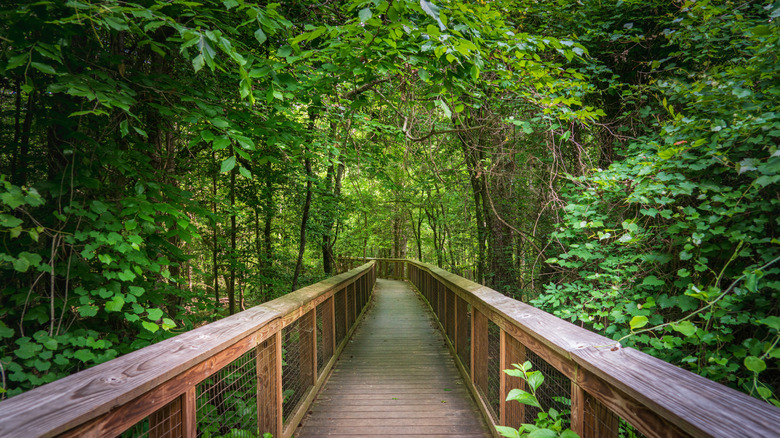
The 2.6-mile Boardwalk Loop begins at Congaree's Harry Hampton Visitor Center, where you can preface your nature walk with informative exhibits on the park's ecosystem, admire the park's impressive golden orb weaver spiders, or buy something at the gift shop. The visitor center also has brochures for self-guided boardwalk tours. From the center, the boardwalk loop embarks into Congaree's titanic tree canopy almost immediately, with vertigo-inducing pine and hardwood trees on all sides.
The upper boardwalk is closer to the visitor center and features broader planks higher above the water for a more immersive experience within the trees. The lower boardwalk is much closer to the water, taking hikers past haunting cypress trees with up-close views of the park's rich wetlands. Both sections meet at the Weston Lake Overlook. Weston Lake is a serene oxbow lake leftover from an ancient shift in the Congaree River's course. Today, it's a terrific place to see turtles, snakes, and maybe even alligators. You can then explore the other half of the boardwalk (depending on which way you came) before returning to the visitor center. The rest of the route provides excellent opportunities to see abundant birds passing through the dense tree canopy.
Most hikers can complete the full boardwalk loop in 30 minutes to an hour. If you want to explore the park further, the boardwalk also connects to longer trails that provide a more "up-close" experience of the park's muddy ecosystem. From the boardwalk, you can access other interconnecting trails, like the 4.7-mile Weston Lake Loop and the 7.2-mile Oakridge Trail. If you're really up for a challenge, you can eschew the boardwalk altogether and try the challenging Kingsnake Trail (which has some of South Carolina's best birdwatching) through Congaree's backcountry wilderness.
A convenient boardwalk tour of an underrated national park gem
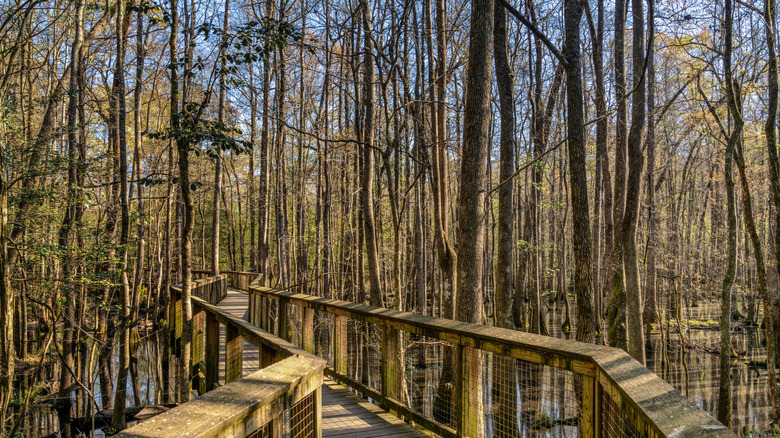
Congaree's boardwalk is an accessible means of experiencing "the largest intact expanse of old growth bottomland hardwood forest remaining in the southeastern United States," per the NPS website. This type of forest was once abundant, but centuries of logging, cultivation, and urban development have largely depleted it. Congaree National Park's more than 20,000 acres serve as an essential preserve of an endangered forest ecosystem, drawing from a fertile floodplain around the Congaree and Wateree rivers. The trees grow to record-breaking heights, resulting in the tallest tree canopy east of the Mississippi River and several examples of "champion trees" (i.e., the largest individual tree of a particular species). The trees' impressive height protects an extremely biodiverse ecosystem within the broader Congaree Biosphere Region. In short, this may be the most underrated national park in the United States.
Congaree's boardwalk serves to solve a key problem on the park's visitor-facing end. Regular flooding is essential for the delicate ecosystem, but it also means that visitor trails are often extremely muddy or too inundated to even access. The boardwalk bypasses this via an elevated trailhead connecting the park's visitor center to the main forest. Since its first sections were built in the 1980s, the boardwalk has expanded into a comprehensive loop that takes visitors directly underneath one of the world's tallest tree canopies. Along the boardwalk, you can gaze up at towering loblolly pines, bald cypress, and water tupelo, among many others (and maybe even vibrant wildflowers if conditions are right). Despite the muddy terrain underneath, the boardwalk maintains a flat and even surface that's perfect for an accessible walking tour.