
Florida's Largest USFS Wilderness Area Is A Secluded Gem For Camping And Paddling Near Tallahassee
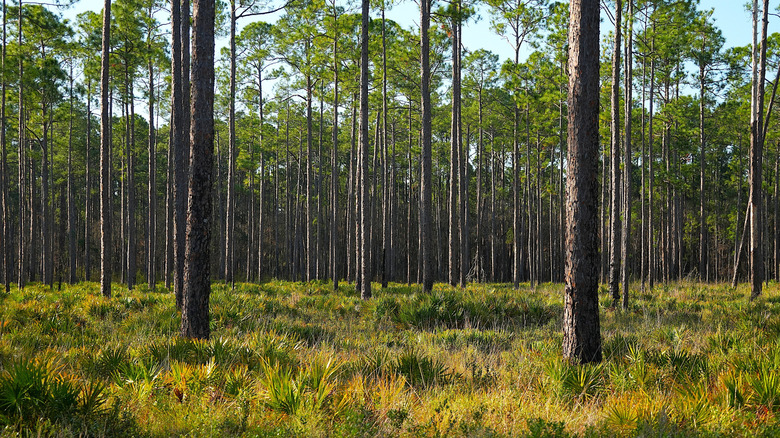
Look at a map of Florida, and you'll see vast swaths of varying greens spreading across it, blotting the page from top to bottom. Florida contains millions of acres of conservation land, some of it wild, remote, and difficult to access. Within the sprawling Apalachicola National Forest in the Florida Panhandle, roughly 25 miles southwest of Tallahassee, Bradwell Bay Wilderness is one such 24,000-acre expanse of green.
Bradwell Bay practically defines the word wilderness. It's secluded, wild, and rustic — part swamp, part dense woodlands, and part thickets of undergrowth. It's home to wildlife like alligators, black bears, white-tailed deer, and even bobcats, as well as wild turkeys, osprey, bald eagles, sandhill cranes, and rare southern dusky salamanders. A remnant of old-growth forest, including virgin slash pine and cypress, gives a rare glimpse of the native forests that once dominated the state. The Florida National Scenic Trail, a roughly 1,500-mile route traversing the state, passes through Bradwell Bay Wilderness for approximately 12 miles, and Backpacker Magazine included a route through the area in its 1999 "Twelve Toughest Trails" feature.
Bradwell Bay Wilderness is Florida's largest U.S. Forest Service-managed wilderness area and the state's second-largest federally designated wilderness area. It's protected as part of the National Wilderness Preservation System and one of the most protected sections of the Apalachicola National Forest. There's no conventional open-water "bay" here; the name refers to the low-lying basin at its core, much of it occupied by Monkey Creek Swamp, which is characterized by deep standing water, aquatic plants and tangled grasses, moss and pitcher plants, blackgum, cypress, and swamp titi thickets. On higher ground, hammocks of palmettos and pine flatwoods, with longleaf and loblolly pines rising above palmettos and the wiregrass undergrowth, contrast the swampy landscape. The Sopchoppy River runs along the wilderness's eastern boundary, offering opportunities for kayaking and canoeing, while the surrounding Apalachicola National Forest engulfs the western reaches of the landscape.
The remote wilderness invites primitive hiking and camping, but visitors should plan accordingly
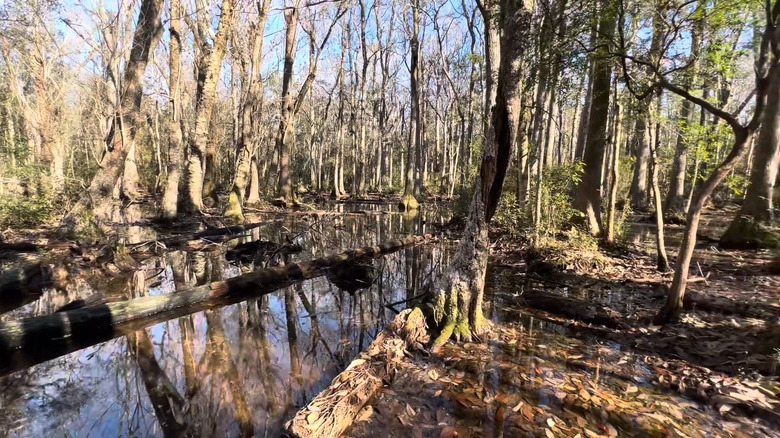
Centered within the Apalachicola National Forest, a recreational paradise for camping, swimming, and hiking, Bradwell Bay is one of its most undeveloped areas, where recreational opportunities are more limited and largely primitive. It's sometimes compared to another remote wilderness about 30 miles south: Tate's Hell State Forest, a coastal wilderness crisscrossed by beautiful but secluded trails and rumored to harbor some eerie stories. Even the Bradwell Bay section of the Florida National Scenic Trail can be challenging to navigate, with portions sometimes submerged in up to waist-deep water that can become dangerously cold in winter. "Go in the summer when it's wet if you want a surreal experience, wading through a swamp, hip deep in black water, surrounded by towering trees. Like something out of 'Heart of Darkness' or 'Apocalypse Now,'" wrote a reviewer on Google. "Bring the bug spray and watch for snakes."
Camping in Bradwell Bay offers a unique but challenging outdoor experience for those who truly enjoy remote adventures. Thorough preparation is essential, as the area is rugged and undeveloped, and it's easy to get lost. There are no customary visitor facilities, such as bathrooms, potable water, or developed campsites. The Forest Service provides dispersed camping rules and recommendations, including packing out trash so as to "leave no trace," following campfire restrictions, and avoiding damage to plants and wildlife. The Florida Trail Association notes that one of the few camping spots within the swamp itself is a tiny dry patch of land known as Bradwell Island. However, camping here is best avoided unless necessary, with more suitable spots available alongside Monkey Creek and the Sopchoppy River. Note that the wettest months are generally June through September. Many visitors opt for alternative camping sites along the Florida National Scenic Trail within the greater Apalachicola National Forest — such as Porter Lake, Camel Lake, Mantis Camp, and Sapling Head.
Canoeing and kayaking through the remote waters of Bradwell Bay Wilderness
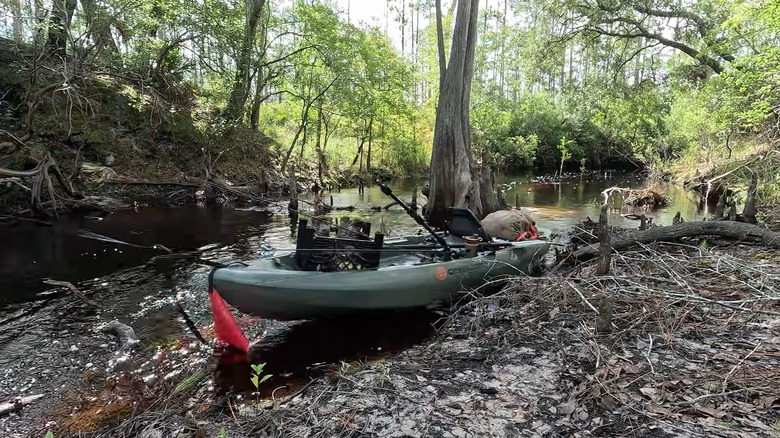
Although much of the wilderness is flooded and swampy, it's not necessarily navigable by boat. However, the twisting, 50-mile-long Sopchoppy River along its eastern edge has a 15-mile paddling trail popular with kayakers and canoeists when water levels are high enough. According to the Florida Department of Environmental Protection, the recommended river gauge reading is between 9 and 11 feet, so paddlers should always check levels before they go. The river is considered quite challenging yet scenic, characterized by limestone banks, overhanging cypress canopies, white sandbars, and a dark brown color caused by the tannins from Bradwell Bay. The Florida Department of Environmental Protection's Sopchoppy River Paddling Guide identifies four primary access points: from north to south, Oak Park Cemetery Bridge, the closest to Bradwell Bay Wilderness; Mount Beasor Church Bridge; Myron B. Hodge City Park, which charges a small ramp fee but also offers camping and facilities; and U.S. 319 Bridge. However, the guide discourages using the latter because of limited parking and difficult access, recommending that paddlers end their trip at Myron B. Hodge City Park or continue downstream to Ochlockonee River State Park, a lovely site for camping, swimming, and fishing, just 15 miles from Bradwell Bay.
There aren't many local outfitters where visitors can rent paddling equipment. However, TnT Hideaway, located in Crawfordville, offers guided paddle tours of the Sopchoppy River, including kayak rentals and shuttle service. Its 7.5-mile trip ends at Myron B. Hodge City in Sopchoppy, a quirky little town known as the gateway to the Florida Trail.
How you plan to explore Bradwell Bay Wilderness will impact how you get there. If kayaking and canoeing, use the access points outlined in the Sopchoppy River Paddling Guide. If you're hiking and camping, you can access the Bradwell Bay South Trailhead from Forest Road 329, where unpaved parking is available. Directions are also available on the U.S. Forest Service website.