
Unwritten Rules You Should Know Before Visiting Italy
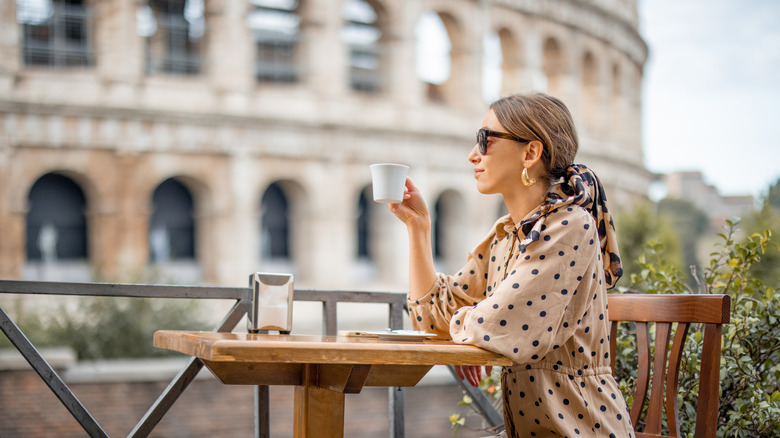
Falling in love with Italy's historic cities, troves of impressive artwork, and delicious food is not hard to do. It's a country that easily charms all who visit. But as beautiful as Italy is, it is also a place that, at least from an outsider's perspective, seems to have a lot of arbitrary rules, especially when it comes to food and communicating with locals.
Italians are very proud of their culture and cuisine, and respect is of utmost importance regarding both. At home, no one would bat an eye if you requested extra protein with your pasta or decided to treat yourself to a late evening cappuccino before a long drive home, but these will earn you the infamous side-eye on a trip to Italy. Tourists sometimes forget how essential it is to learn the culture not only so they can have a pleasant journey but also so they can come away with a deeper understanding and appreciation for the place they're visiting.
That said, it's hard to learn these rules unless you already know a local or an expert guide because many of them are unspoken — almost as if they're inherently learned only by those who live there. But it's not impossible to become an expert yourself if you're just visiting. If it's your first time in Italy, it can feel like a lot to remember, but give it a few days, and you'll find that the Italian way of doing things is actually the perfect way to ease into "la dolce vita."
A proper greeting is expected

When you enter any shop or restaurant in Italy, you must greet the cashier or host with a friendly hello with eye contact. This is also true in France, where you will typically get a very rude reception if you don't respond with a simple "bonjour" — one of the top phrases tourists should know when visiting France. In both countries, it's considered basic politeness in any one-on-one interaction. Learn a few basic phrases and keep them at the ready whenever you're about to greet someone.
Most people generally use "buongiorno" from the mornings until the late afternoons as the main greeting. Once you get to very late afternoon and evening time, you can switch to using "buona sera," or good evening. "Buona notte," or good night, is more something you say when you are leaving, so it can be a bit awkward if you use it to say hello. If you're so jet lagged, you're not sure what time of day it is or have forgotten the words, you can also say "salve" as a generic and very polite greeting. "Ciao" means both hello and goodbye, but it's typically only used as a greeting if you are already familiar with the person you're speaking to. And if you're leaving somewhere while it's still daytime and want to wish someone to have a good morning or good day, you can say "buona mattinata" or "buona giornata," respectively. Both are kind of like saying, "Have a good morning/day!"
Dress tidily

Americans have a reputation for being a bit informal when it comes to getting dressed to run errands like grocery shopping or stopping at the bank. In Italy, you'll very rarely find someone out and about in their sweatpants, unless they just came from the gym, and you will never see any Italian walking around the street in pajama pants.
In general, you'll notice that most people in Italy are almost always put-together, especially the older generations. This doesn't necessarily mean that you have to wear designer clothes to fit in, only that you should wear clothes that are clean, unwrinkled, and well-fitting, even if you are just going out to pick something up from the grocery store.
There are no fashion police in Italy to enforce a dress code, although most churches will ask you to cover up — especially if you're wearing shorts or a sleeveless top — if they deem you are bearing too much skin or if you have underwear showing, but it's a good way to blend in and prove the American stereotype wrong.
Meals are for enjoying
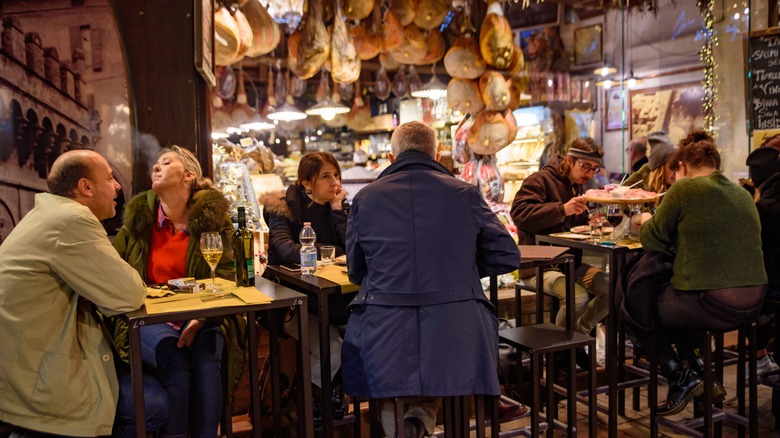
When you sit down for a meal at a restaurant, the last thing Italians will do is rush you. Dining out in Italy is a full experience that should be savored and enjoyed very slowly. When you finish your first course, the waiters will not rush to bring out the next dish, and instead will let you take your time before clearing the table. Once you place your order, actually, this is probably the only time you will see your waiter. Unlike the U.S., where servers are constantly checking in on you to see if you need a refill or extra dip, Italian waiters might only check in once every hour, if at all, depending on how busy the restaurant is that night.
This also means they won't rush you to pay the bill. In fact, dropping a check on a table without the guests asking for it first is considered extremely rude. If it has to be done because the restaurant is closing or someone is changing shifts, it's usually done with a big apology. When you're ready to pay, ask for the check by saying "il conto, per favore," and if you can't get the waiter's attention but need to get going, you can generally walk up to the bar and pay.
Big, savory breakfasts aren't really a thing
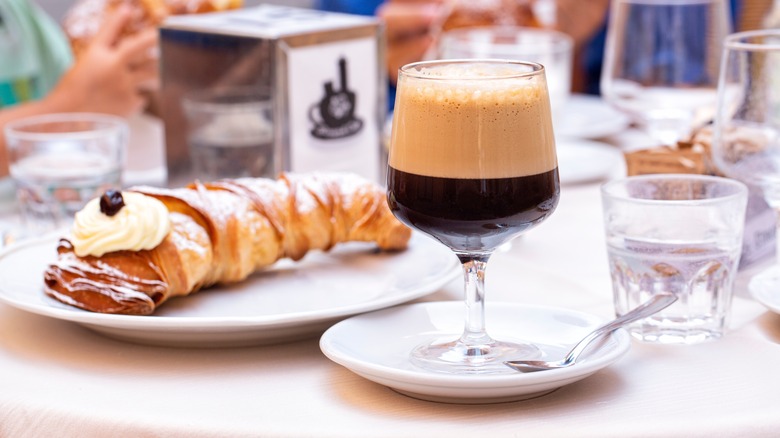
When you have a big day of sightseeing to do — a common thing in Italy since the country has tons of historic landmarks to see and art museums to visit — you might want to start the day with a big breakfast: eggs, toast, and lots of coffee. If your hotel has breakfast included and caters to a lot of Americans, you might even be able to do this. But if you're going out for breakfast on your own, a savory, gut-stuffing start to the day can be a tall order in Italy.
Italians don't eat very much in the morning, and what they do eat is usually quite sweet. In Sicily, you can even find people eating a brioche bun and granita (a type of shaved ice) for breakfast. The most typical thing to eat for breakfast is a small pastry with a small cup of coffee, a meal that is often enjoyed quickly and on the go. Most Italians plan on having a big lunch later, so this is usually enough to hold them over until the afternoon, but if you're a tourist embarking on a busy day of back-to-back sightseeing, it's probably a good idea to have a backup plan in case you can't find somewhere to eat.
For a quick coffee, stand at the bar
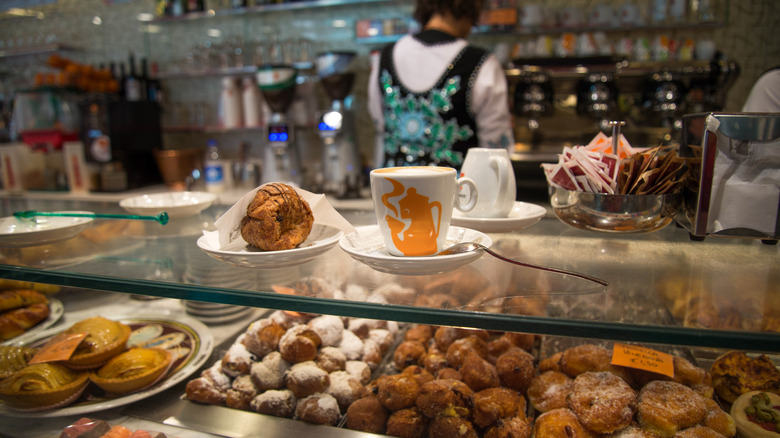
Every European country has a unique café culture, but in Italy, drinking coffee is basically a national pastime. In fact, a "bar" in Italy, more often than not, refers to a coffee bar, which is also a place where you can find over-the-counter pastries and alcohol. However, coffee is the main attraction. This is where the culture of espresso — a word that comes from the Italian word for "to press out" or "express" — began. When people are on their way to work in the morning, they'll stop at the bar for a coffee and will drink it while standing up, a tradition which can be very fun to try when you're in Italy.
When you get to the bar, you'll ask for "un caffè," which is a word that's interchangeable with espresso. If it's a busy bar, you may have to pay before you order, telling the cashier what you want to order and then handing the receipt he gives you to the server afterwards. You can also ask for a "macchiato" if you would like a little milk. If plain espresso is too strong for your taste, you can order it "lungo," which is a thinner shot with slightly more hot water that takes longer to pull from the machine. Or you can try an "Americano," which is a shot of espresso mixed with hot water (usually at a ratio of one shot to two or three parts water). Whatever you do, don't ask for a "latte" unless you want to be served a cold glass of milk. Typically, you'll also get a small glass of water, which could be still or sparkling, served alongside your coffee to clear your palate.
Cappuccino is a breakfast-only drink
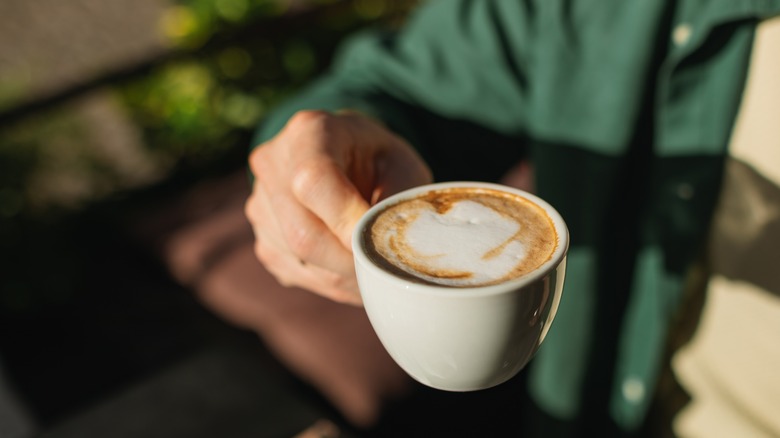
Cappuccinos are delicious, but this common coffee order is only for the mornings and should never be placed in the afternoon. The drink is made with equal parts espresso, steamed milk, and milk foam and is often sprinkled with cinnamon powder for an extra sweet kick. It's not the typical order for an Italian on the go, but a drink to be savored, enjoyed, and never ordered past lunch. As the tour company Walks of Italy puts it on its blog, "It's just not done (some say it's because the milk and foam makes it a replacement for a meal, and all that dairy upsets the digestion)."
Thinking about digestion is a surprisingly large part of Italian culture, and milk is often the villain in this narrative. Many Italian traditions are linked to digestion, such as the aperitivo (drinking and snacking before dinner), digestivo (drinking after dinner), and the passeggiata (walking after eating). If you still want a cappuccino or milky drink after lunch, it's not impossible to find someone to serve it to you in Italy. However, if you plan to eat a lot of pizza and pasta, it may be worth adapting some of these Italian digestion norms.
Chicken and pasta don't go together

You probably could have guessed about pineapples on pizza, but there are a lot of common dishes considered Italian in the U.S. that you won't find anywhere in Italy. Chicken alfredo is definitely one of them. It's hard to understand when there are so many other tasty pastas that use meat, such as ragù alla bolognese (beef) or carbonara (pork cheek, also known as guanciale), so why is chicken so offensive when paired with sauce-covered noodles?
If you ask an Italian, their response is generally going to be one of repulsion, and they might tell you something like "it's simply not done!" or insist that it is against tradition. There's really no clear answer, but one poster on the r/Cooking subreddit may have explained it best: "Most Italians believe that good pasta doesn't need much help. The idea of a pasta dish with big chunks of meat in it (chicken or otherwise) is not really done over there. The pasta is the star of the show. Meat appears most often in ground or stewed form, either as part of a ragu or as a filling for ravioli and the like. I think chicken can be and is used for some of these applications, but cubes of white meat chicken don't bring much to any party."
Don't eat seafood with cheese or red wine
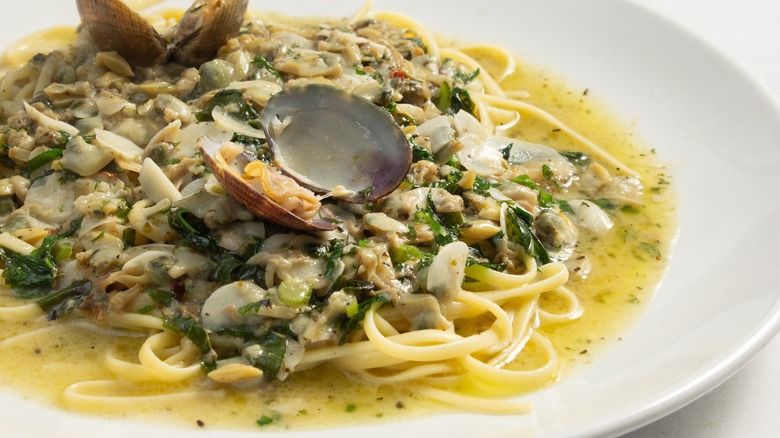
Italians are also very particular about seafood, but the unofficial, unspoken "ban" on cheese and red wine while eating a delicate piece of fish may be more understandable. Most of the 20 regions of Italy — except for landlocked Umbria, Lombardy, Piedmont, Valle d'Aosta, and Trentino Alto Adige — touches the sea, which means seafood has a near-constant presence in Italian cuisine. Of course, because this is Italy, there are unofficial rules and these ones have also infiltrated the culinary world in general. You might have had the idea to sprinkle some parmesan on clam linguine before, but even cheesemongers will tell you that this isn't the best idea.
As writer and cheesemonger Nora Singley explains for The Kitchn, "The rich, salty flavors of cheese can too easily overwhelm the flavors of fish, forcing a contrast not only in intensity of flavor, but also a sacrifice of the integrity of both ingredients. Grated cheese over a fish pasta is considered either extraneous, excessive, or demeaning." The same principle can be applied to red wine, which can overpower seafood if it's too full-bodied, so white wine is more customary. Plus, if you've never tried it before, the aftertaste of red wine with fish can be quite unpleasant, and the restaurant probably wouldn't want you to leave with a bad impression. If you do want to indulge in some good cheese without seafood, skip the big cities and head to the underrated foodie town of Parma.
Good olive oil is not for cooking or dipping with vinegar
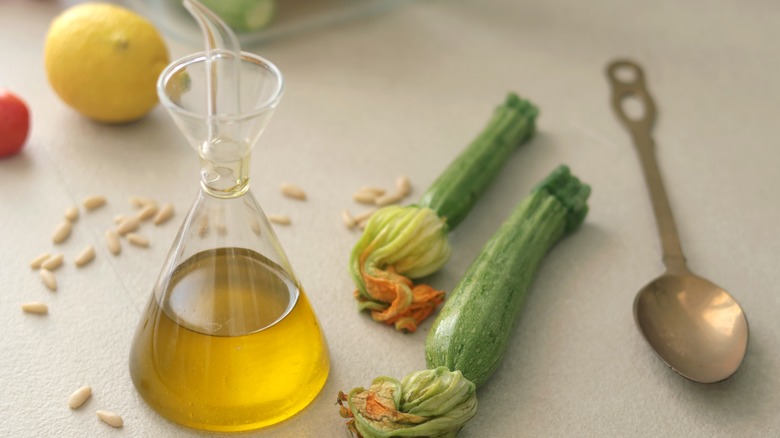
If you're a fan of "liquid gold," aka olive oil, you can have a grand time in Italy sampling high-quality oils cultivated from olive farms all over the country, some of which have thousands of years of olive-producing tradition. You may also have the opportunity to buy fine bottles directly from the makers or from specialty shops. While it's true that olive oil is a staple of Italian cooking, you don't want to use the best oil in a hot pan, especially if it's extra virgin olive oil.
If you buy a very good bottle of olive oil as a souvenir in Italy, you should reserve it for drizzling and dipping, so as not to cook out the flavor. And while you're free to do whatever you like in your own home — i.e., mixing oil and vinegar for a tasty dipping sauce — you won't see any Italians taking part in this bread dipping habit. As the Pasta Evangelists blog explains, "Many Italians find the idea of bread, olive oil, and balsamic vinegar before a meal doubly offensive—not only are you filling up on bread before the main event, but you're also ruining your taste buds with the acidic vinegar."
Dinner is late, but that's why you have aperitivo
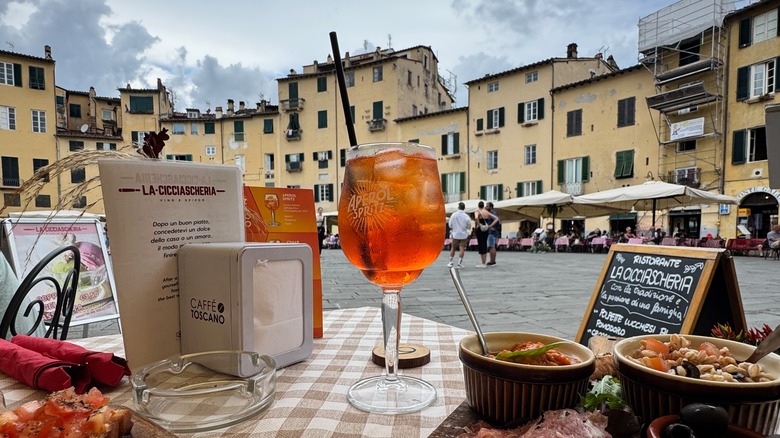
Italians typically eat dinner on the later side, usually between 8 and 9 p.m. That can seem like a long time to wait if you've worked up an appetite, but if you're hungry, all you need to do is go for an aperitivo. This tradition is part of the daily ritual, and it couldn't be simpler to partake in. Simply find a bar, preferably a terrace if the weather is nice, and order yourself a drink. It could be a cocktail, wine, or local beer, but the important thing is that you also order snacks (sometimes, but not always, these are complimentary).
The idea of aperitivo is not to eat too much. This would spoil your appetite for dinner, so snacks are light and small, such as olives, potato chips, or even some bruschetta, which is bread topped with tomato and basil. Some bars are known for their aperitivo, such as Caffè Santa Zita in the Tuscan city of Lucca, which serves upscale snacks that foodies will adore.
Expect a cover charge when eating out
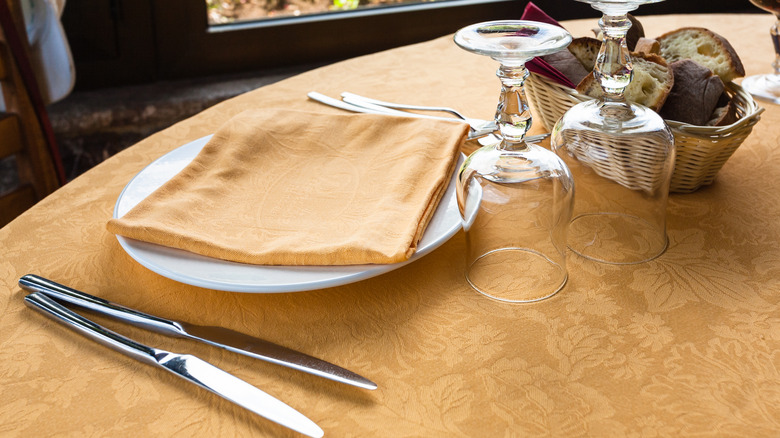
When you dine out in Italy, you should expect to find a "coperto," a cover charge, tacked onto your bill whenever you've sat down and had table service. This is the standard charge, and it typically will cost you 1 to 5 euros per person, depending on the level of the restaurant. The general idea is that this cost covers the cost of plates, glasses, and clean table cloths, and any "free" bread you might get served alongside your meal. However, it's not exactly a tip because it goes to the restaurant, not the server.
Tipping is not expected in general, since the cost of service is usually factored into the cost of food. It is appreciated, though if you are compelled to recognize exceptional service, and generally 10% is considered appropriate in that case. Just make sure you check your bill first to see if an extra service charge, aka "servizio," has been added on. This is a common practice, especially in busy tourist areas, so if you see that written on the check (in addition to "coperto"), don't feel bad about not tipping extra.
Water in restaurants isn't free
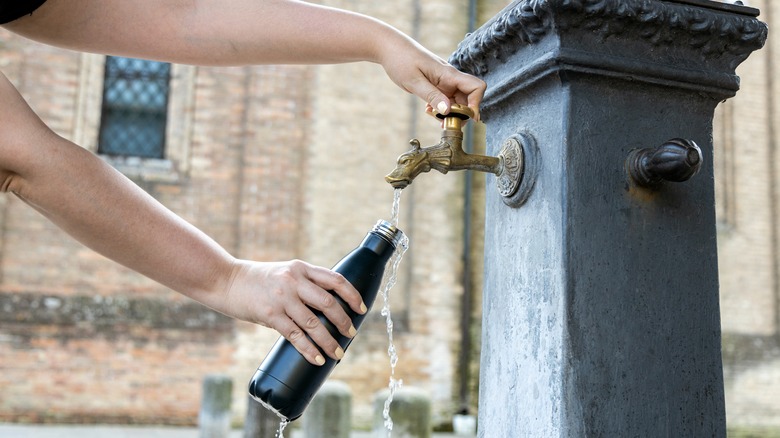
We can thank the Romans for the plentiful amount of clean drinking water available from public fountains. These systems date back to the ancient empire that built a continent-wide system of aqueducts to provide water to citizens, and people still take advantage of them. These fountains are safe to use and are great for filling up your water bottle or washing your face on a hot day.
With free water available in the streets, you may be surprised to learn that the water you order at a restaurant is not free. When you ask for water, the waiter will ask you if you want still or sparkling, and no matter your answer, they will serve you bottled water that will appear on your bill later. Complimentary tap water is generally not served, although you can try asking. Ice is also not a common thing, so if you want it for your water or soft drink, you will also have to ask for it, but thankfully, it is usually served free of charge.
Methodology

To curate the best unwritten rules and tips for people visiting Italy, we leaned heavily on personal experience spending extended amounts of time in Sicily and Italy, as well as experiences learning the Italian language and the writer obtaining Italian citizenship through their ancestry.
This list is a culmination of personal observations and conversations with Italians, but in order to get a more well-rounded list of tip, we also cross-referenced our work with a variety of sources from travel bloggers, Italian tourism companies, Italian local and travel discussion boards on Reddit, and food and culture experts to compile this written list of "unwritten" rules. These are not laws, so no one will come arrest you if you order a cappuccino after 11 a.m,. but you might get a weird look from your server — and now you'll know why.