
Arizona's Secluded Natural Hot Springs Is A Short Easy Hike With Free Camping Nearby
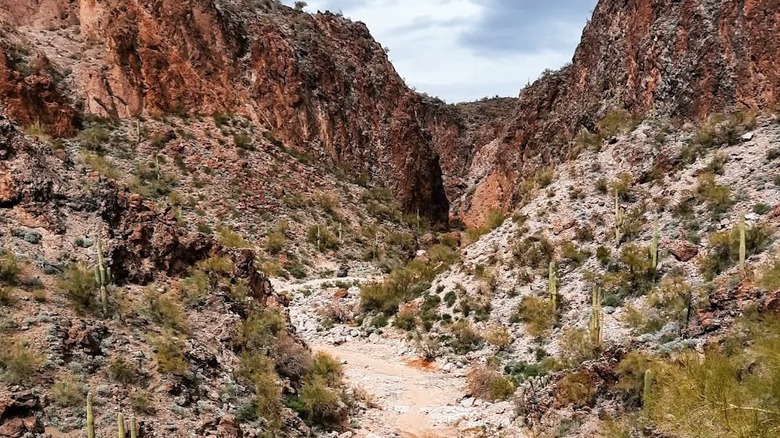
Arizona's natural landscape is gorgeous to behold from any angle. Stunning mesas rise from arid deserts. The sheer scope of the Grand Canyon is almost beyond comprehension, and the state's 2.6 million-acre pine forest ranks among the most expansive ponderosa pine stands in the world. There's even more going on underground — that's where water collected in subterranean pools begins its journey to the surface, percolating through layers of ancient volcanic rock formations to create thermal hot springs that draw visitors from far and wide.
The stunning juxtaposition of Arizona's natural landscapes is rooted in the region's geological evolution. Rainwater seeps through the ground and settles into deep volcanic nooks and crannies formed tens of thousands of years ago, where it's heated by Earth's geothermal energy. The deeper it trickles, the hotter it gets before it eventually percolates back to the surface, creating thermal pools and hot springs.
While Arizona doesn't hold the record for having the most thermal hot springs in the United States — that title goes to Idaho, one of the best states to see hot springs (other than Colorado), according to research — the Grand Canyon State does offer some stunning easy-access spots worth checking out. Located just off U.S. Route 93 at mile marker 135 in Wikieup, Kaiser Hot Springs is one of Arizona's thermal springs. Plus, it's only about 60 miles northwest of Wickenburg — the underrated Wild West Arizona town with modern amenities, specialty shops, and desert beauty.
Access Kaiser Hot Springs with an easy hike through stunning landscape
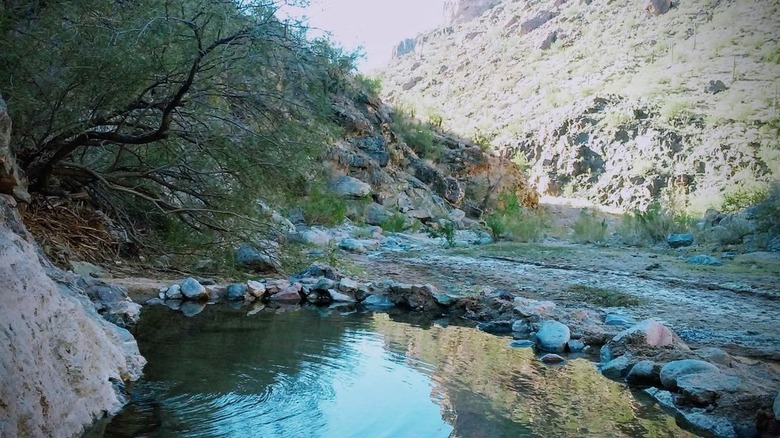
If you're traveling from Wickenburg, head north on U.S. Route 93. Keep an eye out for a narrow dirt road marked by a sign to Kaiser Spring Wash. The dirt road circles back under the highway to a small parking area where Kaiser Hot Springs Trail begins as a short but sometimes slippery slope to the wash below. When you reach the wash, continue along the dry riverbed for about 1.5 miles.
The trail runs through property managed by the Bureau of Land Management. If you're into rockhounding, it's a good place to search for natural minerals, crystals, and gems scattered along the route. Rules vary by location when it comes to collecting gems or gold you find, but the Bureau of Land Management typically allows collectors to gather up to 25 pounds of rock and fossil specimens per day for personal use.
As you approach the spring, you'll notice a small man-made rim of rocks surrounding the pool. It's not large, but it is secluded. Depending on the time of year, you may have the basin all to yourself. If it's occupied, just take a seat on a nearby rock and wait your turn. Keep in mind that because Kaiser Hot Springs is in an off-the-beaten-path location, it's all natural. There's no surrounding infrastructure — just a spring in the desert — which means, if the mood strikes, bathing au naturel is a perfectly acceptable option. The temperature of water pooled in the man-made rock basin averages about 100 degrees Fahrenheit. If you're up for a rustic adventure, it's okay to camp near the springs. Because it's Bureau of Land Management property, it's legal — and free — to set up camp.
It's free and legal to camp near Kaiser Hot Springs
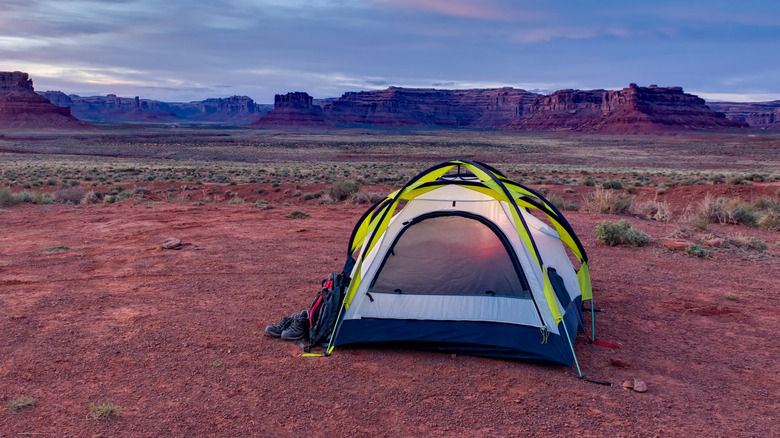
Free camping isn't limited to land directly surrounding the Kaiser Hot Springs. Boondocking and dispersed camping — setting up camp on public land — are allowed on most properties managed by the Bureau of Land Management. It's usually free of charge, but it's also usually free of services and conveniences like running water and toilet facilities. Rules vary by location, and, in some places, permits are required, but if you're up for an adventure, it's worth considering.
Also free of charge but not quite as far from civilization, dispersed camping at Signal Road is about four miles from the Kaiser Hot Springs parking lot (via Campendium). Although there are no services, campsites at Signal Road are hailed for being relatively level (especially important if you're traveling with a camper) and offering fairly reliable cellular service.
If the idea of desert camping without basic services sounds just a bit too rustic — and you are willing to pay a nominal fee — you have an option about seven miles down the road. Located about a mile off U.S. Route 93 near mile marker 140.2, Burro Creek Campground lies within the confines of the Burro Creek Recreational Area in the northwestern region of Arizona's Sonoran Desert. There are 23 campsites that can be reserved for $14 per night, and the day-use area offers picnic tables, fire rings with grates for cooking, grills, and access to flush toilets. No water hookups are provided, but potable water is available on site. Plus, it's only about 70 miles south of Kingman – one of the West's sunniest hidden cities, where vintage Route 66 vibes blend with Arizona's dreamy desert allure.