
5 Astounding Ways The City Of San Francisco Has Become Unrecognizable Since The '70s
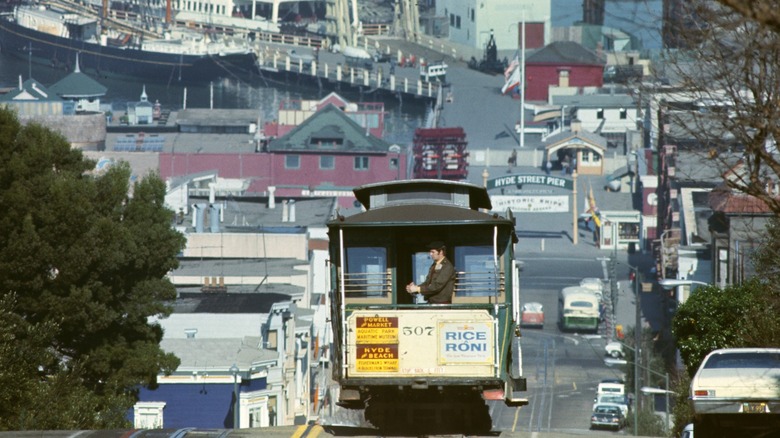
"If you're going to San Francisco, be sure to wear some flowers in your hair," Scott McKenzie crooned in the hit 1967 song "San Francisco," which helped usher in the Summer of Love and cement the northern California city's cultural reputation well beyond the 1970s, making San Francisco one of the best locations for '60s nostalgia. Defined by counterculture rooted in peace, protest, and communal ideals like the hippie, Flower Power, and anti-Vietnam War movements, San Francisco entered the 1970s as an LGBTQ haven, major port and economic center, and vibrant cultural hub.
Around this time, modern computing also evolved. Within a decade, its growth accelerated dramatically. Movements and ideals that had defined the area prior to the '70s began to shift. In many ways, post-1970s San Francisco was captured by the bridge in McKenzie's song: "People in motion, there's a whole generation, with a new explanation." The region was evolving from an affordable, industrial capital and countercultural haven into a global epicenter. The tech boom would soon transform the metro area, bringing economic change, a new skyline, and evolving demographics as gentrification drove up costs of living and homelessness became more visible. Since then, San Francisco has emerged as a leader in technology and creativity, while continuing to spark debate about identity, opportunity, and the city's future.
To examine how this destination changed in the '70s and beyond, we explored reports from publications such as SFGate, 7x7, The New York Times, and Time magazine. We also combed through news coverage and archival essays documented by Found SF, an organization dedicated to digitally chronicling the city's history. Additional cultural tidbits were pulled from historic footage, nostalgic social media posts, and depictions of the city in pop culture (e.g., "Tales of the City," a 1993 miniseries set in 1976 San Francisco).
The tech sector took over San Francisco's economy
In the 1970s, the Port of San Francisco was a blue-collar industrial hub in decline, not the waterfront destination it would later become. Port-related employment and nearby manufacturing supported a largely working-class labor force, with industries ranging from steel to oil refining, auto manufacturing, and food production. Companies such as Hostess Brands and Levi's operated factories in the area, and port labor played a vital role in shipping their goods.
At the same time, environmental awareness began to reshape San Francisco. The 1971 oil spill sparked public concern and led to new policies and initiatives, including the founding of International Bird Rescue. Meanwhile, port operations increasingly shifted across the bay to Oakland, which was better equipped to handle modern container shipping. Meanwhile, according to the San Francisco Chronicle, commercial fishing in the region sharply declined by the mid-1980s. Ports closed, and waterfront facilities were mostly abandoned. By the early 2000s, the city started working to preserve this history by assigning local piers landmark status and shaping the waterfront into a dining and tourism hotspot (per the San Francisco Examiner).
As these industrial foundations weakened, a dramatic economic transformation was just beginning. In the 1970s, the Bay Area emerged as a pioneering center for computer programming and software development. Stanford University (south of San Francisco) led the way in pursuing semiconductor research, attracting talent, and laying the groundwork for the modern tech capital of Silicon Valley. Organizations like Intel, Structured Systems Group, and San Jose-based IBM developed early software systems, and in nearby Los Altos (now one of America's wealthiest suburbs), Steve Jobs and Steve Wozniak founded Apple. Soon, venture capitalists moved into the area, bringing wealth to fund new ideas and innovations. Over the following decades, technological growth accelerated, ultimately transforming San Francisco's economy and industrial landscape.
Urban developments transformed the city's skyline
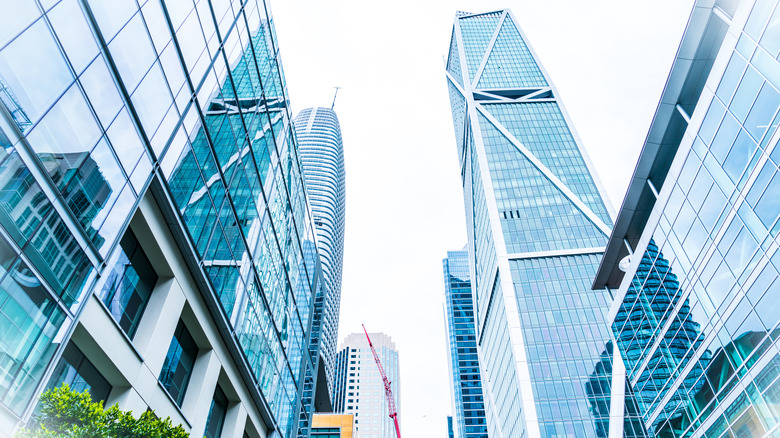
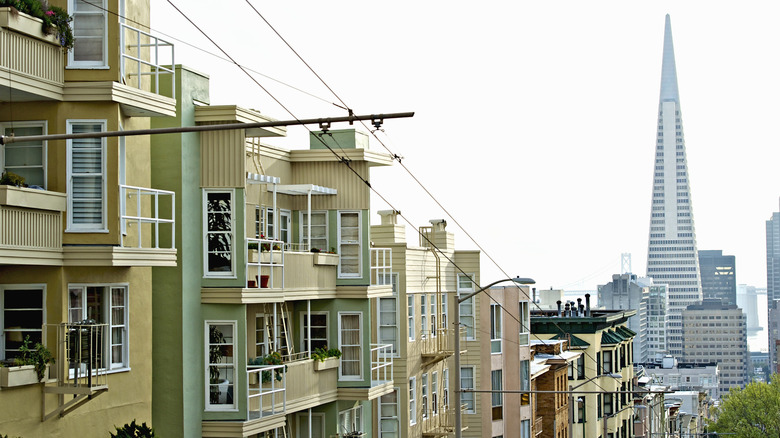
The 1970s kicked off the "Manhattanization" of the city, with skyscraper construction transforming historic San Francisco neighborhoods. In 1969, the 555 California Street tower was completed. Around this time, the controversial landmark that is the Transamerica Pyramid also went up, and until 2018, it was the city's tallest building. In 1973, the 425 Market Street Building arrived. Many Victorian structures were demolished during the mid-century urban renewal trend, although highway revolts sabotaged many attempts to carve the city into freeways. Meanwhile, slow-growth coalitions advocated for strong zoning limits. However, as tech truly boomed, critics say zoning constraints contributed to today's modern housing crisis, according to the San Francisco Examiner. Following the 1972 introduction of transportation lines like the BART rail system, districts also connected farther than the city's iconic streetcars had allowed.
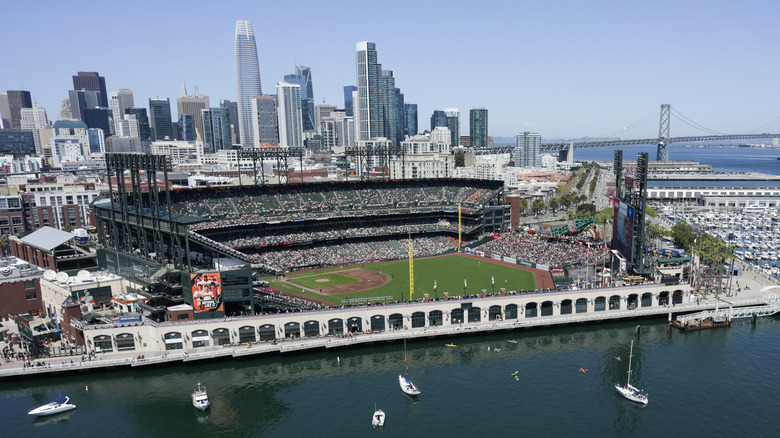
In the following decades, the skyline filled out, and the downtown district densified with high-rises. Vacant and underused areas abandoned or discarded by the shifting industrial sector were transformed. By 2000, Oracle Park was built on the edge of the Bay. New neighborhoods like South of Market, Embarcadero, and Mission Bay emerged. Then, in 2018, the Salesforce Transit Center (a public transportation hub) and the Salesforce Tower were completed. The tower superseded Transamerica to become the city's tallest skyscraper.
Of course, the 1989 Loma Prieta earthquake reshaped San Francisco, too. Houses were set ablaze in the Marina District, while the Embarcadero Freeway was damaged beyond repair, prompting overhauls in neighborhoods from Hayes Street to Rincon Hill. "The 6.9-magnitude temblor made possible a leap of civic imagination. Repair became renewal," John King, urban design critic for SFGate, wrote. "Infrastructure needed to be strengthened (at great cost) or replaced, and San Francisco chose the latter route."
Gentrification changed local demographics and culture
Entering the 1970s, San Francisco's diverse communities flourished in legendary neighborhoods: the Castro, Russian Hill (near one of Anthony Bourdain's favorite California bars), the Tenderloin, and Haight-Ashbury (an American destination packed with '70s retro vibes). The first Pride parade took place in 1970, and music, art, and political activism thrived. However, as time wore on, the movements and ideals that defined the city shifted.
While the Bay Area attracted outcasts and people on the margins of society who were drawn to its reputation of tolerance, it also grappled with human trafficking, drugs, and crime. Major events like the Jonestown tragedy and the Symbionese Liberation Army's kidnapping of Patty Hearst made global headlines. Punk and rock music grew increasingly political on the West Coast and particularly in San Francisco. By 1978, matters came to a head with the assassination of progressive mayor George Moscone and Supervisor Harvey Milk.
In the following years, an era of economic restructuring and new urban policy decisions began. Demographics changed as blue-collar industries disappeared, discriminatory housing practices pushed marginalized communities away, and the technology sector grew. According to the San Francisco Examiner, these conditions often disproportionately affected Black residents, particularly in the Fillmore District, once known as "the Harlem of the West." Its vibrant culture fell into decline, with residents mostly dispersed to outlying neighborhoods. "As a native," one Reddit user wrote, "I can say that the city has become more expensive, less artistic and weird, more corporate, and less diverse." Meanwhile, South of Market, once described in author Jack London's 1909 short story "South of the Slot" as a collection of "factories, slums, laundries, machine shops, boiler works, and the abodes of the working class," gave way to host artists and LGBTQ communities. Eventually, they too were displaced for what is now SoMa, a tech hub and one of the most expensive neighborhoods in America.
The cost of living San Francisco has increased
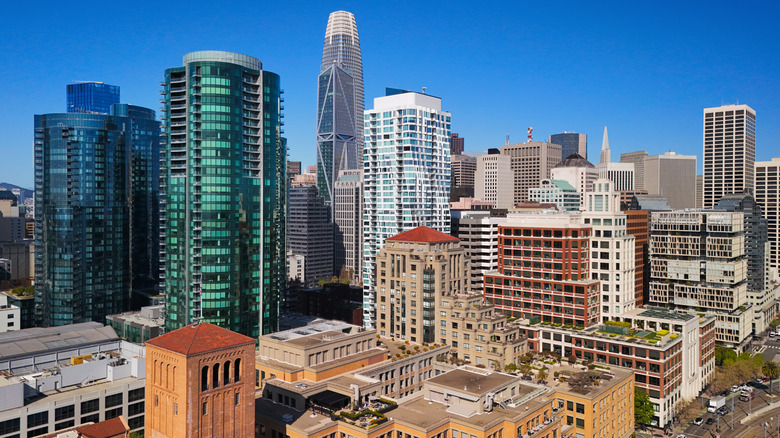
Post-1970s, an influx of tech sector workers fueled a demand for housing, which in turn sent costs soaring. Even before the peak of Silicon Valley, the Residential Rezoning Act of 1978, combined with limited new construction, turned San Francisco from a city that was relatively affordable by coastal standards into a wildly expensive metropolis. What followed was displacement, a housing shortage, and a homelessness crisis that persists today. As contributor Nathan Heller wrote for The New Yorker in a 2023 essay, "When HBO premièred the series 'Silicon Valley,' a deadpan comedy lampooning the Bay Area's life-style blandishments and hapless global power, the city seemed to exist in a helium balloon, floating ever upward. Now the same place is viewed as an emblem of American collapse."
According to SFGate, the San Francisco Rent Board reported average rent for a two-bedroom apartment in 1980 was around $475, and even adjusted for inflation, it would be difficult to find such affordability within the city today. Currently, Zillow estimates the average rental goes for roughly $3,000 per month; that's for a "cool" market with decreased demand. "I grew up in Bernal Heights, once a working class neighborhood filled with lesbians, communists, and Latinx families," a San Francisco native shared on Reddit. "A few years ago, it was the hottest real estate market in the country with homes that were selling for triple what they were worth 10-15 years earlier." Today, homes in Bernal Heights range from about $625,000 to $2 million, and San Francisco consistently ranks among the most expensive housing markets and highest in U.S. wealth disparity: Visible wealth contrasts blatant poverty throughout. "My family grew up in the Mission District in the '70's and '80s," wrote another Redditor. "I get jealous of the city they talk about."
As costs rose, homelessness increased in the city
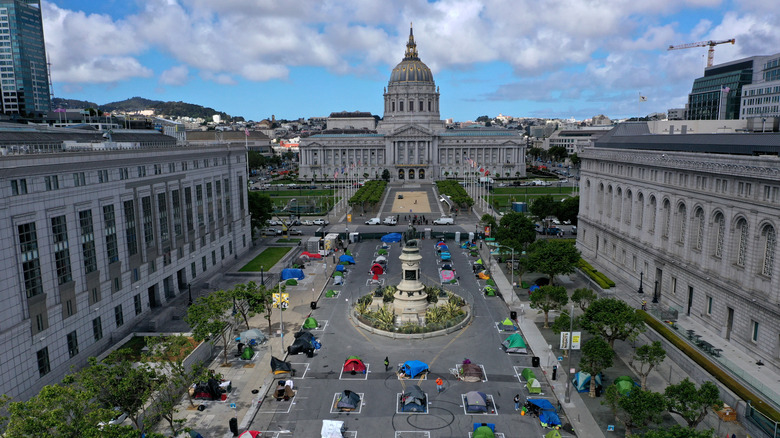
Opinions about how San Francisco has changed through the decades vary widely — from why those changes occurred, to what they look like today, and what they reveal about the city's identity. One of the most controversial issues the city has become synonymous with is homelessness: A chronic, highly visible issue that's ballooned alongside the rise of tech.
For a city that prides itself on technological advancement, computer engineering, and machine learning prowess, San Francisco has struggled to address basic human needs. Nowhere is this more visible than in the Tenderloin District. Once a vibrant immigrant enclave and vital LGBTQ neighborhood — home to dance clubs, bars, and safe spaces — it is now among the areas most deeply affected by homelessness. Many of its historic gay bars have closed, and although San Francisco's city leaders continue to insist they're tackling the issue, the long-term trajectory remains uncertain. "The working class and the artists have lost nearly every neighborhood but some of us still remain. San Francisco is a city of waves," wrote a Redditor. "We happen to be on the downside of a really big one, the third I've experienced since 1992."
Homelessness did exist pre-1970s, before the tech boom, but California's deinstitutionalization of mental health patients, combined with chronic underfunding of public psychiatric care and limited community-based alternatives, sharply reduced access to long-term treatment. Later attempts to criminalize homelessness and vagrancy or subsidize housing, but with strict no-substance-use caveats, have also not succeeded. Combined with displacement, housing demands, and rising costs of the booming new industry, homeless cases have skyrocketed. "We used to be more of a working class city, and that meant a lot of distinct communities," wrote a Redditor, "Whereas now we have people that live in class bubbles of a different sort."
Methodology
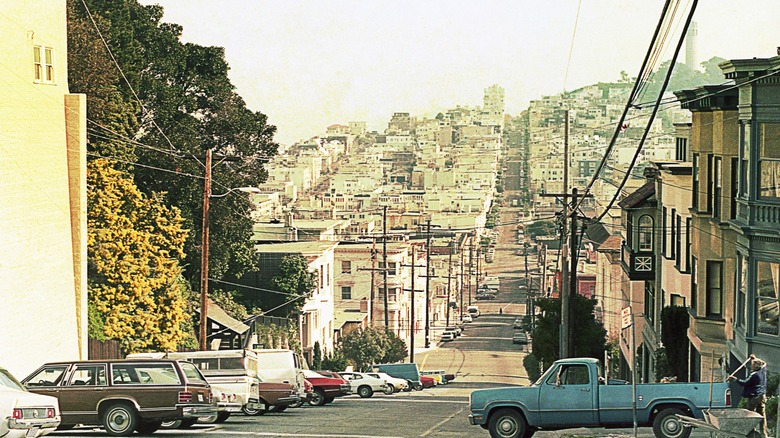
Books, dissertations, and essays could — and have — been written about San Francisco's many evolutions in the past 50 years. This list is a mere overview of some of the most obvious and impactful ways the city has changed.
The 1970s influenced communities everywhere, but San Francisco's evolution since then has been especially pronounced. If you'd fallen asleep as the decade began and woken up today, you'd recognize little. Scientific advancements led to tech companies dominating the local economy. Urban development reshaped and elevated the skyline. The city's demographics and culture shifted. Rising housing costs and an expanding homeless population reshaped daily life in the city. Together, these forces fundamentally altered San Francisco's social and physical landscape.
To hone in on the five most significant ways the city has become unrecognizable since the '70s, we read through years of reporting from local publications such as SFGate, the San Francisco Chronicle, and the San Francisco Examiner. Outlets with a broader reach (including The New York Times, Time, and The New Yorker) were also referenced. Additional insight came from personal experiences, Found SF's historical archives, and pop culture media like "Tales of the City," "Mrs. Doubtfire," and "The Last Black Man in San Francisco." These sources all helped provide a visual language for what the Bay Area looked like through the decades. During the research process, we watched footage, old and new, perused nostalgic social posts, and even consulted Reddit threads. And, of course, we listened to Scott McKenzie sing, "If you're going to San Francisco..."