
America's 5 Most Crowded National Parks (And The Best Times To Visit Them), According To Research
How much overcrowding will you accept before it hinders your enjoyment? Can a temple or church or landscape garden be serene if you're battling through a crush of influencers and selfie sticks? Is a hole-in-the-wall restaurant worth it if you have to stand in line for hours? Or, indeed, does a national park still merit a visit if the only herd you see is four-wheeled vehicles snaking along the asphalt?
National parks are a cornerstone of tourism in the United States: Visitors contributed $56 billion to the American economy in 2024 alone. But there is a cost. In the same year, according to data from the National Park Service, America's national parks received 331.9 million visitors, breaking the record for the most in a calendar year. This resulted in overtourism during peak season and irreversible damage to fragile ecosystems, affecting wildlife behavior, soil conditions, and plant growth. Though 2025 data isn't yet available, figures from Yellowstone and Glacier national parks suggest it could be another record-breaking year.
Of course, the love isn't shared evenly. Great Smoky Mountains National Park was America's most visited, and by some distance, with more than 12 million visitors in 2024. The rest of the top 10, including parks like Zion, Rocky Mountain, and Yosemite, each received between 3 and 5 million. At the bottom of the pile, with fewer than 12,000 visitors, was Alaska's magnificent Gates of the Arctic National Park, where remoteness, inaccessibility, harsh weather conditions, and marauding grizzly bears make it one of the most dangerous parks in the world. You may still want to visit one of America's most popular — and therefore crowded — national parks. But choosing the right season is vital: It will improve your experience, increase the likelihood of wildlife encounters, and minimize your impact on these precious landscapes.
Great Smoky Mountains National Park
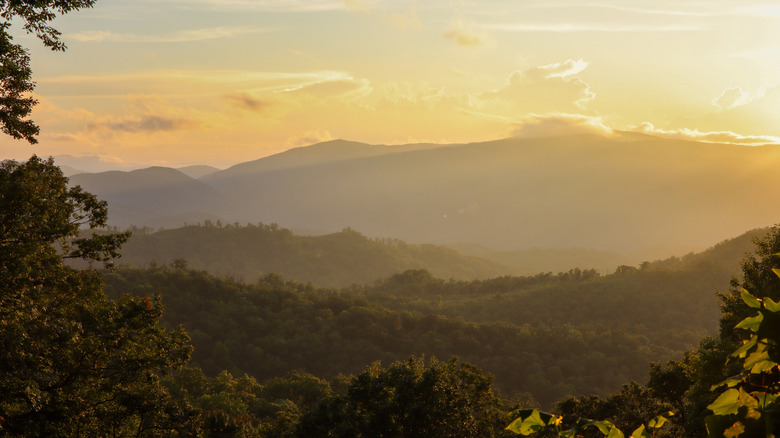
With 12,191,834 visits in 2024, Great Smoky Mountains National Park, straddling the Tennessee-North Carolina border, is easily the most popular park in the country. It's the most biodiverse, too, with more than 19,000 documented species of animals, plants, fungi, and other organisms living in the 800-square-mile patch of southern Appalachia (with another 100,000 or so waiting to be discovered). Drastic elevation changes mean the habitats mimic those from Georgia all the way up to Maine, accommodating animals as diverse as black bears, bobcats, bats, elk, shrews, snakes, fireflies, salamanders, and toads. Songbirds, such as warblers and blue birds, and woodpeckers, cranes, and hummingbirds thrive here, as do hardwood trees, vibrant wildflowers, and shrubs like rhododendrons and azaleas.
The Smokies are also ancient — forming 200-300 million years ago, they're among the oldest ranges on Earth — and are adored for the ethereal haze after which they were named. This optical phenomenon is caused by natural hydrocarbons from vegetation reacting with air particles, which then scatter light through the blue-violet spectrum. Though the biodiversity and scenic beauty undoubtedly contribute to the Smokies' popularity, the fact that the mountains are within a day's drive of more than half the population of the United States is another major factor.
Busy season in the Smokies starts in May and continues through November. This makes early spring one of the best seasons to visit, when temperatures are pleasant enough for hiking at lower elevations and newborn bear cubs and elk calves are found frolicking in the Cataloochee and Cades Cove areas of the park. Crowds are minimal this time of year, compared to the summer and fall crush. Winter is beautiful, but frost, heavy snow, and biting cold mean the park becomes quite volatile.
Zion National Park
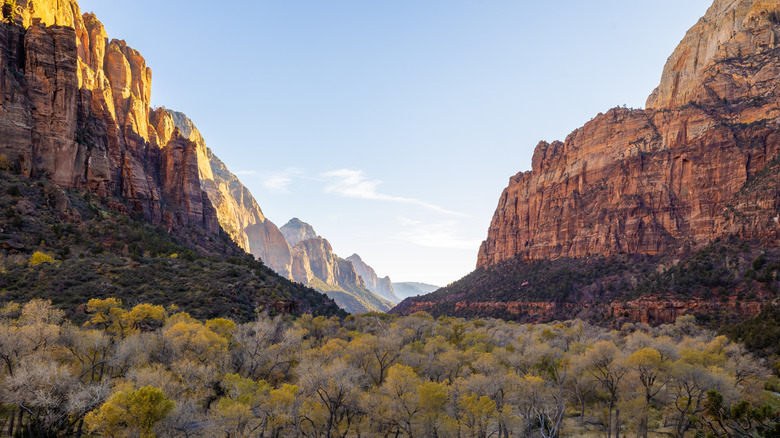
With a little under 5 million visitors in 2024, Zion National Park, Utah's maze of colorful sandstone cliffs, vertigo-inducing canyons, and dreamy night skies, was the second-most-visited national park in the country. Zion has some of the finest canyon scenery anywhere, with an otherworldly grandeur that's accentuated when you view the landscape — as most visitors do — from the canyon floor. But there is a paradoxical coziness; that's why the 19th-century Mormon pioneers who explored this region named it Zion, a Hebrew term for "refuge" or "sanctuary."
Zion offers a variety of outdoor adventures, from hiking, biking, climbing, and canyoneering to stargazing, horseback riding, and wading through the Virgin River Narrows. If you're attracted to dramatic, Martian-like scenery, it makes sense that Zion would top your bucket list. But in an article from 2019, given that it's located in one of America's least-touristed states, the Los Angeles Times wondered, "How did Zion National Park become more popular than Yosemite or Yellowstone?" The park's growing popularity in the social media age and its proximity to Vegas, which is less than 3 hours away, have expanded the busy season across the calendar. The crowds build in early spring and don't see a significant drop off until after Thanksgiving.
If you don't mind the colder temperatures (50-60 Fahrenheit during the day; below freezing at night) or occasional rainfall, winter is the season to visit. Roads are plowed, though there may be limited access, and driving conditions can get tricky. You'll also need extra equipment, like thermals and a dry suit, to ford the Narrows. Though cold, some visitors swear by going in winter, saying it's an excellent season for trekking and taking photos of the park. You're also more likely to get a permit to hike Zion's popular Angel's Landing Trail.
Grand Canyon National Park
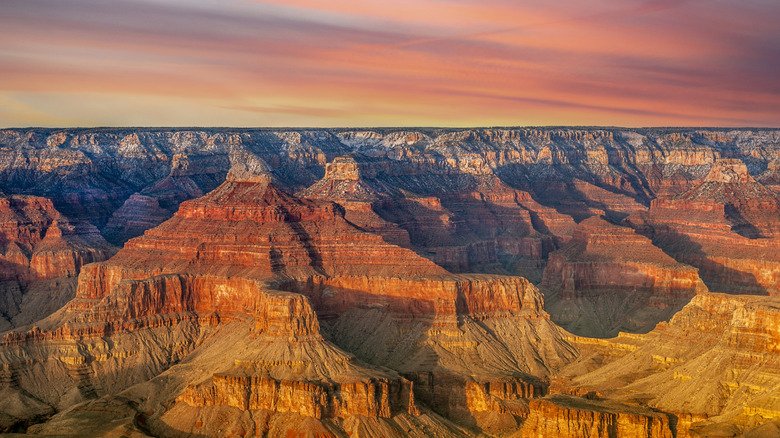
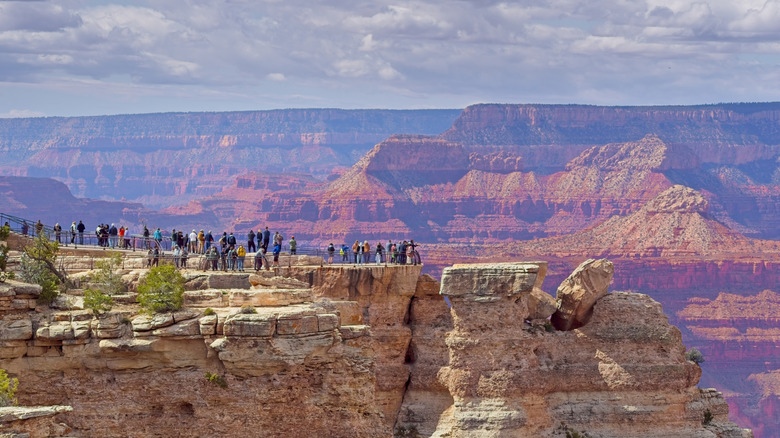
Grand Canyon National Park is unsurprisingly one of America's most visited, coming third with 4,919,163 visits in 2024. It's home to its namesake national treasure, one of the most spectacular examples of erosion in the world, and encompasses a 278-mile stretch of the Colorado River. There are camping and lodging opportunities on its scenic South Rim and lesser-known secrets found elsewhere, like Elves Chasm, a hidden grotto plucked straight from a work of fantasy. The park has significant cultural pull abroad and has long welcomed visitors from all over the world, though the new national park fee of $100 per person levied on foreign tourists could negatively impact this.
The Grand Canyon's popularity has largely been to its detriment. Tourists ignoring the rules have risked — and sometimes lost — their lives as they scrambled over rocks to get the best views or the perfect shot for their Instagram accounts. Regrettably, falling is the second leading cause of death in the park. In response to overtourism, the Grand Canyon Conservancy supports better management to alleviate dense crowds in the developed South Rim and protect the serenity and stunning natural environment of the more secluded North Rim.
The fall elk mating season, called "the rut," is when you'll see bulls fighting over females. It's an awesome sight, but it does attract crowds. Low season at the Grand Canyon is January and February, when temperatures rarely exceed 45 degrees Fahrenheit, and snowfall averages 50 to 100 inches. Despite the trickier hiking conditions, park advocates maintain that winter is the best season for avoiding tourist hordes. You'll also be faced with less competition for backpacking permits and accommodation at Phantom Ranch on the canyon floor.
Yellowstone National Park
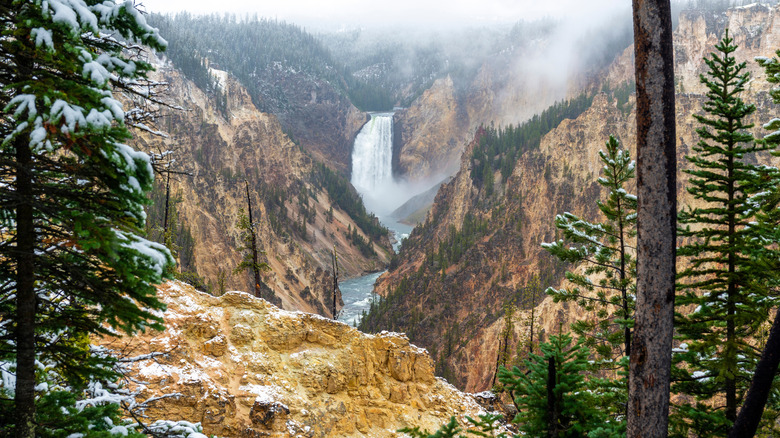
If there's a national park that can compete with the Grand Canyon for icon status, it's Yellowstone. Amid 2 million acres of geyser-laden wilderness are geological wonders like the 20-mile "Grand Canyon of Yellowstone" and the largest concentration of mammals in the lower 48, including bighorn sheep, bison, moose, elk, mountain lions, wolverines, coyotes, and grizzly bears. Yellowstone has attracted nature-loving tourists since it was established as the world's first national park in 1872, and in 2024, it was the fourth most popular park in the country, welcoming 4,744,353 visitors.
Travelers flock to this corner of Idaho, Montana, and Wyoming (the park justs into all three states) for many reasons: to hike Yellowstone's 1,100 miles of trails, view the geysers, mudpots, and fumaroles from wooden boardwalks, camp in the sprawling backcountry, or learn about the region's indigenous culture. But Yellowstone has struggled to adapt to its millions of annual visitors, with tourists getting up to all sorts of mischief: obliterating plant and bug life by going off-trail, putting trash in pit toilets, and (seriously) trying to fight the resident bison. Vehicles are an issue, too. Despite the predators that thrive here, vehicles are the deadliest thing you'll encounter in the park, with traffic being the biggest cause of injury and fatality in Yellowstone.
Yellowstone is at its busiest from May through October, so its low season is longer than in other major national parks. Every season brings different scenery and texture to the landscape, but it's best to avoid the park in spring, also known as "mud season," when thawing snow and ice turn it into a slushfest. The transition into winter is generally a better time to visit Yellowstone, especially once snow arrives in late December, when visitors can go cross-country skiing or snowmobiling through a magical landscape of frozen waterfalls and powdery white basins.
Rocky Mountain National Park
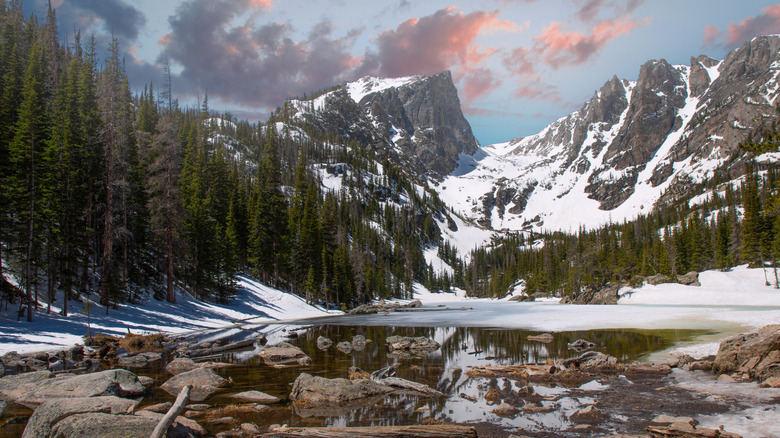
With just over four million visitors, Rocky Mountain National Park in Colorado was the fifth-most-visited national park in 2024. Known for the sturdy mountain range after which it's named, the park has 300-plus miles of trails that connect wetlands and meadows with alpine lakes and snow-domed peaks. Hiking in the Rockies can be challenging, but you're often rewarded for your exertions with trails like the breathtaking Mills Lake and Glacier Gorge Trek, which is widely regarded as one of the best national park hikes in the country. There are numerous species keeping you company here, too: elk, bighorn sheep, mule deer, marmots, pikas, predators like gray wolves and mountain lions, 280 types of birds, and more than 140 species of butterflies.
Rocky Mountain National Park has been among the most proactive regarding crowd management, first implementing a permit system for backcountry camping back in 1973. And recently, it introduced a timed-entry system for the busy summer and fall season. Limited slots are open for reservation on the first day of each month from May to September on a first-come, first-served basis. There are two types of permits, only one of which grants access to the scenic (and popular) Bear Lake Road Corridor.
The timed entry system means overcrowding can be less of an issue than in other national parks. Visiting in the height of summer or early fall, when the park's facilities and roads are all open, is your best bet for seeing greenery in bloom, when thawed snows have left hiking trails in their best condition. Winter is typically quieter, but it's the best time to go skiing, snowshoeing, or sledding. The shoulder season of April to mid-May shows the park in transition and is one of the least competitive times for accommodation bookings.
Methodology
Data for the most-visited national parks in America came from the National Park Service's Visitor Use Data webpage. For this article, we used 2024 figures, as they were the most recent available at the time of writing. Overtourism has been a hot topic in national park discourse — as discussed in policy papers and travel news media — so it made sense to qualify the "best time to visit" for each park as the season with the fewest crowds.
We also used National Park visitor data to identify each park's low tourist season, then cross-referenced this with expert information from local tourism websites (Visit Grand Canyon), travel and tourism companies (Zion Adventure Photog), and park-specific blogs (We're in the Rockies). This allowed us to ascertain if there are worthwhile activities in the relevant national parks during the months when they experience the least tourism.