
5 Las Vegas Hotels That Were Big In The 1950s
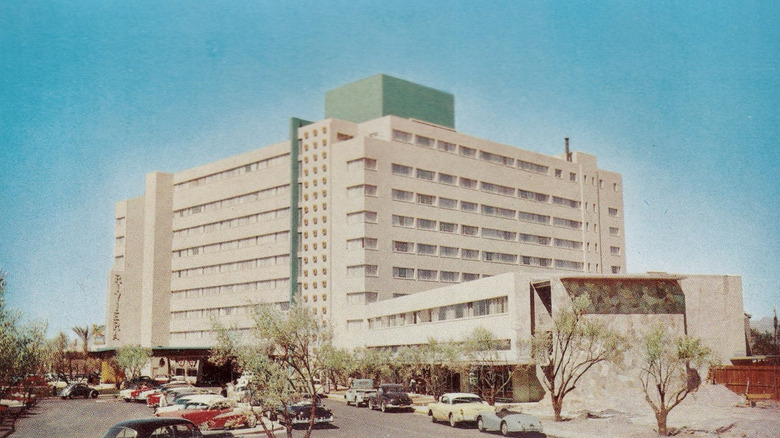
When it comes to reinvention, no city does it quite like Las Vegas. Once a desert railroad town, the glitz and glamor transformed this hotel-filled city into one of the top summer destinations in the U.S. Las Vegas constantly demolishes and rebuilds, eternally building upon itself to go bigger. Its borderline grotesque palaces of excess are the progeny of the Las Vegas Strip that developed in the 1940s and '50s. The 1950s were the defining decade, laying out the blueprint of what was to come. The era brought Hollywood to Vegas, solidified the relationship between organized crime and hotel-casinos, and established Sin City as an emblem of glamor and hedonism.
The foundation of Las Vegas as the destination for vices was established in 1911 when Nevada began offering "quickie" divorces. In 1931, the state re-legalized gambling to combat the economic downturn of the Great Depression, although the mob was already entwined with the city by then, running illegal casinos and speakeasies during Prohibition. The construction of the Hoover Dam that same year brought thousands to the city, creating demand for more casinos and entertainment.
In 1941, El Rancho Vegas Resort became the first hotel to open on U.S. 91 – later known as the Strip — just outside the city's jurisdiction. A series of mob-linked hotels followed in the 1940s and '50s, which became stomping grounds for the famed Rat Pack, who helped turn Las Vegas into a go-to destination for luxury and entertainment. This list includes hotels that were at their peak in the 1950s and stood out for their size, amenities, ownership, or cultural impact.
The Sands
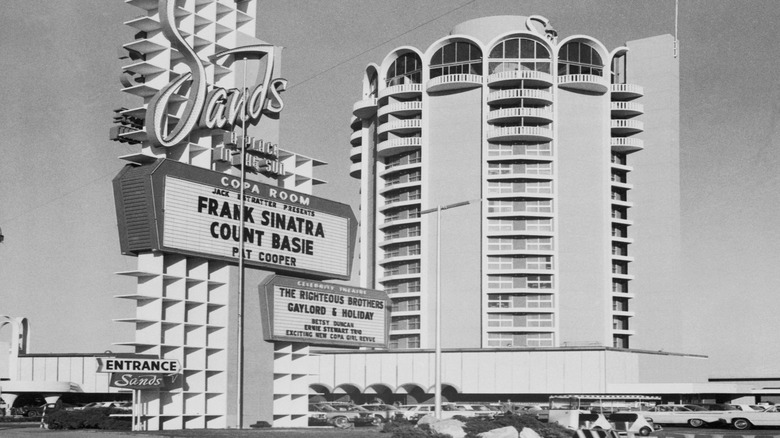
Perhaps no hotel is more emblematic of 1950s Las Vegas than the Sands. Opened in 1952, the Las Vegas Sun described it as "overwhelming in its architectural design, distinctly different in overall conception ... [and] destined to become the most talked about hotel in the Western Hemisphere." It was a prescient statement. The Rat Pack made the Sands' world-famous Copa Room their unofficial residency spot, helping establish Vegas as the world's best city for nightlife. The hotel quickly became synonymous with elegance and glamor, which once defined Vegas before cargo shorts and flip-flops took over the most fun city in America.
The Sands became the hub of the Strip, where A-listers like Audrey Hepburn and Lauren Bacall gathered, and even played a key role in its desegregation. In 1955, Nat King Cole became one of the first Black headliners allowed to stay at the hotel where he performed. Before that, many Black entertainers — including Sammy Davis Jr. and Lena Horne — weren't even allowed in the casinos and had to enter and exit hotels through the kitchen.
The Sands was mob-owned and operated, but its owners eventually included Frank Sinatra and Dean Martin (whom some believed were acting as fronts for the crime bosses bankrolling the hotel). That crime link was immortalized by the Rat Pack's 1960 film "Ocean's 11" about a heist to rob five of the famous hotels on the Strip, including the Sands, Riviera, and Flamingo. Reclusive billionaire Howard Hughes purchased the property in 1967 as part of a broader buying spree that marked a shift from mob-linked ownership to corporate control. By the 1980s, the Sands had lost its allure and profitability, and it was demolished in 1996, replaced completely by the Venetian.
The Golden Gate's golden secret: shrimp
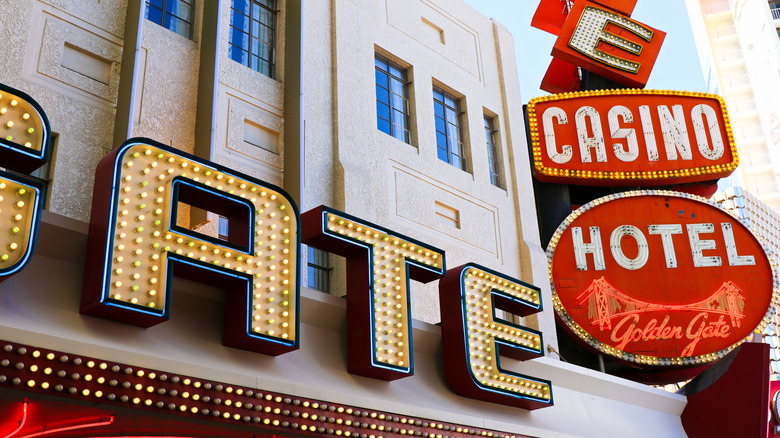
In a city that's constantly rebuilding, there's something subversive about holding on, but that's exactly what the Golden Gate Hotel & Casino has done for 120 years. Las Vegas' oldest casino mixes historic charm with modern flair at its downtown address of 1 Fremont Street. Opening just a year after the birth of the railroad town of Las Vegas, Golden Gate — then known as the Hotel Nevada — offered rooms for just $1 and was the first casino in Vegas. In fact, it offered many firsts: the city's first telephone in 1907 and one of its earliest electric signs in 1927, predating the neon signs that later characterized Las Vegas.
In 1955, a group of Bay Area Italian-Americans bought the hotel-casino and renamed it after the Golden Gate Bridge. Four years later, they introduced one of Vegas' most iconic staples: the 50-cent shrimp cocktail, a favorite treat in San Francisco's Fisherman's Wharf, now available in the desert. After selling over 25 million shrimp cocktails, the hotel stopped serving them in 2017, but its sister hotel, the Circa, has it on the menu. While it's unknown how many shrimp cocktails the Rat Pack ate, what is known is that these Las Vegas stalwarts used to party at the Golden Gate's Bar Prohibition and performed there in the 1960s.
Although the Golden Gate was renovated in 2012, visitors can still enjoy historical elements. Artifacts like early-1900s hotel ledgers and Prohibition-era flasks line the lobby, where you can also find a 1907 Kellogg telephone like the one the hotel had, once reachable by just dialing 1. There are also the 10 rooms from the original Hotel Nevada, whose furniture has changed, but the structure has not, allowing guests to feel a bit of Las Vegas' long-lost history.
Flamingo
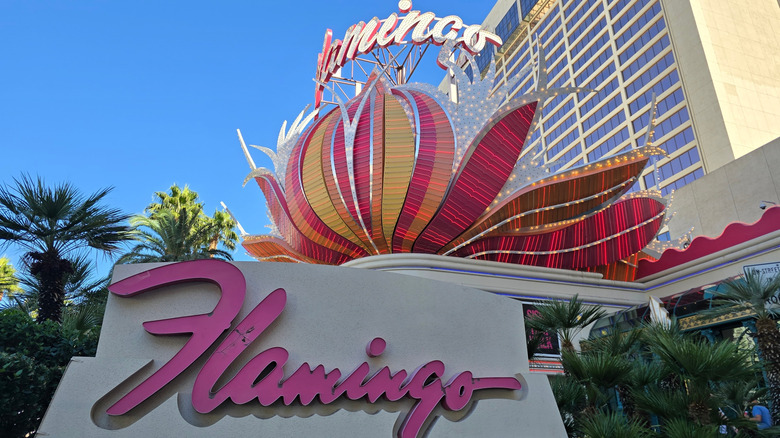
While many of the 1950s hotels on the Strip had links to the mob, none was as strong as the Flamingo. This accommodation option was one of the first hotel-casinos to be opened by a famous gangster. Billy Wilkerson, founder of the Hollywood Reporter, bought land on the Strip to open a hotel for the Hollywood elite. He sought the investment of New York crime boss Meyer Lansky, who appointed Bugsy Siegel to oversee the whole operation.
When it opened in 1946, the hotel helped popularize now-standard elements of Vegas casinos: no clocks or windows, 24/7 air conditioning, and a reception you had to reach by walking through the casino. Siegel became the face of the hotel, openly canoodling with A-list guests like Cary Grant and Frank Sinatra. Siegel's murder in June 1947 only further cemented the hotel's mafia image. According to legend, within hours of his death, three gangsters walked into the Flamingo to say that there was going to be a change of ownership.
Of the famous 1950s Las Vegas hotels along the long, somewhat unwalkable Strip, the Flamingo is one of the few still standing, though its original buildings were demolished by 1993. Even so, the presence of Siegel remains, which is somewhat jarring considering he was a murderer who committed multiple sexual assaults and was pro-segregation. Folks can dine at Bugsy & Meyer's Steakhouse, and Siegel's face is on decorations around the hotel, with management explaining the idea of wanting guests to feel like they're in the Flamingo of the '40s and '50s, filled with "glamor, class, and intrigue."
The Tropicana
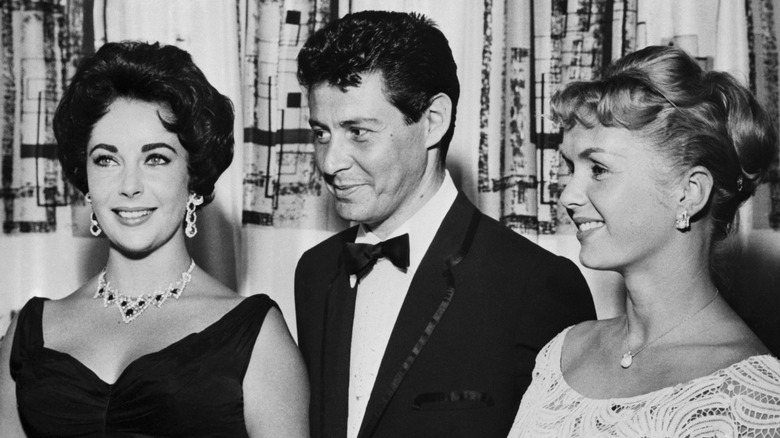
Known as the "Tiffany of the Strip," the Tropicana (or the "Trop") was the epitome of high-end luxury when it opened in 1957. It was one of the Strip's first resort hotels and among the most expensive, with a reported $15 million price tag ($165 million adjusted for inflation). A 60-foot fountain, pool with music underwater, and 300 rooms all created a fantasy world where guests — both celebrity and regular folks — could lose themselves in opulence. As the Las Vegas Sun wrote, "This fantastically beautiful resort hotel combines lush luxury, extremely good taste, warmth, intimacy and functional efficiency."
Not long after its opening, the Trop's mob connections became public. The hotel's management company had ties to crime boss Frank Costello (one of the inspirations for Vito Corleone in "The Godfather"), who survived a botched assassination attempt in 1957. The police found a paper in his pocket listing the Tropicana's earnings, alerting the public to who was behind the hotel, and leading it to become one of the "most mobbed-up casinos" in Vegas.
The hotel itself became an icon where Siegfried % Roy debuted, and it was known as "the most expensive and glamorous" of the Vegas Strip hotels, according to SF Gate. In 1972, Sammy Davis Jr. acquired a financial stake in the property, making it the first resort to sell shares to a Black man. Unfortunately, its decline came soon after, when the FBI uncovered a massive mob skimming operation (the inspiration for Martin Scorsese's "Casino"). Ownership and identity changes coupled with the rise of the mega-resort rendered the Trop obsolete, turning it into a decrepit simulacrum of itself, and it was demolished in 2024 to make way for the Oakland A's stadium.
El Cortez brings flair to downtown Las Vegas
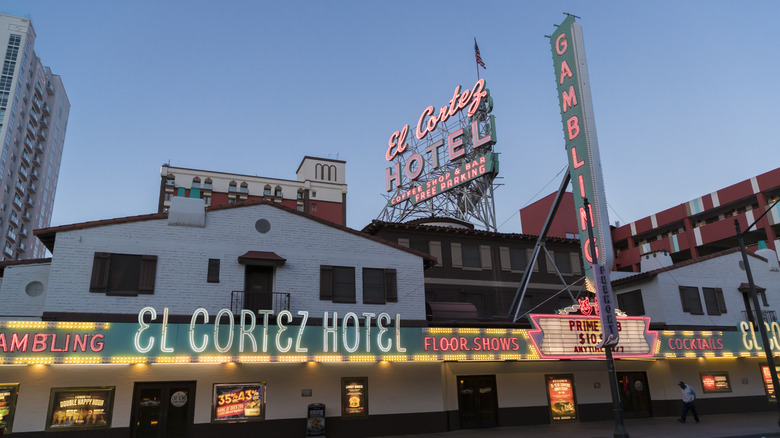
While the Flamingo may have been Bugsy Siegel's most famous Vegas investment, it wasn't his only one. In fact, it wasn't even his first one. That honor goes to El Cortez, downtown's underrated casino resort, which opened in 1941. Owned by John C. Grayson, Marion Hicks, and J.K. Houssels, El Cortez was a Las Vegas pioneer. As downtown's first luxury hotel-casino, the style and modernity of El Cortez illuminated what was to come in Vegas, which wouldn't see its explosion of mob-operated hotel-casinos for a few years yet.
Its style was Spanish colonial revival, inspired by a hotel in Mexico, and its air conditioning throughout was a novelty at the time. In 1945, Grayson and the others sold the hotel to mobsters Bugsy Siegel, Gus Greenbaum, and Moe Sedway, although this investment was kept mostly hush-hush. This marked the beginning of their involvement with Las Vegas hotel-casinos, making El Cortez a seminal part of Las Vegas' development in the 1950s.
Houssels bought the hotel back in 1946 and added a swimming pool, nightclub, and barber shop, cementing its place as a go-to desert escape. A neon marquee was added in 1952 that still flashes today. In a city that's eternally developing, El Cortez stands out as one of the few Vegas institutions that has retained its history. The vintage and modern meet in the "Original 47," rooms in the hotel's first wing, which offer modern amenities in historic spaces for those wanting to experience old Las Vegas. It's no wonder El Cortez was added to the National Register of Historic Places in 2013, and to date, it's the only active casino on that list.
Methodology
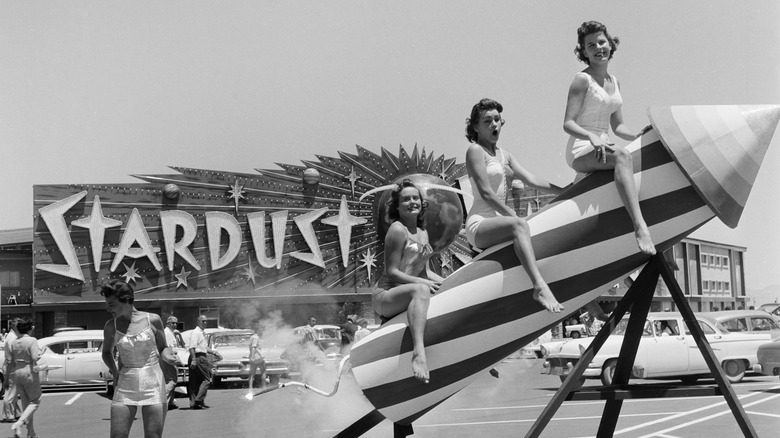
Las Vegas is filled with once-thriving casinos that no longer exist, so we initially sought a mix of 1950s hotels that had been demolished and others that were still standing. That proved to be somewhat of a difficult task in Las Vegas. The city of ephemeral pleasures and desires is constantly rebuilding upon itself, which means that nearly all of these hotels are now gone. So, we chose hotels that were not only iconic in the 1950s but also had something special, whether that was the size, amenities, or their impact on the city and culture.
Besides that, we sought information from national publications and websites such as SFGate, Esquire, and History.com, as well as local publications such as the Las Vegas Sun, to provide a broader context on the history and influence of these hotels in their heyday. The Mob Museum and the Neon Museum, both based in Las Vegas, were also very helpful with organizing this list and offering a deeper understanding of Las Vegas history.