
Michigan's Once-Thriving Mining Site Is Now A Scenic Nature Preserve Home To The State's Longest-Known Cave
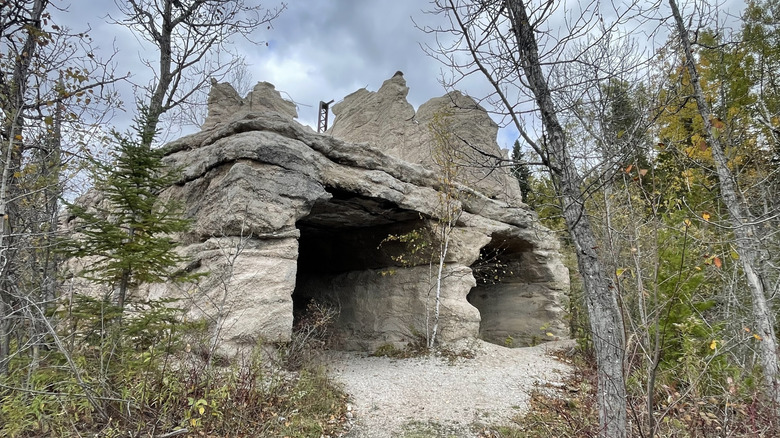
One might sometimes think that time stands still in the Great Lakes State, especially since Michigan is home to some of the best abandoned ghost towns worth exploring. One of these distinctive destinations is hidden in the Upper Peninsula. Back in the day, the village of Fiborn was established around a thriving quarry, which began its operations in 1904. That said, what makes this once-prosperous mining site so unique and interesting today is its geological feature — it contains Michigan's longest known cave, the Hendrie River Water Cave. Now, the former quarry has been rehabilitated into a scenic nature preserve called Fiborn Karst, where you can discover its past and wonders.
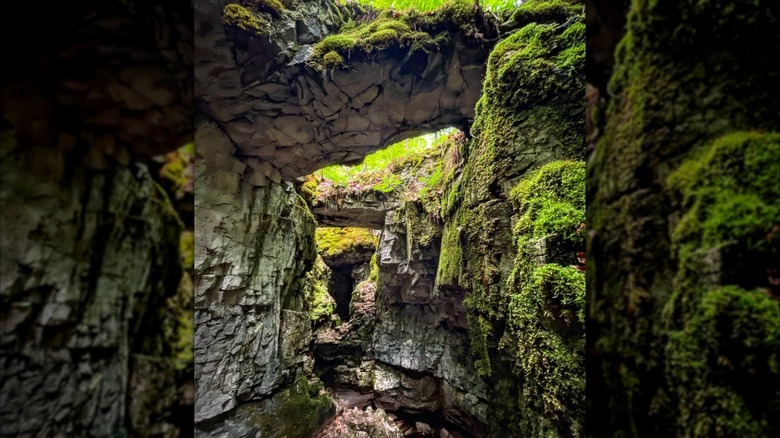
The discovery of the Hendrie River Water Cave occurred around the same time this area was being surveyed for its high-grade limestone. The sedimentary rock was processed and transported, intended mainly for steel, construction, and chemical applications. Unlike the Sea Lion Caves in Oregon, the largest of its kind in the Americas, this cave is much younger. The Oregon attraction is estimated to have formed over 25 million years, while the one in Michigan is 7,000 to 10,000 years old. As the longest of its kind in the state, it has a length of about 1,500 feet.
Although the quarry closed down in 1936, the 480-acre Fiborn Karst Preserve was founded decades later in 1987, allowing visitors to enjoy hiking and spelunking. Despite being open for caving, it can be quite challenging for those uncomfortable with confined spaces. The preserve is located 2.5 hours from Marquette, a small city on Lake Superior's shores. Escanaba is closer at a little over two hours, while the drive from Sault Ste. Marie takes about an hour.
What you'll experience at the Fiborn Karst Preserve
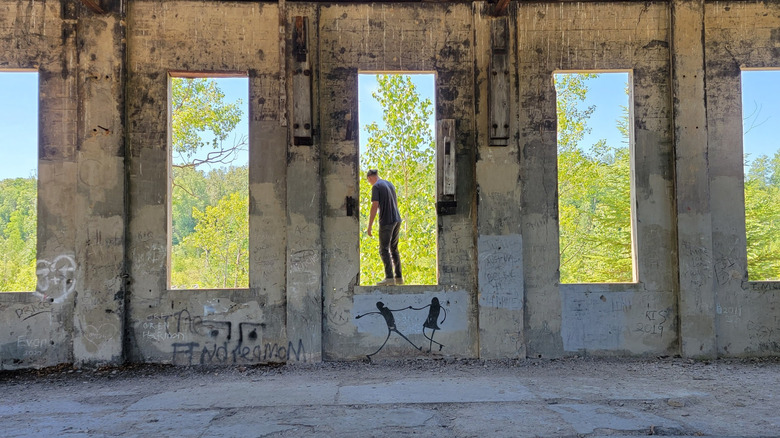
The Fiborn Karst Preserve is maintained by Michigan Karst Conservancy, which has kept the area as raw as possible. Instead of turning it into a touristy spot, the preserve offers a ghost-town feel with crumbling, 90-year-old concrete structures dotted all over the place. The preserve consists of beech and maple forests, as well as hemlock and balsam fir. Meanwhile, the karst landscape is characterized by soluble bedrock that dissolves, creating features like sinkholes and streams.
You can learn about the former mine by following two different self-guided trails. Take the 1.5-mile Barbara Ann Patrie Memorial Trail to make a loop around the preserve. This path starts in the forest, leading you to remnants of extraction sites, spoil ridges, small caves, and abandoned buildings. The Dr. Rane L. Curl Sinkhole Trail, on the other hand, exposes you to limestone-dissolution sinkholes and subtle karst landforms. You'll walk past the Flat Creek Sinkhole, Cone Sink, and Brushy Sink, all of which have been formed due to acidity in the water.
Thrill-seekers may be especially intrigued by the preserve's cave. Stretching for 1,500 feet, the Hendrie River Water Cave was created as a result of acidic water seeping into limestone cracks after the last-remaining glaciers melted. This widened the cracks into passages large enough for exploration. The cave boasts narrow yet high openings, with a stream on the floor that might have you walking in knee-deep or deeper water. Note that you can't enter the cave without securing permission from the committee beforehand. Not only that, but the cave is a winter habitat for hibernating bats, such as the northern long-eared bat and little brown bat. For this reason, the cave is closed from mid-October to mid-May to protect the populations.
Tips for visiting the Fiborn Karst Preserve
Since the Fiborn Karst Preserve is conserved in its authentic form, it has limited mobility access and is not suitable for wheelchairs or strollers. Moreover, they can cause severe soil erosion, trail expansion, and damage to the local vegetation. Wear full-coverage clothing and proper footwear to navigate the muddy terrain — and most importantly, do not go near the sides of the sinkholes, as the surface is pretty loose. Don't forget to bring enough water and a compass. Should you stray from the Sinkhole Trail, walk north via the forest to reach Norton Camp Road and reorient your direction.
Fiborn Karst Preserve has strict rules that everyone must follow. For instance, you shouldn't light a fire or camp out at the preserve. For the health of the forest, you must leave all deadwood and vegetation in place. If you want to gather minerals or plants, you must have explicit permission to do so — the same applies to moving rocks and caving. Once you obtain the permit from Michigan Karst Conservancy, you can plan a spelunking trip at Hendrie River Water Cave.
The cave is open between late spring and early autumn — either way, be prepared for a lot of mosquitoes in the area. The best time to go caving is during dry spells, as the passage can become dangerous due to flooding after rainfall. You must equip yourself properly for the wet environment with waterproof footwear, knee pads, gloves, and helmets. Because you are entering a lightless environment, carry at least three separate light sources, such as a helmet-mounted light and two backups. It's best to avoid caving here if you have no prior experience. Instead, you can check out other spooky caves in the U.S. or Canada that don't require as much effort.