
The Best Cruise Ship Water Parks And Rides, Ranked By Innovation And Thrill Factor
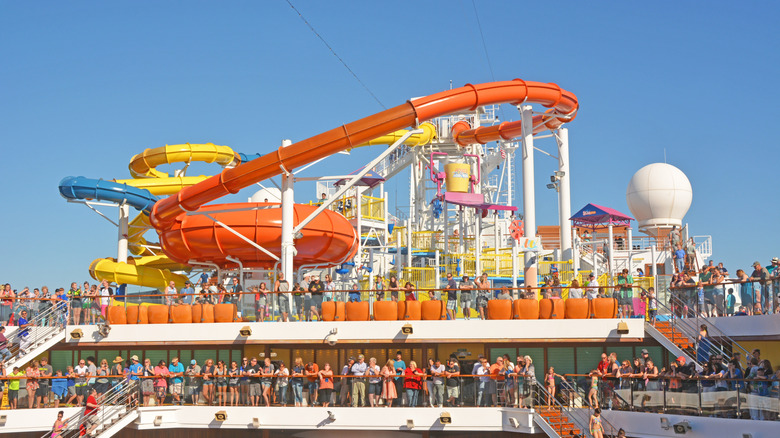
Once no more than simple poolside slides, cruise ship water attractions have undergone a change into some of the fastest-evolving spaces on sea. What began with modest additions, like Carnival's early waterslide installations in the late 1970s, has grown into a full-scale arms race among major cruise lines — each pushing the limits of size, spectacle, and design.
Today, top decks resemble floating water resorts, with multi-level aquaparks featuring slides that stretch hundreds of feet, drop several decks, and cater to a wide range of passengers, from thrill-seekers to young families. Advances in technology such as acrylic fiberglass have enabled transparent slide sections, allowing riders to glide above open ocean, a breakthrough first popularized by Disney Cruise Line's AquaDuck in 2011 and later expanded into more ambitious attractions across rival fleets.
With cruise lines resolved to out-splash one another, innovation has become the name of the game. Come 2026, this momentum will only accelerate. Royal Caribbean's Legend of the Seas debuts in July with what promises to be the largest waterpark at sea, featuring six waterslides. As the scale continues to grow, these spaces are becoming central to how cruise lines compete for attention. Against this backdrop, the list below ranks the best cruise ship waterparks and rides at sea today, based on how they combine scale, innovation, and overall experience.
1. Category 6 Waterpark: Icon of the Seas by Royal Caribbean
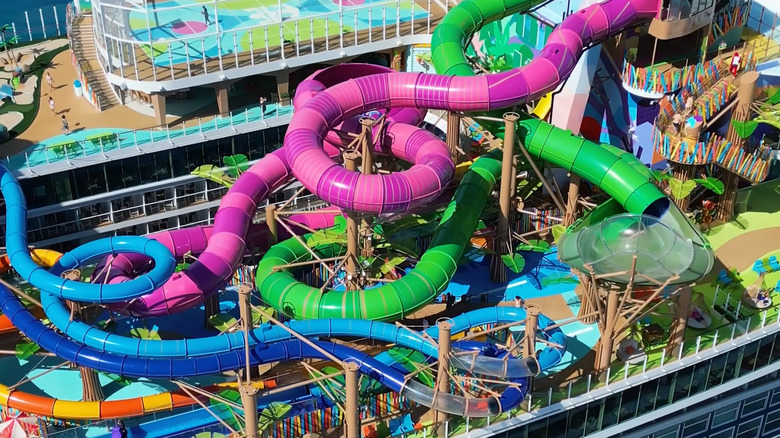
The scale of onboard waterparks on luxury cruise liners has shifted dramatically in recent years, but few have taken it to the level of Category 6 Waterpark aboard Icon of the Seas, the world's largest cruise ship. At the heart of the ship's Thrill Island "neighborhood" — a zone exclusively dedicated to high-adrenaline pursuits — the complex is widely described as the largest waterpark at sea, not just for its footprint, but also for the concentration of record-breaking rides it brings together.
Its top ranking rests on a combination of size and engineering ambition. Category 6 comprises six waterslides, each designed to push a specific boundary. Frightening Bolt rises as the tallest drop slide at sea, while the Pressure Drop — with its near-vertical 66-degree incline — introduced the first open free-fall concept at sea. Another first comes in the form of Storm Chasers, which introduced a dual mat-racing slide, allowing riders to race side-by-side through high-speed twists. The experience expands with Hurricane Hunter and Storm Surge, both offering multi-rider family raft slides for the first time, both splashing riders with surprises from all directions on long slides reaching over 400 feet each. In particular, the Storm Surge stands out for its promise of a near weightless sensation, wherein it extends outwards in a section cantilevered over the ocean, creating an illusion of almost being thrown off the ship. Riders are not charged extra for this immersive experience, as access is included within the cruise fare.
In Category 6, the scale is not just vertical, but also spatial. The slides stretch across multiple decks, incorporating 360-degree tailspins, not just establishing supremacy over waterparks at sea, but rivaling those on land as well.
2. Aqua Slidecoaster: Norwegian Aqua by Norwegian Cruise Line
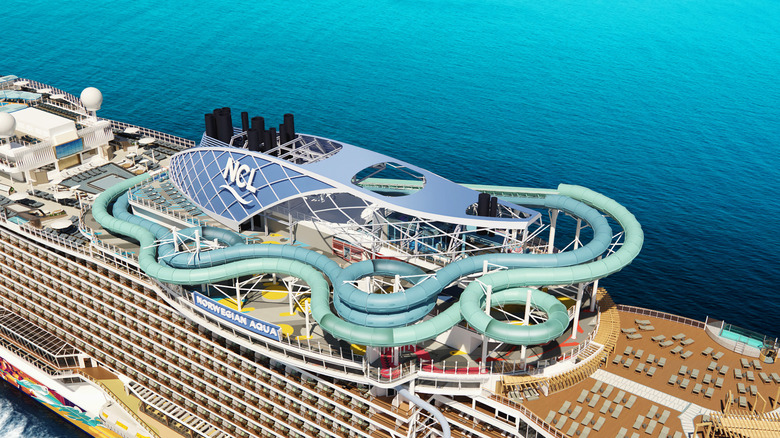
If Category 6 represents scale, the Aqua Slidecoaster aboard Norwegian Aqua secures its second spot for pure innovation. Debuting with the ship's launch in 2025, the attraction is widely billed as the world's first slidecoaster that blends water fun with a coaster twist, the longest and fastest of its kind, setting it apart from every other ride on this list. Positioned at the very top of the ship, the ride feature two slides — each about 886 feet — that wrap around the vessel's funnel in a striking, tubular structure that feels closer to a roller coaster than a cruise amenity (hence the name). What sets it apart is its unique and patented propulsion system. Instead of relying solely on gravity, the ride uses a combination of conveyor lift and magnetic propulsion technology to push rafts uphill before releasing them into high-speed sections. The launch mechanism uses a contactless linear synchronous motor technology, similar to what's used in major accelerated roller coasters, propelling the rafts simultaneously along both slide tracks.
Riders can go solo or in pairs on inflatable rafts, racing along dual tracks winding across multiple decks. The experience begins at high speed before settling into a more controlled momentum, as one twists and turns through illuminated tubes, shifting between open and enclosed segments, dialing up the thrill. At a speed of up to 31 mph, it can accommodate around 720 riders per hour, a testimony to its engineering sophistication. Having made a splash on board the Aqua, the Slidecoaster has now been introduced on Norwegian Luna as of 2026. Norwegian Cruise Line had set out to create something "that had never been done before on ships," and it delivers on that ambition.
3. The Blaster: Navigation of the Seas by Royal Caribbean
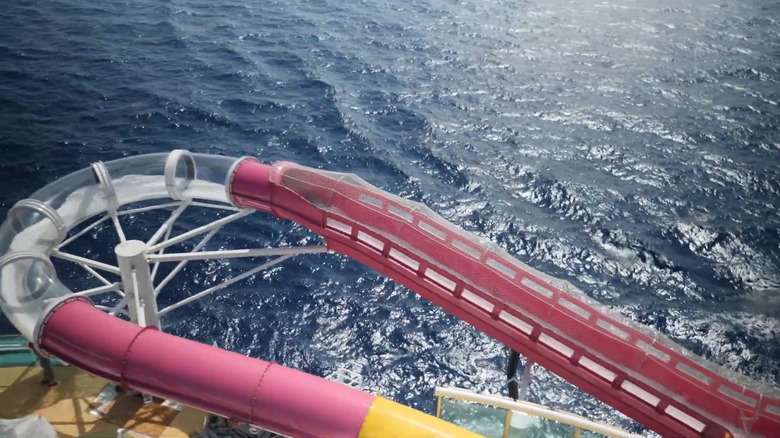
While newer rides like the Aqua Slidecoaster signal where cruise attractions are headed, The Blaster aboard Navigator of the Seas shows where they began. Introduced in 2019 as part of the ship's major refurbishment, it was, at launch, the longest water coaster in the industry at over 800 feet, edging past Disney's AquaDuck by about 35 feet.
The Blaster marked a shift from traditional slides to a true aqua coaster format. Using water jets to propel two-person rafts uphill, downhill, and forward, it extended ride time and complexity beyond gravity-led designs. Riders wind through a serpentine network of brightly-colored tubing weaving around the deck, before sections of the slide push out over open water. The experience favors sustained motion over steep drops. Enclosed tubes give way to open-air and transparent stretches, that briefly expose riders to the ocean below, while undulating rises and turns sustain the thrill for around two minutes. The Blaster was also conceived as a shared, two-person ride, with tandem rafts encouraging a more social, family-oriented experience, something Royal Caribbean identified as a key driver of guest satisfaction.
This ride is unique to Navigator of the Seas ship where it's positioned next to Riptide, a headfirst mat racer. As the cruise line's first aqua coaster, it stands apart by virtue of its propulsion technology, extended ride length, and engineering complexity, when compared to other slide-based experiences that define "Perfect Storm" elsewhere, and which are ranked separately below. It may no longer be the most advanced ride at sea, but The Blaster's legacy lies in setting the template.
4. Perfect Storm: Multiple ships by Royal Caribbean
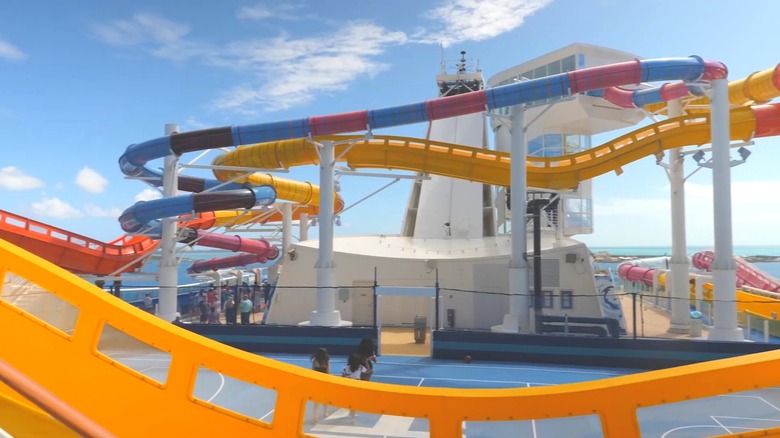
Where The Blaster promises a singular, high-impact ride, Perfect Storm delivers variety at scale across parts of the Royal Caribbean fleet. Featured on multiple Royal Caribbean ships, including vessels like Symphony of the Seas and Harmony of the Seas, the concept is not one slide, but a multi-slide complex designed for repeat thrills.
At its core are the twin racer slides, Cyclone and Typhoon, both rising roughly four decks high and built for side-by-side competition. Riders launch simultaneously, twisting through tight turns to see who reaches the bottom first. On some ships, a third slide completes the lineup. The Supercell, found on at least five Oasis-class ships, sends riders swirling through a bowl basin before a final drop, while Tidal Wave, featured on ships like Liberty of the Seas, propels riders up a near-vertical wall for a brief moment of weightlessness before the splashdown. The strength of Perfect Storm lies in its accessibility and replay value. Unlike single headline rides, this is a complex guests can return to multiple times, with all slides included in the cruise fare.
It ranks just below The Blaster because it lacks the same level of engineering complexity. But its fleet-wide presence, variety of slide styles, and broad appeal make it one of the most influential waterpark concepts at sea.
5. AquaDunk: Disney Magic by Disney Cruise Line
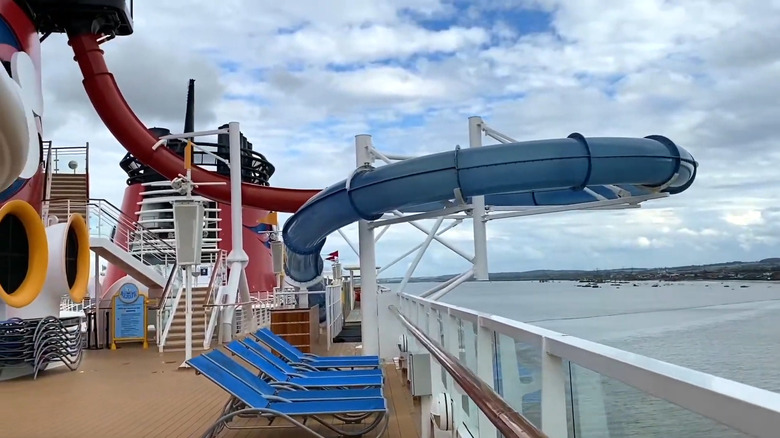
Disney Cruise Line has long been known for its family-friendly water attractions that blend storytelling with accessible thrills, from rides like the AquaDuck water coaster to the floating amusement park-like AquaMouse, with its 700-foot water slide. The AquaDunk aboard Disney Magic takes thrill levels up a notch, shifting the mood toward a more intense, high-adrenaline experience.
Introduced as a more extreme counterpart to Disney's waterslides, this three-story body slide begins with a trapdoor release, dropping riders into a near-vertical plunge through a translucent tube that extends out over the side of the ship. The experience is built as much around anticipation as speed, where riders step into a capsule, brace for the countdown, and then free fall as the floor disappears beneath them. At roughly 212 feet in length, with sections projecting over open water, the ride creates the illusion of being suspended beyond the ship's edge, amplifying both the visual and physical thrill. Unlike raft-based attractions, AquaDunk is a solo body slide, designed for riders seeking a sharper adrenaline rush. Its higher height requirement (48 inches) and short, intense duration, underline its focus on adrenaline alone, rather than a shared experience.
It ranks below Perfect Storm as a single ride attraction, but its trapdoor drop and near-vertical plunge make it markedly more extreme than AquaDuck, securing its place among the most thrilling water experiences at sea, especially under the care of a cruise line known to have the best crew members.
6. AquaDuck: Disney Fantasy and Disney Dream by Disney Cruise Line
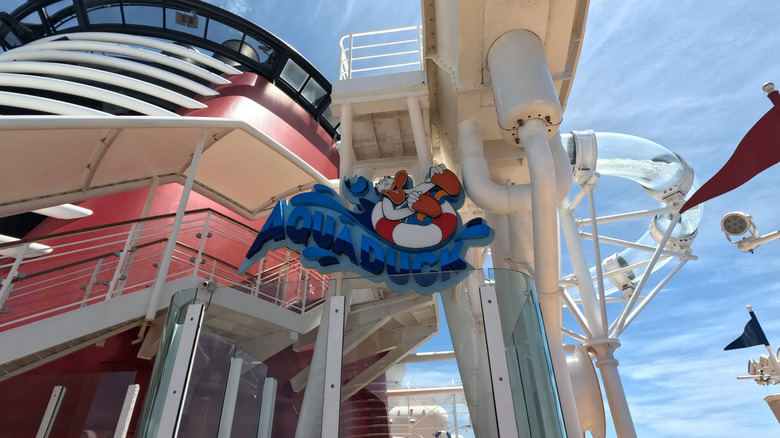
The AquaDuck water slide on Disney Cruise Line's Disney Dream and Disney Fantasy bears strong testimony to Disney Cruise Line's core strength, combining engineering innovation with broad, family-friendly appeal. Widely regarded as the first water coaster at sea when it was launched in 2010, it set a new benchmark by blending rollercoaster-style propulsion with a traditional waterslide format.
Stretching 765 feet across four decks, the ride sends two-person rafts through a network of clear acrylic tubes that wrap around the ship's upper decks. Water jets propel riders uphill before gravity takes over, creating a continuous experience that alternates between enclosed and open-air sections. At several points, the slide extends beyond the ship's edge, offering sweeping ocean views before easing into a gentler, lazy river-style finish. In keeping with Disney's signature storytelling, the ride is framed as a creation of Donald Duck's nephews, adding a playful narrative layer to the experience.
Unlike AquaDunk's near-vertical drop, AquaDuck champions duration over intensity. The raft system provides a sense of security, while the smoother ride profile makes it suitable for a wider age range, though its popularity often leads to long queues on sea days. This one ranks below AquaDunk for its lower thrill factor, but its pioneering design and enduring appeal makes it one of the most recognizable water rides at sea.
7. The Drop: Norwegian Prima by Norwegian Cruise Line
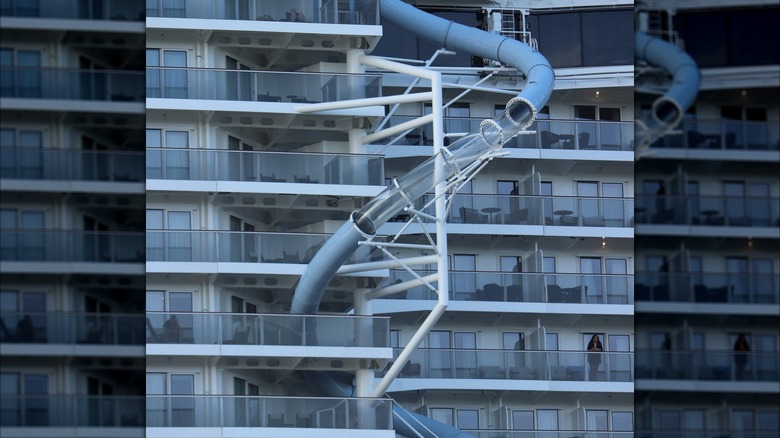
At a towering 10 stories, The Drop aboard Norwegian Prima class ships delivers a near-vertical plunge that prioritizes raw speed over twists and turns. Touted as the world's first free-fall dry slide at sea, this one promises one of the most intense, high-speed descents on any cruise ship rides.
According to Travel Weekly, the ride begins inside a vertical capsule, where riders are secured in a fitted liner before the countdown starts. Within seconds, the floor drops away, sending them plunging through a dark, enclosed tube. The descent is abrupt and disorienting, driven entirely by gravity, before the slide curves and briefly opens into a transparent section that reveals the ocean below, adding a fleeting visual jolt to the experience. Unlike water-based rides and slides aboard cruise liners, The Drop offers no floatation, no gradual build, and no extended ride path. It is designed as a single, high-impact moment, lasting only a few seconds but delivering intense G-forces comparable to high-speed coasters.
While it shares the trap-door free-fall concept with AquaDunk, the latter ranks higher for its story-telling element and fun water-splashes along the way. The Drop, however, stands out for its stripped-down advance design, making it the only extreme dry slide of its kind at sea. Some riders have also noted occasional mid-descent slowdowns, underscoring the ride's reliance on gravity and rider positioning rather than continuous propulsion.
8. VR-enhanced waterslides: MSC World Europa and fleet by MSC Cruises
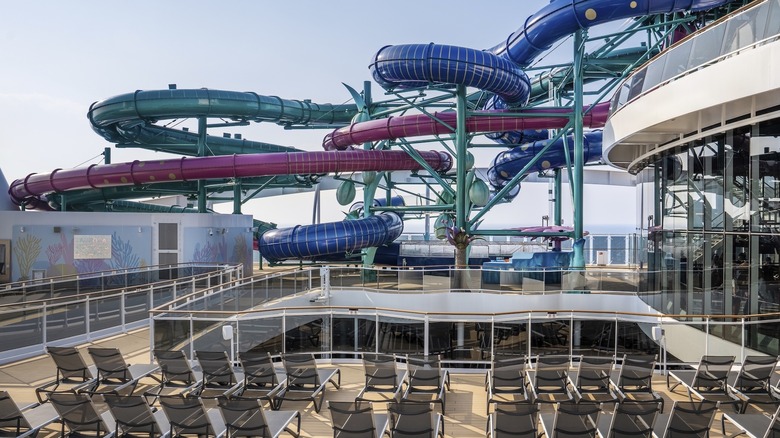
MSC Cruises takes a different approach to onboard waterparks, shifting the focus from physical scale to tech immersion. On ships like MSC World Europa, one of the largest cruise ships, which debuted in 2022, sits the biggest waterpark in the MSC fleet — the Aurora Borealis Aquapark, which combines traditional slide formats with digital enhancements.
The setup typically includes a mix of raft slides, racing slides, and vertical drop experiences, but the standout feature is a VR-enhanced waterslide, where riders can opt to wear headsets that layer virtual visuals onto the physical ride. Similar configurations are also found on sister ships like MSC World America, where an aquapark within zones like The Harbor feature a range of multi-slide layouts, including a raft slide with VR integration and a near-vertical drop attraction. The vertical drop slide delivers moments of intensity, while the racer and raft slides prioritize accessibility, making the overall experience suitable for a broad range of passengers.
It ranks lower because the innovation lies in the experience aspect rather than ride mechanics. While the VR element adds novelty, it does not fundamentally impact the physical thrill of the slides, placing it below more structurally ambitious attractions on this list.
9. Carnival WaterWorks: Multiple ships by Carnival Cruise Line
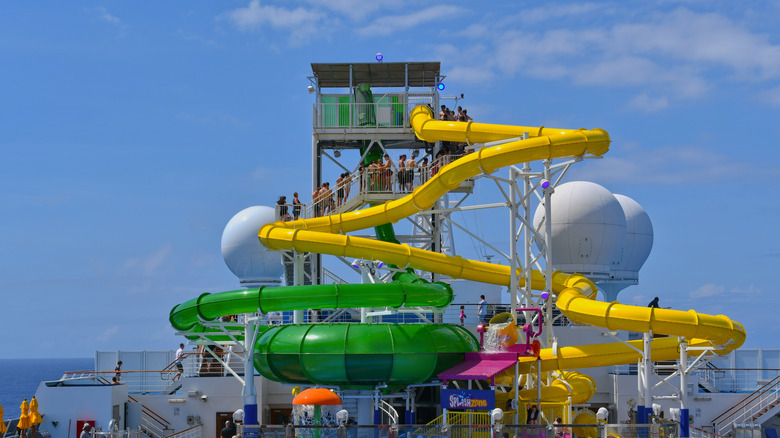
Widely credited as an early pioneer of waterslides at sea, dating back to a modest installation on its ship Festivale in 1978, Carnival Cruise Line has since expanded the concept into full-fledged waterpark zones found on nearly all its ships. Today, its on-board waterpark, WaterWorks, varies by vessel but follows a familiar formula, comprising a mix of twisting waterslides, racing slides, and interactive splash zones. Signature elements include spiraling slides like the Twister, racing tracks such as Speedway Splash, and interactive features like the PowerDrencher dump bucket. On select ships, like the Carnival Horizon, the concept is extended with themed or enhanced slides, including Dr. Seuss-inspired attractions, while on ships like Carnival Vista, the Kaleid-O-Slide adds a visual dimension with lighting effects designed to simulate a video-game-like environment.
The consistency across its fleet is central to its appeal, offering a familiar, repeatable experience regardless of itinerary or vessel. At the same time, the setup remains deliberately broad in its design, with features that cater to both younger passengers and adults looking for casual, repeat rides. Set against the scale and engineering ambition of today's aquaparks at sea, WaterWorks falls behind other entries on this list. However, its accessibility, fleetwide availability, and familiar format solidify its position as one of the most enduring waterparks at sea.
10. Pirates Cove: MSC Seascape and MSC Seashore by MSC Cruise Line
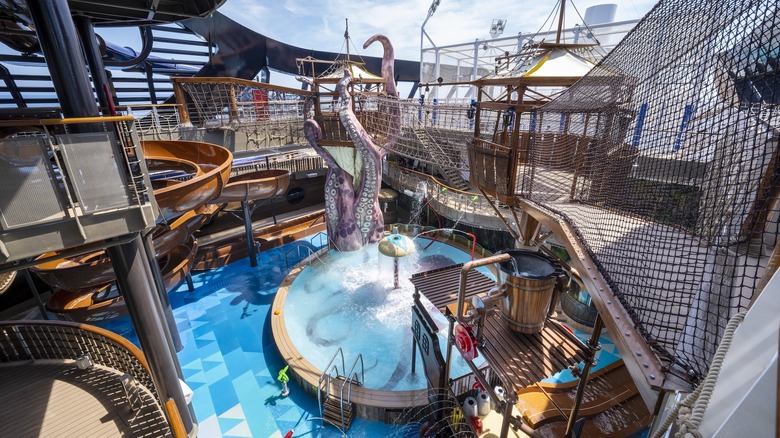
Pirate's Cove Aquapark on MSC Seascape and MSC Seashore shifts the focus from high-thrill spectacle to more immersive, family-oriented design rooted in storytelling. Built around a detailed pirate-ship theme, the space combines waterslides with interactive play features, creating an environment that functions as much as a themed playground as a traditional waterpark.
With a minimum age requirement of 7 years, the setup includes multiple slides — raft-friendly and slower options, alongside water cannons, drench buckets, and climbing structures spread across multiple decks. Some slides incorporate translucent and opaque tubing, creating alternating light and dark effects that heighten anticipation while offering fleeting views out toward the sea. Themed elements such as oversized kraken tentacles and a central pirate play structure further anchor the space in a seafaring narrative, adding to its immersive, story-driven design. On ships like MSC Seashore, the concept is extended with elements such as a VR-integrated slide and adventure trails, broadening its appeal to younger passengers.
Beyond the slides, the space is designed as a multi-layered play environment, with features like the AquaPlay area and tipping-bucket structures that encourage continuous interaction without lines. Add to this the color-patterned safety flooring enhance both visual depth and slip resistance, making it a safe zone while also offering a low-adrenaline, thematic escape.
11. Splashaway Bay: Multiple ships by Royal Caribbean
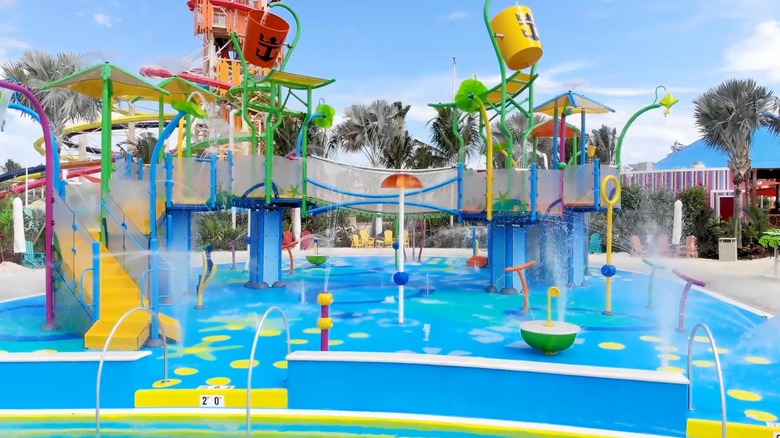
Splashaway Bay, introduced in 2016 on Harmony of the Seas, represents the most accessible end of cruise ship water attractions, designed specifically for young cruisers. Now featured across more than a dozen Royal Caribbean ships, the concept centers on a compact, brightly colored aquapark tailored to children between the ages of 7 and 11.
Typically located on the main pool deck, the space combines shallow pools with a cluster of interactive features, including water cannons, fountains, and a large tipping bucket. Small waterslides are integrated into the layout, with configurations varying by ship, some offering multiple slides for older children alongside smaller ones for younger users. Height restrictions (42 inches minimum) ensure that larger slides remain accessible only to kids above a certain threshold, while adjacent Baby Splash Zones on select ships with extremely shallow water cater to infants. The zone will also be featured on Legend of the Seas, the world's largest cruise ship that debuts later this summer, further expanding its presence across the fleet.
Unlike larger aquaparks, Splashaway Bay is tailored for continuous, low-intensity play, where the emphasis is on movement and interaction rather than structured rides. Its compact layout keeps all elements within easy reach, allowing children to cycle through activities without queues. A friendly space where play takes precedence over thrill.
12. Methodology
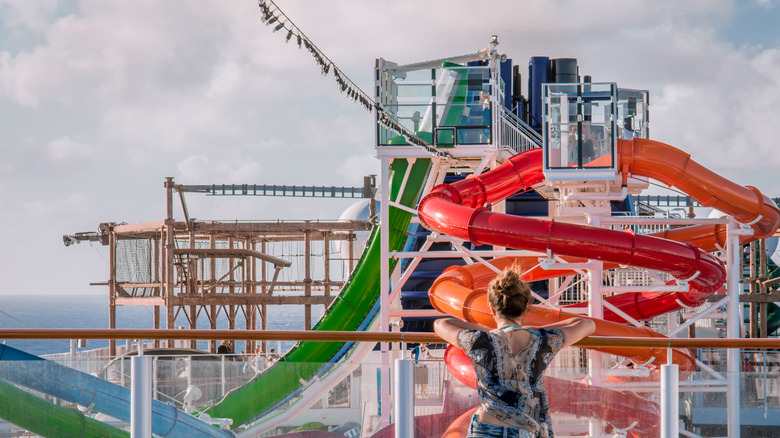
This ranking was shaped by a mix of reported insights and in-depth analysis of how cruise water attractions are designed and experienced today. We considered factors such as scale, engineering innovation, thrill level, and overall design, as well as how enjoyable and repeatable each experience is for different kinds of travellers. Sources ranged from cruise industry reports and ship reviews to insights from aquapark manufacturers and architects, along with official cruise line information, enabling a balanced view of both technical ambition and guest experience. Rather than focusing on a single metric, the ranking weighs how each attraction merges innovation with enjoyment to create a well-rounded experience.