
Why Are Clocks In Airports So Hard To Find?
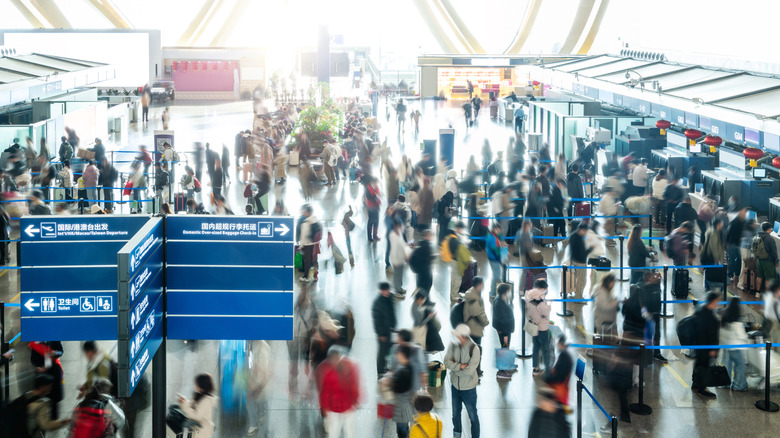
We all know the feeling: you arrived slightly behind schedule to the airport, and there was a longer-than-expected line at security. Now your flight is boarding and you're speed-walking to your gate, aware that you're cutting it close and scanning the terminal to check what time it is. But there are no clocks around, save for the tiny digits displayed on one corner of departure and arrival screens. As you arrive at your gate, catching your breath, you ask yourself: Why are clocks in airports so difficult to find?
There's not a simple (or universally agreed upon) answer to this question. It's a bit of a mystery why airports don't have large clocks on display to help travelers stay on schedule — after all, most train stations do, from the classic Swiss railway clock at Zurich Hauptbahnhof to the four-faced glass clock suspended above the main concourse at New York City's Grand Central Terminal, one of the most beautiful train stations in America.
One theory is that air travelers just don't need clocks anymore. Everyone's carrying a smartphone and many are wearing a watch or fitness tracker that displays the time. (Why, then, you might ask, do train stations, not to mention other time-dependent places like schools and gyms, bother with clocks?) Another hypothesis is that the airport doesn't want to be responsible for travelers missing their flights — or draw extra attention to delayed flight schedules, especially in an era where travel delays are reaching crisis levels.
Keeping track of time at the airport

What are some other reasons that large airports clocks are difficult to find? Some travel experts have pointed out that installing clocks would be a costly proposition for many airports, given the sprawling size of major travel hubs like the 7.5 million-square-foot Beijing Daxing International Airport (PKX), the world's largest airport terminal. "Airport concourses can be exceedingly long," wrote one frequent flyer on the travel blog Your Mileage May Vary, who suggests that airports may see large clocks as an unnecessary expense. "At an airport such as Charlotte Douglas International Airport, Terminal E alone, with all its twists and turns, would need to have a minimum of five large clocks in the concourse, just so people at all 38 gates will have a fighting chance to see one." (Curious which U.S. airport has the shortest walking distances? It's Trenton-Mercer Airport in New Jersey.)
Maybe it does all come down to dollars and cents: one prevailing theory is that airports want travelers to lose track of time so that they spend more money at duty-free shops, restaurants, and bars between flights. As one person posted on the "Design Mystery" section of the TED Blog, airports have something in common with other places where people tend to overspend. "Airports, like casinos and spas," he wrote, "are conspicuously clock-free." If you don't know what time it is, you'll possibly play another round or order another drink — and more consumer spending is a win for the owners.
The bottom line is this: When it comes to air travel, you need your own method for keeping track of time. And if you have a long layover, when it's especially easy to get disoriented, check out these 14 ways to effectively use your extra hours at the airport.