
13 Unwritten Etiquette Rules You Should Know Before Staying In A Hostel

Staying in a hostel can be one of the most memorable parts of travel. It's affordable and social, and often puts you right in the middle of the action. But if you're new to travel, or you've only ever stayed in hotels or Airbnbs, adapting to the hostel experience can be a bit of a learning curve. You're suddenly sharing kitchens, bathrooms, and sleeping spaces with strangers, all with different schedules, habits, cultures, and expectations. And while many hostels do have a list of posted rules, a lot of what actually makes or breaks your stay comes from the unspoken ones.
The truth is, hostel life runs on a lot of shared understanding. It's often about being considerate and keeping things comfortable for those around you. After all, no one wants to deal with a roommate waking everyone up at 3 a.m., or one who mysteriously "borrows" your leftovers from the fridge. Individually, each thing can seem small — but when they add up, they can make a huge difference between a great stay and a place you can't wait to leave.
Whether you're a first-timer or just need a quick refresher, following these unwritten etiquette rules is key to not only being a great guest but also helping you get the most out of your experience. As a budget traveler who has stayed in too many hostels to count over the years, I've largely relied on my own experience to compile these unwritten etiquette rules. However, I've also consulted Reddit travel threads as well as travel blogs like Nomadic Matt, Travel Lemming, the Savvy Backpacker, and Cuppa to Copa Travels, to incorporate the experiences and opinions of other travelers.
Clean up after yourself

There are already plenty of dirty surfaces in a hotel. Now think of a hostel full of high-traffic shared spaces, people coming in and out, and generally careless travelers. Not to say that all hostels are dirty — in fact, I've stayed in some that are on par with or even nicer than hotels — but regardless of what the conditions of the hostel are like, don't be part of the problem.
Cleaning up after yourself is the number one rule of following hostel etiquette. I'm still a bit disgruntled over the times when I've gone to prepare a meal in the hostel kitchen only to find a sink full of dishes and not one clean pan. So before you walk away, try to leave the space the same — or even better — than you found it. The same goes for the bathroom.
"I can't for the life of me figure out how people get places so damn dirty," said long-time travel blogger Nomadic Matt. "Throw your trash, toilet paper, etc., in the bin, don't pee on the floor, and, if you have to throw up, do it in the toilet, not the sink or shower." It might sound obvious, but in a shared space, even small messes can quickly pile up when everyone assumes someone else will take care of it.
Not all food is up for grabs

The lack of courtesy and boundaries among hostel-goers shows up in many forms. But one of the most egregious ways is when it comes to food. As you may know, the majority of hostels feature a kitchen, including a refrigerator, for travelers to store their food. Sounds great, right? The problem arises when other travelers feel entitled to whatever is in the shared refrigerator. And while it might seem harmless to grab "just a little bit" of something, those small actions are exactly what create tension in shared spaces.
A general rule of thumb is to assume that nothing is meant to be shared. Some hostels do provide basic cooking items like seasonings or olive oil, but beyond that, it's probably not yours for the taking. Hostels that do provide free breakfast or drinks will make it abundantly clear, and you definitely won't find those complimentary items hidden in the back of a shared refrigerator. When in doubt, ask — many travelers are happy to share, but no one appreciates having their groceries quietly disappear.
Minimize noise at night and in the early morning
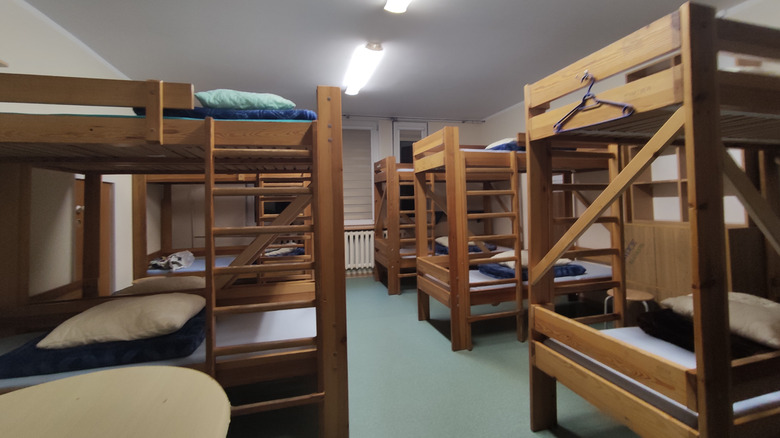
If you're staying in a shared room, it's reasonable to assume it won't be completely quiet. But a little effort goes a long way. When arriving at your hostel late at night, try not to make too much noise when entering your shared room and getting ready for bed. And the same goes for travelers with early wake-up times. Pack your things and lay out your outfit ahead of time — not only will it make your morning less stressful, but your roommates will appreciate not being woken up by the noise of you frantically throwing things in your bag.
You can still use an alarm, but keep the volume as low as you can — avoid setting it at full blast. And don't be the person who snoozes it five times. And whatever you do — "Never, ever, ever try to get something out of a plastic bag quietly while other people are sleeping," warned one Reddit user in r/SoloTravel. "It is impossible. Don't even rummage around near a plastic bag."
Noise is acceptable during the day, but don't forget basic etiquette
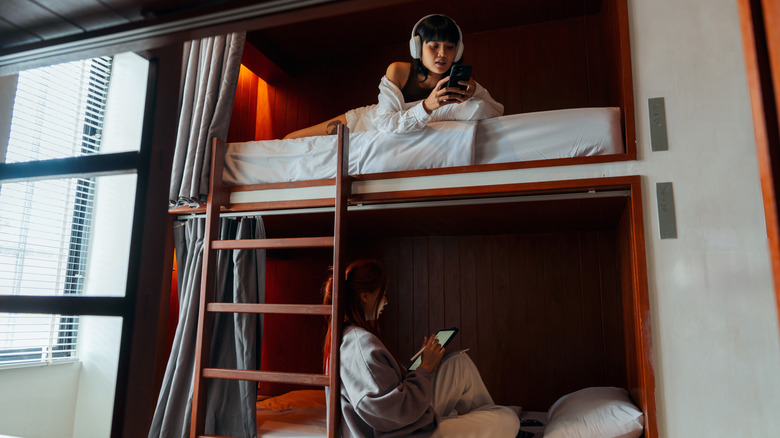
While a general rule of thumb is to try to minimize noise when sharing a dorm room in a hostel, there is a certain point where you don't need to tiptoe around. It's generally understood that around 8 a.m. or so, it's acceptable to move about freely. That doesn't mean you can throw all etiquette out the window, though.
Regardless of what time it is, remember that you're in a public space. No one else wants to listen to your choice of music, so keep those earbuds in. And if someone is still sleeping at odd hours, "try to let them rest," said travel blogger Travel Lemming. "Someone may need to go to bed at 10 p.m. for an early morning flight, or someone might need to sleep until 1 p.m. to catch up from a late night out."
If you're going to FaceTime, talk on the phone, or just chat with another roommate, be considerate and make use of one of the hostel's common rooms instead. Being mindful doesn't mean walking on eggshells. It just means remembering that shared space comes with shared responsibility.
Consider your dorm mates
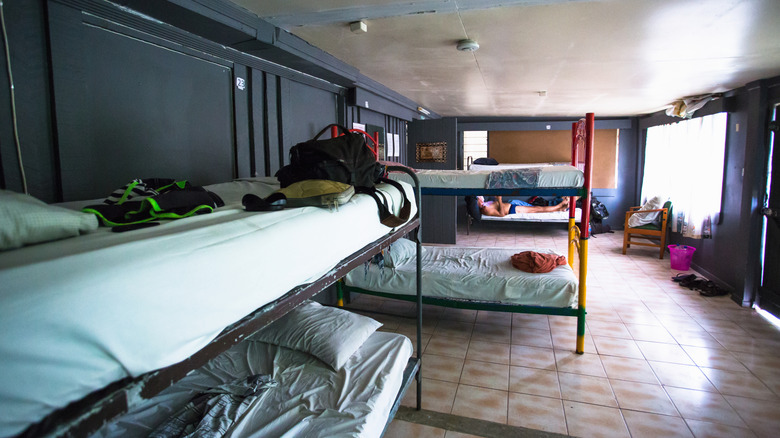
There's a lot more to being a good roommate than just monitoring your noise levels. When it comes to hostel etiquette, be mindful of the fact that you are — above all else — sharing a space. If you're arriving in the middle of the night, don't be that person who turns the dorm room lights on, waking up everyone. "Every hostel has one jerk who barges into the room and flips the lights on at 3 a.m.," said travel blogger The Savvy Backpacker. "Most rooms aren't pitch black so just take 30 seconds to let your eyes adjust to the light before finding your bed. Or use a key chain flashlight or the light from your phone."
Although it is a bedroom, you also want to avoid completely undressing in a shared dorm. Get changed in a bathroom stall, instead, or have a traveling companion hold up a sheet for a makeshift dressing room. And definitely do not bring other people into the dorms, for safety reasons and just general respect for your dorm mates. If you need private time with someone you've met on your travels — please, on behalf of travelers everywhere who have at least one or two horror stories about this — book a private room.
Don't hog the facilities
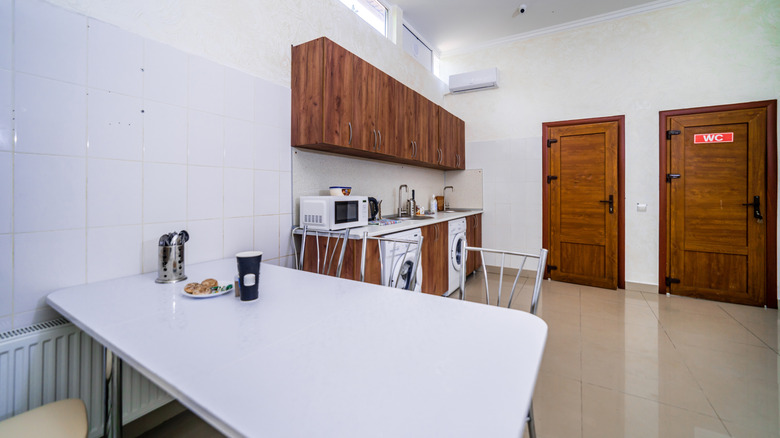
If there's one mantra to keep in mind throughout your time at a hostel, it's this: you are sharing a space. A little awareness of how long you're using shared resources can make a big difference, especially during peak morning and evening hours. Hostels do not have infinite resources, which means there can be a limited number of showers available, and the hot water won't run indefinitely. "I remember a guy taking an hour-long shower multiple times a day in a dorm of ten. Don't be that guy," said one Reddit user in r/SoloTravel.
The same goes for using the kitchen. Don't use up the entire stove when cooking or take over every shelf in the shared refrigerator. Some hostels have limited outlets, so be mindful of how long you're leaving your electronics plugged in if that's the case. If there's only one outlet, don't take it over by charging all of your electronics at once. The Savvy Backpacker recommends bringing your own power strip with a USB port — sharing it might even help you make some friends!
Keep your belongings confined to your space
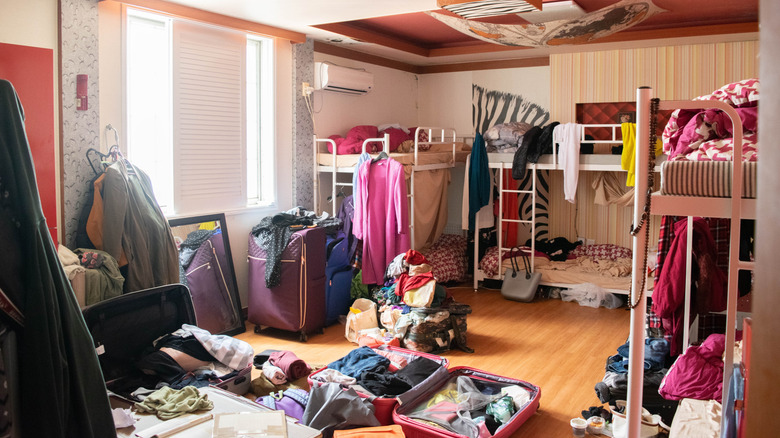
It can be difficult to stay perfectly tidy and organized in a cramped, shared space. But at the very least, contain any mess to your own bed and designated area when staying in a hostel. While there's no problem with doing laundry, skip hanging or laying your items on other people's beds or around the room. Not only will this keep your roommates happy, but it will also help you keep your belongings safe. If you leave any toiletries in the bathroom, for instance, don't be surprised if people use them, or even take them.
And while we're on the subject, it's not just about your possessions, but you as well. When in a shared hostel dorm, avoid sitting on other people's beds. "I notice this happens particularly with top-bunk people. I've seen a top bunk person sit on the bottom bunk in order to put their shoes on, fold their laundry, or just check their phone," said travel blogger Travel Lemming. "When I'm in the bottom bunk, I don't want some random person sitting on my bed. It might not seem like a big deal — especially if the bottom bunk guest would never know — but it's basic etiquette."
Consider hygiene
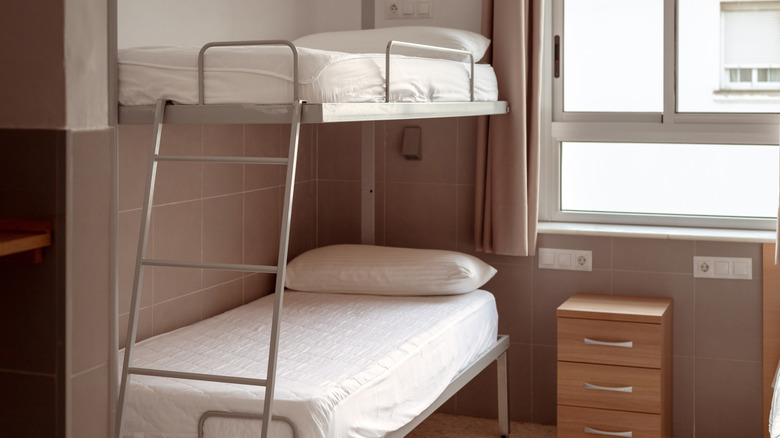
It's not uncommon for anyone who's traveled for an extended period to end up lugging around shoes or other unclean clothing items. I get it — it's not always easy to find the best laundromat when traveling, or maybe you simply don't want to spend time on your limited vacation doing laundry. But please, don't subject your dorm mates to your smelly shoes — leave them outside the room. "I'm begging you. Don't gas out your dorm-mates, and if they're that smelly, just trust that no one — no one — is going to steal them," said travel blogger Cuppa to Copa Travels.
The same goes for all sorts of hygiene-related factors. Don't leave food in the dorms where it can smell or, even worse, attract bugs. And if the dreaded happens and you get sick while traveling, bite the bullet and get a private room. It's best for everyone's sake.
Know that not all hostels are the same

Before staying at a hostel, you may have an image in your head about what they're like. But with 18,000 budget accommodations on the booking platform HostelWorld, it's impossible to lump them all together. Believe it or not, not all hostels are geared toward partiers. Some offer relaxing beach getaways, others target digital nomads, and some solely focus on specific activities, like yoga or surfing.
With that said, it's fair to be a bit disappointed when the atmosphere does not meet your expectations. Doing a bit of research ahead of time, like reading recent reviews, can help you avoid surprises and choose a place that matches your travel style. But when it comes to etiquette, it's best to adapt a bit to a hostel's atmosphere. If the accommodation has a quieter vibe, be extra mindful of noise. On the flipside, if you accidentally find yourself at a party hostel, be a little more tolerant of, well, partying. (Within reason, of course, and if a hostel is ever truly not working out for you, you can always leave early and find somewhere else to stay.)
Be open to talking to others
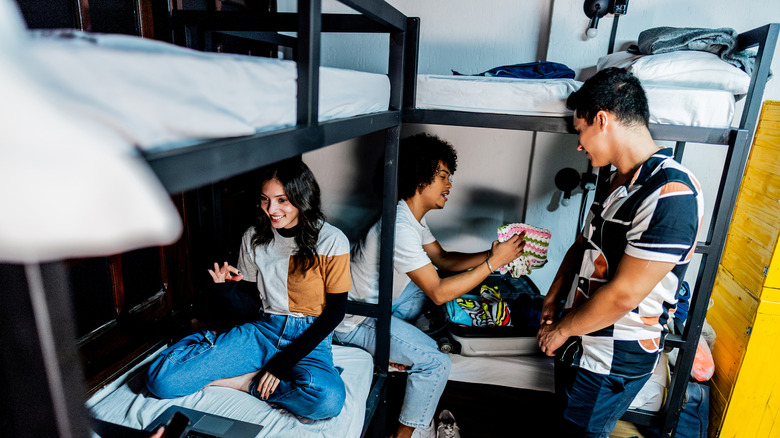
Socializing with others is one of the best ways to make the most of your stay, which ranks it among the biggest benefits of opting for a hostel over a traditional hotel or short-term rental. Connections made at hostels can lead to shared meals and excursions, travel tips, and even long-term friendships. If you're looking to make friends, "set up in the common room with a pack of beers and a deck of cards, play solitaire till you can tempt some folks into a game," advised one Reddit user in r/SoloTravel. "Also, learn some games." Simple conversation starters like asking where someone is from and how their trip is going can go a long way.
Even if you've already found a group, avoid getting cliquey, and remember to be inclusive and welcoming to other travelers as well. If you're not in the mood to socialize or looking to make friends, that's okay too. But, at the very least, stay polite (especially if staying in a shared dorm), and say hello and introduce yourself to others.
Respect other people's boundaries

Yes, it's great to be friendly and make conversation, and generally, most hostel guests are open to socializing. But, it's equally — or even more — crucial to recognize when someone isn't interested in chatting. "Maybe they're busy (digital nomads getting work done on their laptops)," said a Reddit user in r/SoloTravel. "Maybe they just need to decompress (girls with their earbuds in who've already had seven dudes approach them before breakfast)."
Reading the room (or the dorm) is one of the most underrated skills when it comes to hostel etiquette. Pay attention to body language and social cues. For instance, if someone has the curtains closed around their bed, is working on a laptop, or is wearing headphones, it's safe to assume they're not open to conversation. Other signs can include one-word answers and avoiding eye contact. Respecting other travelers' boundaries is key to maintaining a safe and comfortable environment for everyone. And on the flipside, if you find yourself caught in a conversation you don't want to be in or at the receiving end of unwanted attention, don't be afraid to politely state your boundaries, remove yourself from the situation, or, in more serious cases, get hostel staff involved.
If you can't follow these rules, get a private room

If you find any of these unwritten hostel etiquette rules difficult to adhere to, that doesn't mean you need to write off hostels completely. The good news is that most hostels offer private rooms. Yes, they're a bit more pricey than a dorm bed, but they're still reasonably priced if you're traveling on a shoestring budget. They're generally far more affordable than a hotel and may even include some of the same perks, like private bathrooms or housekeeping.
I've opted for private rooms at hostels myself and have often been impressed by the quality for the price. So if you plan to have guests, are particularly messy, or even just have a tendency for loud snoring, book yourself a private space. You can still take advantage of all the socialization opportunities that hostels offer while enjoying some extra privacy. At the end of the day, choosing the right setup for your travel style is just as important as following etiquette once you're there.
Respect hostel staff

Many travelers can overlook the role that hostel staff plays in maintaining a clean, safe, and enjoyable space for everyone. From setting up breakfast each day to housekeeping and helping coordinate tours and other activities, they do a lot behind the scenes. As you would with other travelers, greet them when you see them, and always be polite and respectful. And following all these unwritten (and written) hostel rules is the best way to do so, from cleaning up after yourself to respecting the check-out time.
"The staff doesn't have much control over the behavior of the other guests," said travel blogger The Broke Backpacker. "If you have any problems with other people in the hostel, definitely bring it up to the staff — especially if you feel unsafe or uncomfortable – but please be friendly about it when you do."
Beyond just following basic etiquette, getting along with hostel staff can even improve your trip. Over the years, I've gotten lots of restaurant and sightseeing recommendations and general travel help from kind hostel employees.