
8 Things You Didn't Realize Could Get You Banned From An Airline
Most airline passengers know that major misconduct on a plane, like physically assaulting a crew member, becoming severely intoxicated, or smoking and vaping in the bathroom, can quickly get a person removed from a specific flight or even permanently banned from an airline. However, there are also a surprising number of lesser-known actions that can result in a ban.
Some of the issues we'll look at here are fairly apparent in-air safety violations, but others fall into more of a gray area, involving things like attire, etiquette disputes, and behavior on the internet. So-called travel hacks like skiplagging can seriously violate airline rules, while disruptive behavior, such as refusing to move a seat out of its reclined position, can have more serious consequences than many travelers know. As you read on, you'll learn about 8 things you probably didn't realize could get you banned from an airline,
To come up with this list, we dove into reliable sources including other travel site's like View from the Wing and Live and Let's Fly. We also researched the topic on legal sites like Criminal Defense Lawyer and university Law Reviews, plus government sites like the FAA and the Federal Register. Finally, we referenced news and entertainment sites like CNBC, People Magazine, the New York Post, and The Independent, in addition to comment hubs including Reddit. The result? A list that's both enlightening and cautionary for travelers.
Wearing clothing deemed inappropriate
While the majority of travelers will never board a plane in attire that is considered so offensive or inappropriate that it could get them removed from a flight or banned from an airline, it has happened. A lot of things have changed since the golden age of aviation, including what in-flight meals look like in the '60s. One thing that hasn't shifted, though, is that carriers still have dress codes by which passengers are expected to abide. Although nobody is expecting airline passengers to dress as if they're extras in "Mad Men," a bit of care and consideration with one's appearance goes a long way toward making the in-air experience more pleasant for everyone. While every airline has its own policies regarding what to do with patrons whose clothing is deemed too offensive to fly, many brands do reserve the right to refuse boarding or ban passengers who fail to comply with dress code regulations.
A New York Post article shared several specific dress code rules from popular airlines. It's important to remember that these rules extend well beyond obvious violations, like t-shirts featuring profanity or explicit images. Hawaiian Airlines, for instance, does not allow passengers to board wearing only their bathing suits. Qatar Airways, meanwhile, is rather rigid, with policies against shorts and sportswear while in the air. Major domestic carriers tend to have looser language, with Delta, United, and American all indicating that passengers must simply wear proper attire, including shoes. In two specific instances, Southwest banned a female flier from boarding for a top that was deemed too low cut, and Delta refused boarding to a man whose shirt was emblazoned with an upsetting statement: "Terrists gonna kill us call."
Filming airline staff without consent
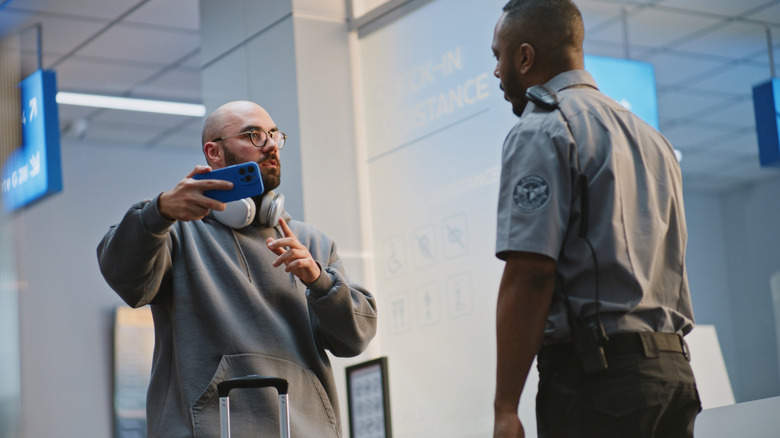
Filming airline employees without getting their express permission may seem harmless to many modern travelers, particularly since airport videos are popular on TikTok and Instagram. However, several airlines have become increasingly cognizant of passengers recording tense interactions with gate agents or flight attendants and subsequently posting the videos on social media. One reason for this is that social posts often tell only one side of the story, potentially portraying airline staff in a negative light without full context. Privacy concerns for crew members are another major issue. Some travelers are unaware that filming and posting crew without consent is enough to get you banned by certain airlines.
British Airways' conditions of carriage reserve the right to ban people from specific flights or from the airline overall if they engage in "filming, live streaming or taking photographs of any BA crew or other colleagues without their consent." According to airline reps who spoke to The Independent and other outlets, this policy was primarily enacted to respect crew members' privacy, and did not stem from a single, particular incident. Other major global airlines like KLM and Qantas have enacted similar regulations. In a specific example, American Airlines refused boarding to a man who began filming a gate agent following a dispute involving his carry-on baggage.
Fake service animals
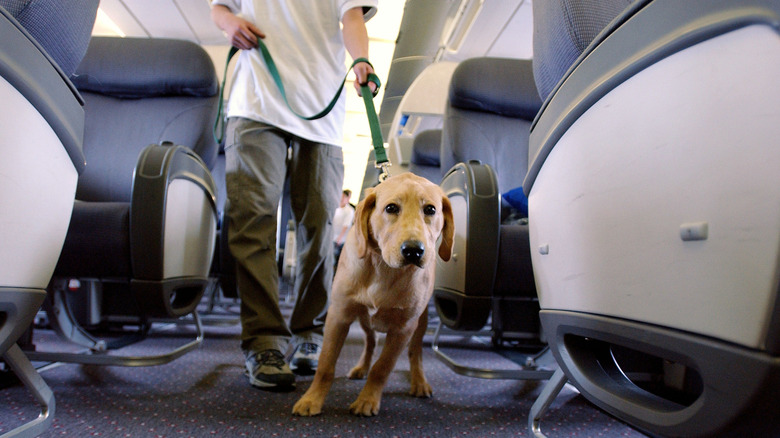
There are many TSA guidelines for traveling with pets, but one thing many people never consider is that agents have to be on the lookout for fake service animals. While the majority of honest, well-intentioned airline passengers are unaware that people even try to falsely claim everyday pets as service animals, this has actually become a significant problem. While legitimate service animals and their owners are under federal protection, many airlines have dealt with people who try to pass off untrained pets as working animals to avoid paying fees. There were so many complaints about this issue, in fact, that the U.S. Department of Transportation revised federal regulations pertaining to service animals on flights.
As of the time this article was published, emotional support animals are not automatically classed as service animals, and carriers are not required to board any animal — or, by extension, its human owner — that is not a trained service dog for a disabled individual. In one situation discussed on Reddit, two dogs that did not appear to be service canines acted disruptively in an airport terminal, leading passengers to believe that their owner was attempting to pass them off as service animals, even though they weren't properly trained. One Reddit commenter reacted to the events by noting, "The FAA already allows airlines to block passengers when their alleged service dog is creating a disturbance. This is a clear situation where the airport or airline could kick this person out of the airport."
Skiplagging and hidden city tickets
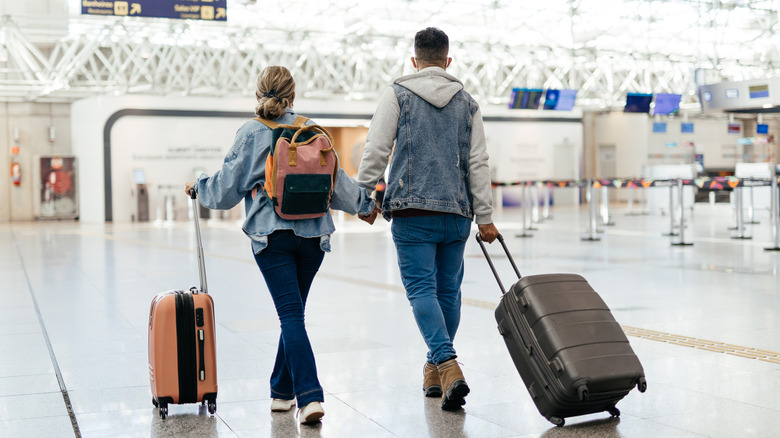
Skiplagging, a practice that is also referred to as hidden-city ticketing or throwaway ticketing, is perhaps the internet's most controversial travel "hack." Although it can save passengers large sums of money on airfare, carriers severely frown upon it, and many have implemented severe consequences for passengers who are caught. Here's how skiplagging works: passengers book a flight with a layover in their destination city, and then intentionally skip the next leg of the journey. As an example scenario, someone wanting to visit Las Vegas might find that a ticket to Dallas with a connection in Las Vegas is less expensive than flying into LAS directly. Then, rather than boarding the flight to DFW, they just leave the airport upon landing at LAS. While travelers sometimes consider skiplagging to be the ultimate travel hack, carriers absolutely do not. As a matter of fact, American, United, Delta, and Southwest all have language that specifically prohibits skiplagging in their contracts of carriage.
Travelers who are found to be engaging in throwaway ticketing can face a range of consequences, from revoked points and miles to complete airline bans. American Airlines is particularly hard-nosed about punishing skiplaggers. In one case shared by View From the Wing, an AA ticket counter agent "suspected the passenger planned to skip the final flight segment and warned them they would be banned from American Airlines if they did not take the connection." In another situation shared by View From the Wing, a teenager who bought a ticket on Skipplagged.com was interrogated until he admitted his intent to miss the second leg of his flight. He ultimately had to pay full price for another American Airlines ticket to his destination. The carrier even sued that website, which helped people more easily engage in skiplagging, ultimately winning their suit.
Fighting about reclining seats
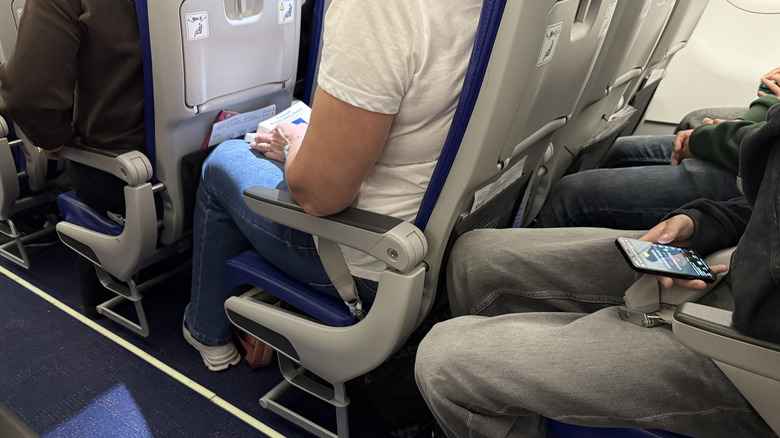
Few airline etiquette debates are as divisive as when it is appropriate to recline one's seat, especially in economy class. This polarizing issue has led to major news reports, Reddit discussions, and plenty of YouTube videos. In some situations, in-flight fights about reclining seats have become so intense that airlines have actually issued permanent bans for certain passengers. One incident that is now rather infamous involved a couple on a long-haul Cathay Pacific flight. Per a CNBC report, the duo engaged in "taunting, using vulgar hand gestures, and jostling the chair" of a fellow passenger whose seat was reclined. Crew members eventually intervened, and the couple was placed on the airline's internal no-fly list.
Another scenario that made major headlines involved a fight on a flight bound for Bali from Melbourne, Australia. In a video shared by People, viewers can see two men scuffling over one of their reclined seats before "multiple flight crew members quickly appeared and pulled the two passengers away from each other." The outlet did not share whether the passengers were banned or restricted. In most cases, airlines allow passengers to recline their seats when the seatbelt light is turned off (e.g., typically outside of takeoff, landing, and, in some cases, meal service). However, even when it's technically allowed, seat reclining can be a contentious matter. Crew members on airlines like American undergo de-escalation training in order to assist with potential conflicts.
Joking about or attempting to open emergency exit doors
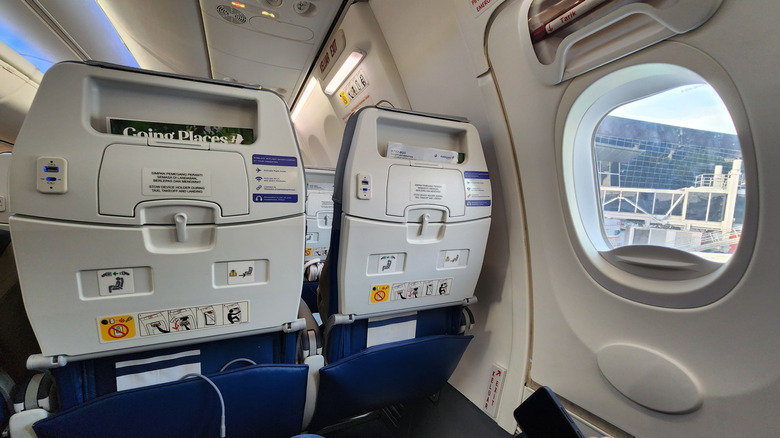
Although there are plenty of exit row perks travelers can enjoy, sitting in this row on a plane also comes with serious responsibilities if a disaster should occur. As a result, airlines take jokes about exit rows and emergency hatches extremely seriously. In fact, making light of exit row responsibilities can have serious consequences, ranging from airline bans to legitimate legal action. In one case that was filmed by another passenger and sent to Johnny Jet, a woman onboard a Frontier flight made a joke about being seated in the exit row and left the plane in handcuffs following a disrespectful conversation with the flight attendant. In another situation shared by Johnny Jet, a JetBlue patron with an exit row seat was forced to deplane after ignoring a crew member's safety presentation.
Although pilots and other aviation professionals confirm that it is physically impossible to actually open an exit door mid-flight (thanks, science!), joking about doing so is no laughing matter. Ask the Pilot's Patrick Smith explains that these doors are like "drain plugs," expounding: "You cannot — I repeat, cannot — open the doors or emergency hatches of an airplane in flight...cabin pressure won't allow it." It is, however, possible to force a hatch open when a plane is barely off the ground before it has reached its full cruising altitude. This actually happened in 2023 when a plane was around 700 feet in the air. The culprit, a 30-something man, was arrested right after the incident occurred. Due to situations like the ones outlined here, it is extremely important to keep any emergency exit row wisecracks to oneself.
Harassing airline crew on social media
Travelers generally assume that once they deplane, any altercations they might have had with crew members are over and done with. However, in the social media age, it's not entirely uncommon for carriers to monitor harassment directed at crew members online, as well. In certain instances, bad behavior on social media can even lead to airline bans. Perhaps the most notorious occurrence is when comedian Tyler Fischer was banned from flying Delta Air Lines after posting untoward comments about a flight attendant's sexuality on a social platform. The "Ask Dr. Drew" podcast shared that Fischer did delete the post prior to receiving his lifetime ban, but it was too little too late. Screenshots like those shared by Behind the Wings on Facebook had already begun circulating.
Despite Fischer's frustration, saying he spent "$10,000 in flights just in the last year with Delta. Now, what chance did they give me? Zero," the airline stood by its staffer. This is the perfect example of how free speech can sometimes backfire when a private company is involved. And, passengers aren't the only ones whose online antics are being scrutinized these days. While there's plenty of rude passenger behavior that flight attendants hate, some of them have engaged in their own impolite actions. Certain airlines have even suspended their own employees over toxic internet posts. Two British Airways crew members, for example, were placed on leave after their WhatsApp comments about a co-worker's weight became known to higher-ups.
Being barefoot on a plane
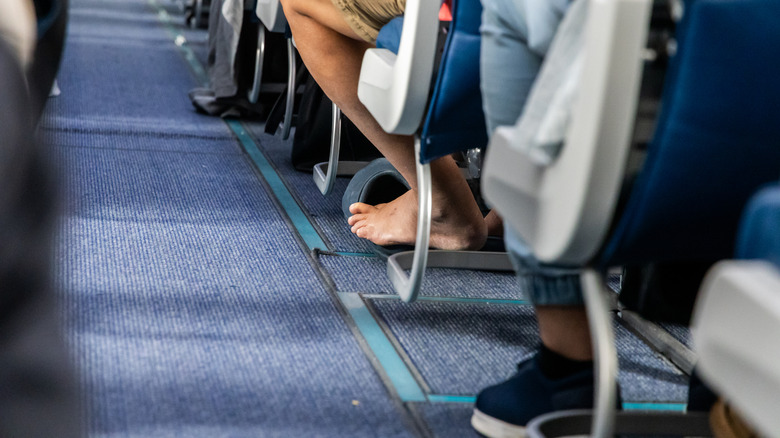
While it may seem harmless to remove one's shoes and socks on an airplane, especially during a long international flight, some airlines actually have policies that ban this behavior. In some cases, carriers even provide in-flight socks and slippers, even in economy classes. While policies about bare feet in-flight differ from one carrier to another, many popular domestic airlines, such as American, United, Southwest, JetBlue, and Delta, all reserve the right to "bounce" passengers from flights if they won't don at least socks. Exceptions are typically made for those with documented medical problems and for babies and toddlers. Southwest, for instance, allows children under age 5 to go barefoot.
In addition to facing a potential flight ban, passengers may simply offend others in their vicinity by removing their shoes and socks while in the air. Numerous social media videos have launched etiquette discussions about the propriety of going barefoot on a plane. The New York Post shared thoughts from etiquette pro Jacqueline Whitmore, who said, "For fellow passengers, seeing someone walk around barefoot can be considered unpleasant or unhygienic."
It's also worth noting that the floors in planes, especially in the restrooms, can be extremely dirty, so it's best to cover your feet properly to prevent illness. In addition to basic hygiene concerns, it's also worth thinking about what would happen if you were caught without shoes in an emergency situation, such as a water landing. It could be more challenging to exit the plane and put you at additional risk once in the water.