
What Nobody Believes About The Florida Everglades Until They See It For Themselves
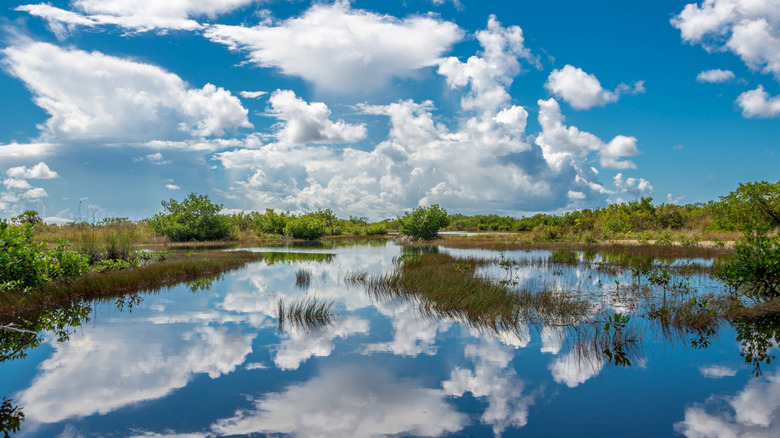
With its tall grasses, dense mangroves, and vast expanses of water, you could easily mistake Florida's Everglades for a swamp. After all, much like one of the largest swamps in the world — the Pantanal in South America, nicknamed the "Brazilian Serengeti" — the Everglades are tropical wetlands home to a wide diversity of wildlife. Yet the Everglades are not a swamp, but rather a slow-moving river.
It's a fact that lots of people won't believe until they see it for themselves. Many travelers on Google Reviews casually referred to the Everglades as "a swamp." One visitor described the place as "a very large, impenetrable swamp," and another, less-than-enthusiastic traveler chimed in, "this is a swamp and there are not as many points of interest as I would like."
Why do so many people share this misconception? First of all, Everglades National Park has waterways, but they're not conventional rivers. The park features a pair of freshwater sloughs, or marshy "sheets of water," that flow from Lake Okeechobee to Florida Bay. The larger of the two, which is 60 miles wide — much wider than any traditional river that visitors will have ever encountered — is nicknamed "the River of Grass." Perhaps that's because it looks more like a huge grassland than a river when you're standing in the wetlands, taking in views of one of America's most endangered national parks.
Explore the slow-moving rivers of the Everglades
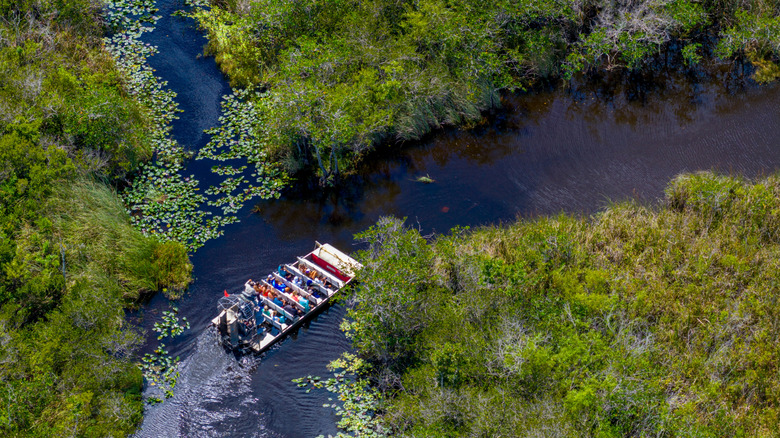
There's another good reason most people think that Florida's wildly underrated national park is a swamp. On a hot, sticky day in the Everglades, it seems like the water is still. But the river is flowing, just very slowly — about 2 feet each hour. In summer, the "River of Grass" can flow up to a mile per day, according to the National Park Service. In winter, it flows a mere 100 feet per day.
When's the best time to observe the slow-moving sloughs in action, and see for yourself that the Everglades are not, in fact, a static swamp? Summer into early fall is the region's rainy season, when the water moves more quickly. If you visit in the dry season of November through April, on the other hand, you might not see much movement, as the waters recede without daily rainfall. But the weather is milder and more pleasant, mosquitoes are less problematic, and it's prime time for alligator spotting. In either the rainy or dry season, depending on the conditions, the national park offers Wet Walks, also called "slough slogs," where participants follow the park rangers on a guided walk through marshes and sloughs to see plants, animals, and, yes, moving water. Check the park's calendar for availability.
Looking for more ways to explore the Everglades? Consider an outdoor adventure around crowd-free beaches and wildlife habitats in the Everglades' coastal backcountry. Or stick (somewhat) closer to civilization in Everglades City, an underrated Gulf Coast getaway with outdoor activities like fishing and kayaking.