
12 Things You Didn't Realize Could Get You Banned From National Parks
National Parks have delicate ecosystems and receive thousands of visitors each month, so safety precautions and resource protections are taken very seriously. Visits require some common sense and advance planning, as park regulations vary by location. And some of the things that have gotten people banned even make you think, "How do they come up with this stuff?" Yes, there may be some unwritten rules you should know before visiting a national park, but there are definitely written ones, too.
While the National Park Service doesn't have a comprehensive list of activities that would lead to a person's banishment, it's a punishment often doled out in addition to fines and, depending on the severity of the offense, jail time. There's also no set amount of time someone can be banned; it can range from one to a handful of years and may apply to a single park or several.
To compile this list, we referenced a range of news items related to actual incidents that resulted in park bans, and we considered how national parks treat a range of crimes. We've also consulted other articles, the Justice Department, law firms, and NPS.gov for lists of prohibited items or behaviors to provide a comprehensive overview of things you may not have even thought of. The next time you visit a national park, keep these tips in mind for a safe, respectful, and legal visit.
Defacing or contaminating park features (in ways you might not expect)
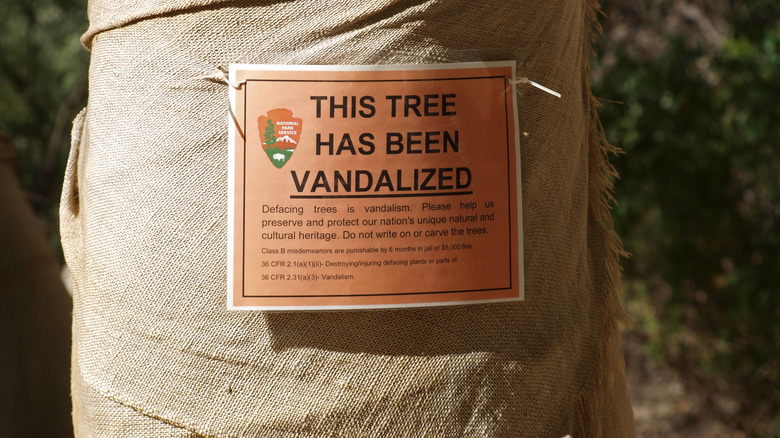
Defacing national park property probably seems like a no-brainer, but vandalizing, removing, or tampering with park features such as petroglyphs and geologic formations is also prohibited. The rule also applies to things that might not pop to mind right away, such as altering signage. According to Backpacker.com, one pair of social media content creators had a lark "correcting" the punctuation on a park sign at the Grand Canyon, only to be fined more than $3,000 and banned for a year for messing with what the park considers a historic artifact.
Graffiti in national parks is totally off-limits, and the U.S. Attorney's Office made an example of a San Diego woman who defaced rock formations in seven national parks with paint and marker. Removing or toppling features is off-limits, and no one should be trying to take fossils or ancient rock art. In Death Valley National Park, an ancient rock art depiction of a bighorn sheep is now permanently surrounded by the chisel marks of a failed theft.
Of course, national parks are composed of so much more than rocks and structures, as their diverse forests and waters are also vulnerable to human interference. Carving into trees is absolutely considered defacement. And in a unique interpretation of how to make the most of a visit to Yellowstone National Park, an Idaho man was banned for using a "hot spring as a hot pot," according to Meateater. Let's just say that cooking anything in a hydrothermal feature is a no-go.
Leading unauthorized commercial tours
There are several U.S. national parks you can see in one day, making group tours a popular option. Especially in places like the Grand Canyon, Yosemite, and other major parks, there are numerous authorized tour companies that are permitted to lead trips, but you can't just roll up with a large group and lead a commercial tour — you need a Commercial Use Authorization (CUA) for that.
Depending on the park, there may be different categories for this. The Grand Canyon, for example, offers options for those leading road-based van tours, backcountry treks, river equipment rentals, and more. Voyageurs National Park offers a variety of permits for different types of watercraft services, guided dog sledding, snowmobiling, and ice fishing trips.
The consequences can be steep if you ignore the rules. The National Park Service reports that one man was banned from Yellowstone for 5 years, along with other consequences, for leading unsanctioned tours that included trespassing. Another was sentenced to a year of probation, according to WATE 6 News, in addition to a $2,500 fine and a two-year ban from the Grand Canyon for leading an illegal packrafting trip on the Colorado River — for the second time. For your safety and others', adhere to park guidelines regarding CUAs for commercial ventures.
Flying a drone
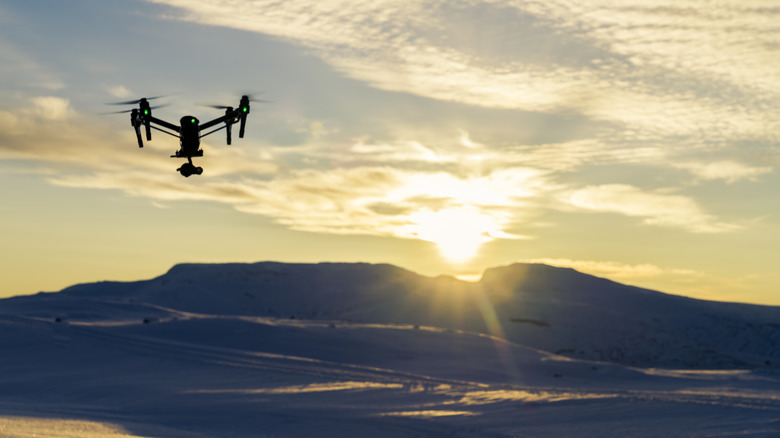
If you've paid attention to social media or to most films or nature documentaries made in the past few years, for that matter, drones are an integral part of how some of the most beautiful aerial photography and cinematography is captured. Unfortunately, that doesn't fly in national parks — literally. Any kind of uncrewed aircraft is prohibited in national parks, no matter if it's for personal or commercial use.
Drones are typically a nuisance to those not using them, as their electronic buzzing sounds and jarring movements distract from the wild scenes we're there to enjoy. Nothing takes you out of a beautiful sunset or wildlife encounter faster than one of these zipping over your head. Drones often crash, too, due to power loss, inclement weather, and other factors, which can lead to people being caught and banned. One even crashed into the Grand Prismatic Spring in Yellowstone, per the BBC, resulting in a hefty fine.
In May 2026, AOL.com reported that someone was flying a drone in Yellowstone National Park and harassing bears, visibly disturbing a mother and her cubs as they wandered through a meadow. Bystanders caught the interaction on video, but the person remotely operating the drone has yet to be identified. If found, they'd likely face a misdemeanor charge, which results in a maximum jail sentence of six months and a $5,000 fine, and a discretionary ban is probably a good bet.
Misleading law enforcement
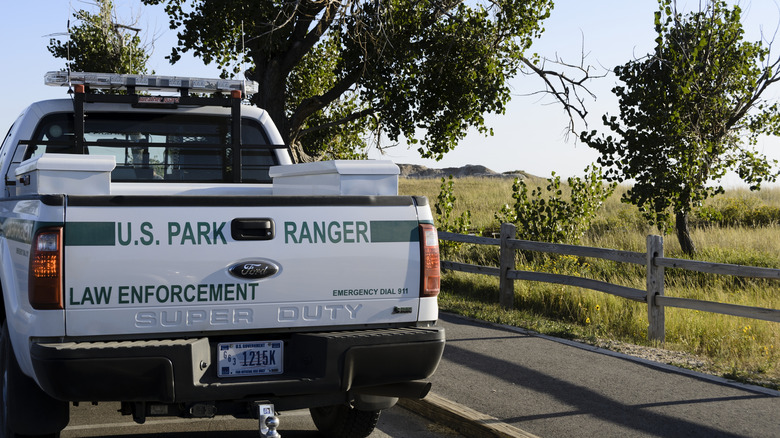
According to Fox 11 News, a man from Wisconsin spent a couple of years in jail for a triple threat committed in 2024: camping without a permit, assaulting a ranger, and interfering with law enforcement's daily activities by repeatedly calling 911 and harassing dispatchers. And in 2022, a woman was banned from Grand Teton National Park, one of the best places to visit in the winter for hiking, for knowingly providing false information about a missing hiker, per a report by ABC 4.
Her report led rescue teams to spend an incredible amount of time and resources looking in the wrong place. They determined the damage exceeded $17,000, which she was ordered to pay, and she was banned from the park for five years.
What do these two cases have in common? Wasting rescuers', rangers', and police officers' time can have serious consequences. According to the National Archives' Code of Federal Regulations, it's illegal to interfere with or provide false information to an officer or about an incident under investigation. Essentially, if you get in the way, you'll probably have to pay.
Carrying weapons (even bear spray)
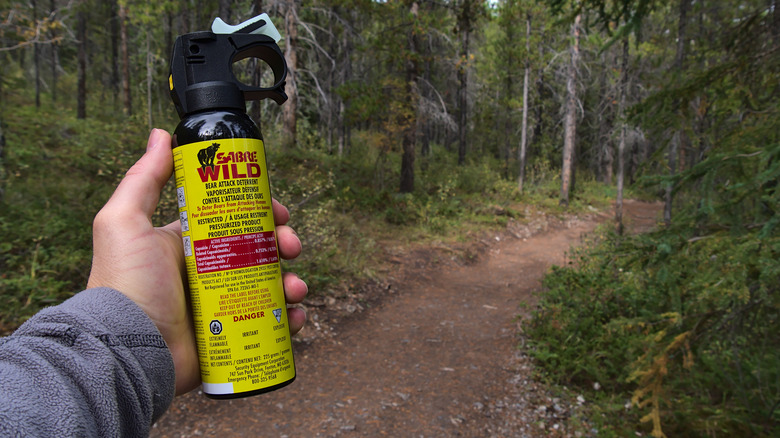
Some rules within national parks also adhere to state laws, and firearms are one such example. According to the National Park Service, as long as the individual has the correct license or permit to carry a concealed firearm, which is allowed in that state, it may be all right. That said, they're prohibited inside buildings, and they can't be discharged. That said, guns certainly aren't the only kinds of weapons out there, so don't bother bringing your crossbow, swords, throwing stars, or any kind of explosive — including flares and firecrackers.
Because there are so many regulations and they vary from state to state, you may have even committed a crime in a national park without realizing it. While bear spray is permitted — even encouraged — in Yellowstone, Glacier, and Grand Teton National Parks, it's illegal in all California parks. That's because grizzly bears, which pose a greater threat to people in the wild, are more common in the Rockies, while black bears are found in the Sierras and are easier to scare away by other means. Tools like air horns and bear bells, combined with other practical safety precautions, are a legal, less harmful bet in the Golden State.
Going off-trail or off-road
Yellowstone is a perfect example of a place where going off-trail can literally mean life or death. There's a very good reason for those boardwalks around the geysers and springs at Yellowstone, and the park takes it very seriously when people decide to tread outside the lines.
No one wants to face the same fate as a young man visiting in 2016, according to The Guardian, who accidentally fell into a boiling, acidic spring, which cost him his life. The U.S. Attorney's Office also announced that in spring 2026, a Texas man was jailed for five days for walking off the boardwalk in Yellowstone, and in 2025, The New York Times reported that another visitor from Georgia was banned for five years, plus a fine and probation, for driving off a road and walking into a thermal area that was off-limits.
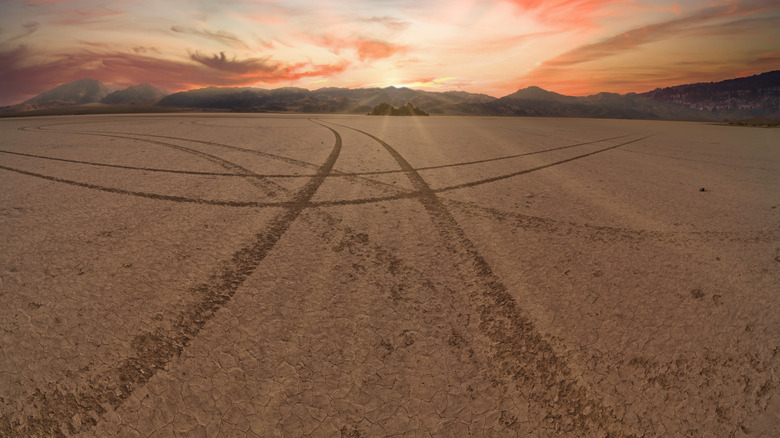
Over in Death Valley National Park, one of its greatest ecological threats is off-road driving, and violators can face misdemeanor penalties of up to $5,000 and six months in jail. Trails and roads also often close seasonally to protect wildlife, so flagrantly disregarding these notices could lead to a ban. Parks take the safety of both visitors and wildlife seriously. Although it's not clear they were issued a ban, five hikers were cited at Acadia National Park for hiking a trail that was closed to protect breeding peregrine falcons, per an article on Acadia on My Mind. A good rule of thumb is to follow posted signage, and if you're asked to leave an area, make haste.
Harassing bison and other animals
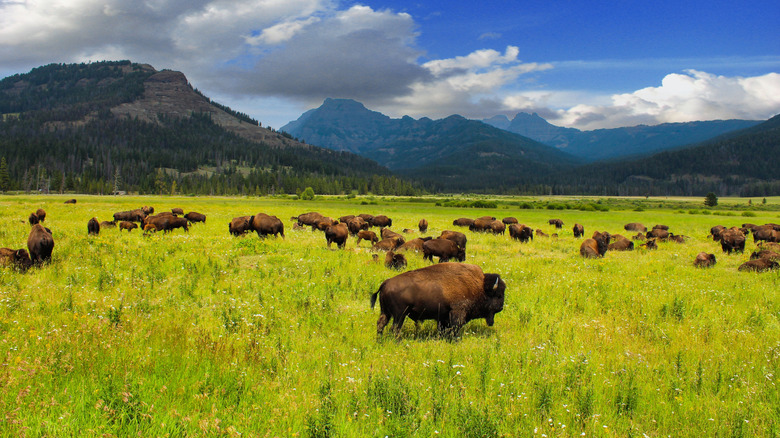
Even if the intent wasn't to disturb the falcons at Acadia, it's possible that it happened anyway, and that's what the National Park Service wants to avoid. Beyond it being common sense to give animals their space, parks often prominently display warnings and reminders not to approach any of the critters. In other words, don't charge at a herd of bison as a tourist did in June 2026, according to Cowboy State Daily, which a bystander recorded and reported to Yellowstone National Park authorities.
In 2018, according to the Missoula Current, a man who taunted a bison was banned from Yellowstone, Glacier and Grand Teton National Parks. These seemingly docile, if enormous, grazers can turn defensive in a heartbeat, and the park often sees at least one goring during the year. Essentially, it's never in a visitor's best interest to get too close, let alone harass them on purpose. Parks also do not want visitors feeding any animals or enticing them into campgrounds or other public places, not to mention hunting and trapping are off-limits unless expressly authorized, usually during established seasons and in specific areas.
Ignoring fire regulations
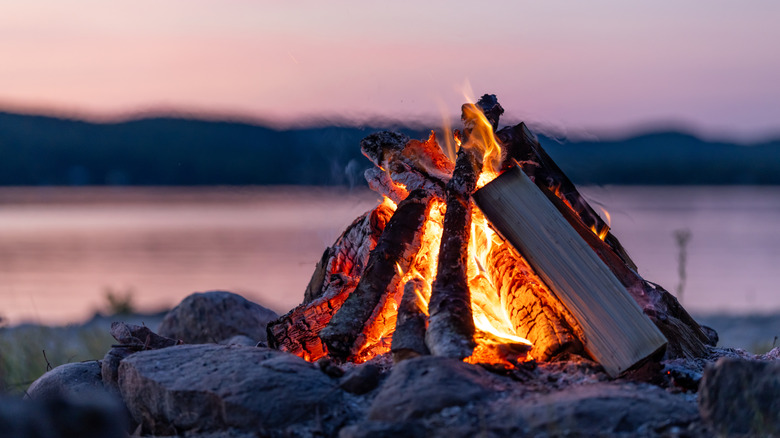
Depending on the park and the time of year, fire regulations can vary. Firewood shouldn't be brought in from outside the park unless it's heat-treated, as at Great Smoky Mountains National Park, which grapples with tree-killing forest invaders such as spongy moth, Dutch elm disease, emerald ash borer, and more. While bringing in firewood from outside may not result in a ban, it's generally good practice to protect these delicate ecosystems in any way we can.
Due to the dry conditions at Badlands National Park, for example, campfires are never permitted. In the Grand Canyon, where arid conditions and high winds can increase fire danger, there are often restrictions, such as requiring fires to be contained only in fire rings. According to data published in 2023 by the National Interagency Fire Center, a mind-boggling 88% of wildfires over the preceding ten years were caused by humans. If someone commits arson or is neglectful and it results in a wildfire, they could face felony charges, hefty fines, and most likely be barred from the park.
Releasing balloons (and other waste)

When a PhD student named Erin Zylstra set out to research tortoises in Saguaro National Park, she stumbled across other findings, too, such as plastic bags and a surprising number of balloons. Her research suggested that across the park's 105-or-so square miles, there were nearly 17,000 stuck and scattered around. And to illustrate a similar problem, Joshua Tree National Park once constructed one of its namesake trees out of wire mesh and hundreds of balloons collected within its boundaries, demonstrating just how many fly in from celebrations and become party favors that threaten wildlife and habitat.
National parks are federally protected lands, so dumping garbage in unauthorized places or sewage or other toxins into the wilderness is totally off-limits. This is illegal anywhere, but it's taken very seriously in national parks, which uphold their mission to protect their delicate environments. In terms of balloons, it might seem like innocent fun, but consider alternatives to releasing plastic into the air, which will eventually drift back down into the landscape and potentially harm animals, such as strangling birds.
Sky lanterns, which are traditionally set afloat with tiny flames inside, are also strongly discouraged. While it may not be against the law, if the flame sparks a wildfire, for example, or the park is able to connect you to a waste-dumping activity — especially if it directly harms animals or their habitats — major consequences will likely be on the table.
Camping without a permit (or overstaying your welcome)
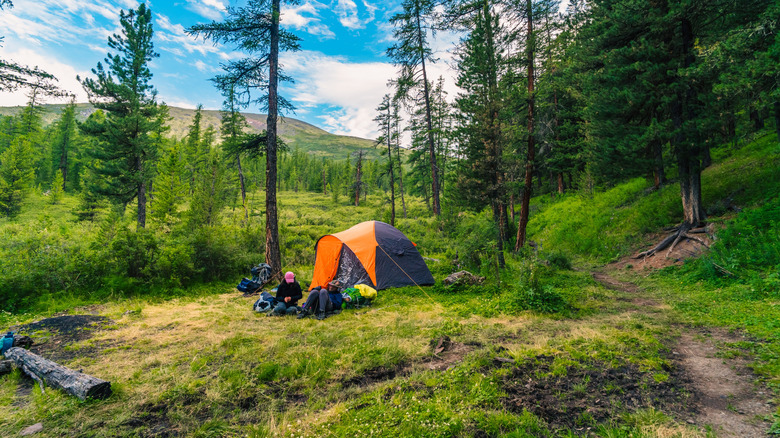
Backcountry or wilderness camping is an exciting way to experience many national parks, especially in rarefied places like Glacier National Park, which spans nearly 1,600 square miles and is so stunning it's known as the "crown of the continent." You do need to secure a permit to camp in the wilderness, which can be reserved in advance or picked up in person on a first-come, first-served basis. Depending on the park, there may or may not be fees. Glacier, for example, charges $10 plus an additional $7 per night, per person, but only during the warmer part of the year. During the winter — for the truly adventurous among us — they're free.
Remember the Wisconsin man who had camped too long in Yellowstone faced a charge of camping without a permit? Then there's an instance of misunderstood directions and probably some confusion during wintry conditions in the Grand Canyon when a hiker set up a couple of hundred yards from where they were instructed to camp in the backcountry and faced the maximum misdemeanor consequences.
There are also issues in national parks and other federal public lands with people overstaying their permit limits or, worse, squatting. There are numerous issues at play when people illegally stay for long periods of time or even try to live within national park boundaries, and law enforcement approaches vary. But to save yourself a headache and a potential fine or worse, stick to the park's published limit for the length of time you can stay. For Glacier, for example, there's a 14-night backcountry limit in July and August, but the rest of the time is flexible.
Using marijuana
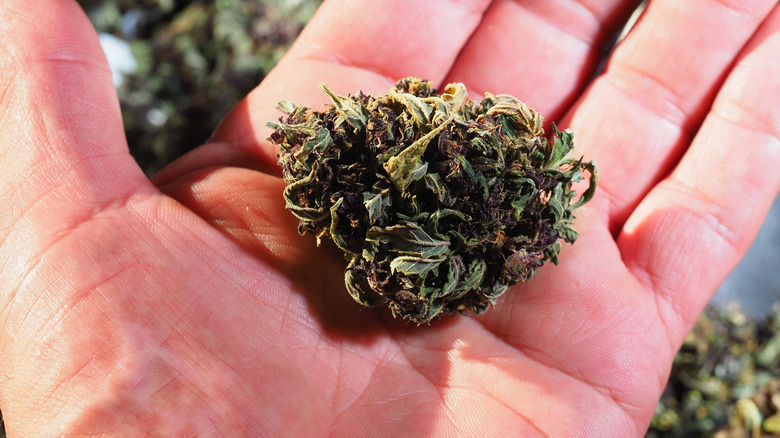
National parks are federal lands, so crimes committed there are typically prosecuted in federal courts. And one of the instances where this is a particularly important distinction is in the case of marijuana use. Because the substance is still classified as a Schedule 1 drug per the U.S. Drug Enforcement Administration, state laws don't apply, even though 24 states have legalized it recreationally. So even though Colorado is among these, Mesa Verde National Park, for example, still prohibits its use.
According to Spodek Law Group, nearly 28,000 people have been cited for possession on federal lands since 2009. And in late 2025, the U.S. Attorney's Office in the District of Wyoming doubled down, saying the office is "committed to using every prosecutorial tool available to hold offenders accountable." Essentially, if it's considered contraband, don't bring it.
As an aside, bringing a bit of alcohol into a campground is typically not an issue, and many parks even have bars in their lodges. A little social-time tipple is fine. But like anywhere else, it's a bad idea to get behind the wheel if you've had a few. One man was banned from Yellowstone, per reporting from the New York Times in 2025, along with being placed on probation for three years and fined over $3,000, for driving under the influence.
Blocking roads or creating obstructions
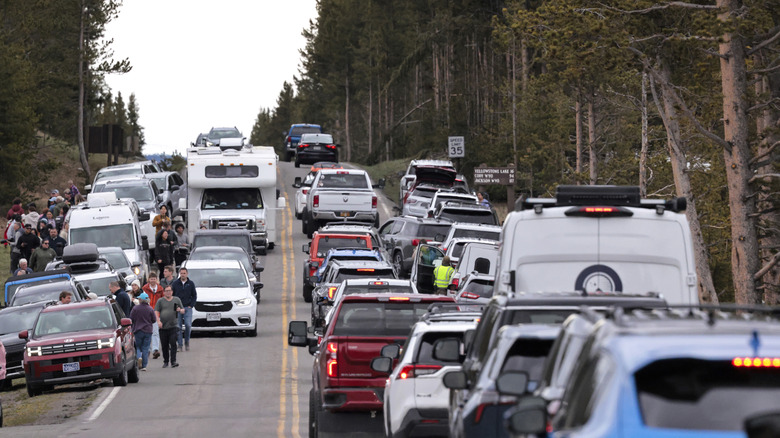
Given the number of visitors in national parks at any given time, and the need for law enforcement or emergency services to have full access to park roadways as needed, anyone who intentionally obstructs or blocks roadways will be removed and likely banned.
One dramatic example came in the form of a protest, according to Boulder Weekly, when a young Montana man chained himself to a barrel full of cement and metal at Yellowstone National Park in an effort to keep officials from trapping bison and relocating them outside of the park. He had to be carted away in a tractor, and it took hours to extricate him. He was then sentenced to three years of probation, according to Backpacker.com, plus had to pay more than $3,000 and was banned from the park for three years.
Anyone who's been to America's most-visited national parks will probably know what it's like to suddenly get stuck in traffic in a seemingly random stretch of road, only to find out that there's a bear hanging out nearby or a bison herd crossing to another meadow. Everyone may be stopping for photos, and traffic can get backed up. As long as no one's purposely causing issues, it's the way of busy parks. Wildlife always has the right of way!