
Philadelphia's Once-Abandoned Railroad Is Now An Underrated Urban Gem With Hidden Skyline Views And An Artsy Vibe
Everyone loves a happy ending, especially when it entails preserving an important part of a city's history. One shining example is Philadelphia's Rail Park, which traces its origins back to the area's industrial rise in the 1890s, when the Reading Railroad developed a network of elevated and rail infrastructure leading into Center City. Built during Philadelphia's rise as the nation's premier manufacturing "Workshop of the World," the line served as a critical transportation link. However, as automobiles and highways gained prominence and heavy industry declined, rail traffic dwindled. The viaduct was abandoned in 1984, leaving behind a decaying structure that cut through the Callowhill neighborhood.
Preservation efforts finally took shape in the 2010s, and the space was reimagined as the Rail Park, a public greenway that would preserve the historic infrastructure. The first phase of this elevated linear park was completed in 2018, stretching about a quarter-mile long at the intersection of the Chinatown and Callowhill neighborhoods. The second phase aims for further expansion, culminating in an elevated 3-mile park that links over 10 neighborhoods, including Fairmount, Francisville, and Spring Garden. This would effectively make it twice the length and width of New York City's High Line, no doubt an impressive feat of engineering.
Today, the Rail Park sits in a highly accessible part of Center City, with Philadelphia International Airport (PHL) serving as the primary gateway for visitors arriving by air. Located roughly 25 minutes from downtown, the airport is also directly connected to the city via SEPTA's Airport Regional Rail Line, which provides a seamless rail link into Center City stations. This connectivity makes the Rail Park not just a local attraction, but one of many things you can't skip on a trip to Philadelphia.
Seeing skyline views from the Rail Park in Philadelphia
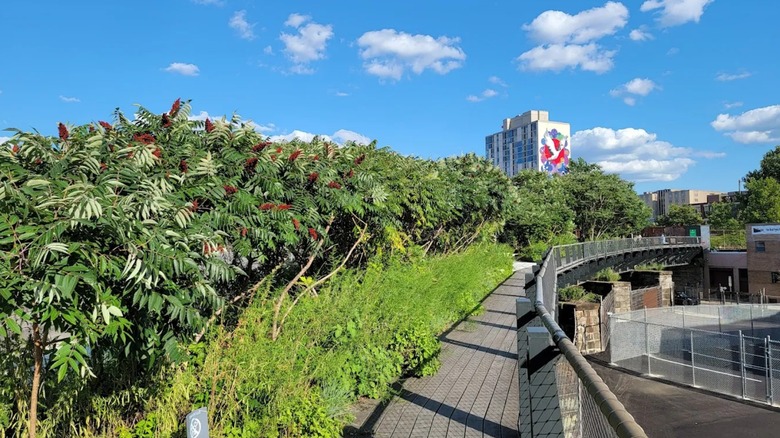
When it comes to photogenic spots in Philadelphia, most people will point to places like Elfreth's Alley, America's oldest residential street and a 16-foot-wide cobblestone lane lined with impeccably preserved Federal and Georgian-style homes — and rightly so. But if it's panoramic vistas or skyline views you're after, don't sleep on Rail Park, which offers an elevated perspective over nearby neighborhoods.
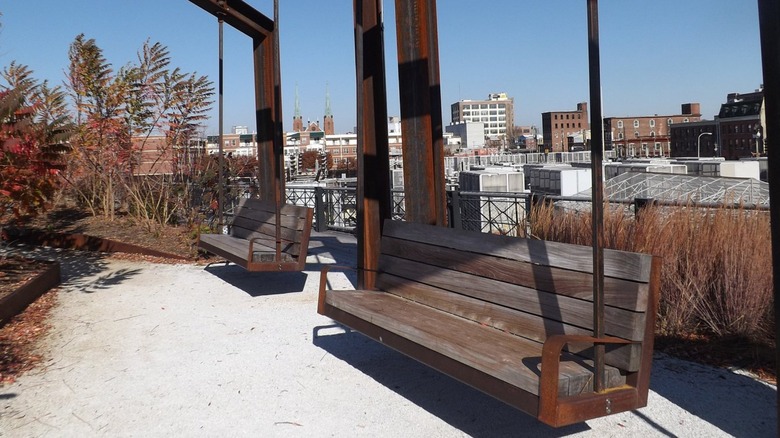
Built atop the former Reading Viaduct, the park functions as a linear green corridor suspended above the surrounding streets, transforming a section of historic rail infrastructure into a linear public space. As one Tripadvisor reviewer described it, "You would never know this existed unless you're lucky to find out about it," going on to gush that "It is a wonderful place to escape. It is quiet and well maintained." Whether it's the Center City skyline or the industrial edges of Callowhill, one can imagine how the juxtaposition of lush landscaping, with over 1,000 native plants, and high-rise buildings makes for great Instagram photos, especially at sunset. Tired from all the sightseeing? Take in the views from benches and swings peppered throughout.
If you also want to treat yourself to superb views even from your hotel, you have several properties to choose from in Center City and around Logan Square. Just a 10-minute drive from the Rail Park is The Logan Philadelphia, whose nine-floor Assembly Rooftop Lounge (21+ only) overlooks the Benjamin Franklin Parkway and makes a great spot for drinks and light eats. Also close by is Four Seasons Hotel Philadelphia at Comcast Center, housed in the tallest building in Philadelphia, where you can soak up breathtaking vistas from the elegant Sky Lobby on the 60th floor.
Enjoy Rail Park's alluring, artsy vibe
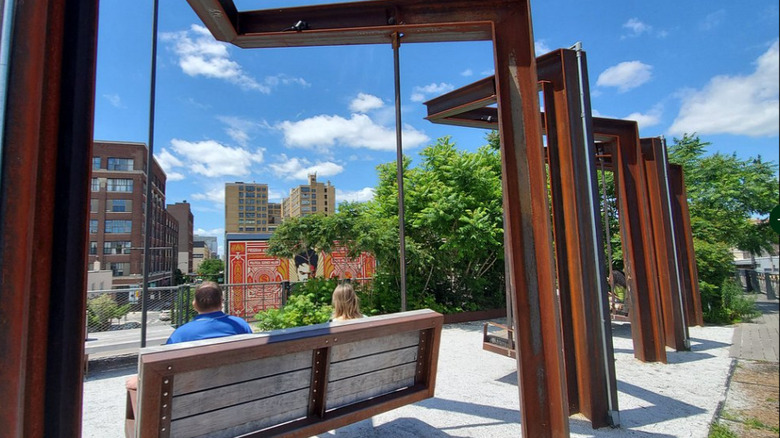
Beyond the splendid views, Rail Park allows you to tap into your creative side. A quintessential example of an abandoned industrial corridor–turned cultural incubator, it brims with events, art installations, and street murals, helping to shape the area's visual identity. This is reminiscent of similar efforts throughout the country to infuse art into otherwise abandoned and ramshackle spaces, such as Seattle's hip SODO warehouse district and Memphis' Crosstown Concourse, a "Vertical Urban Village" inside an abandoned warehouse.
Philadelphia benefits from Mural Arts, the country's largest public arts program, which has turned blank walls and overlooked structures into large-scale public artworks. The result is a gritty, if vibrant, arts scene that almost feels organic rather than curated. The warehouses and manufacturing buildings that once dominated the neighborhoods that surround the Rail Park have been repurposed into studios, galleries, and performance spaces. The Crane Arts Building, built in 1905, is located just minutes from the park and showcases the work of emerging and established artists. Future visitors can look forward to The Tunnel when the second phase is completed, a 3,000-foot subterranean passage where light pours in from the street level.
At Rail Park, Philadelphia's past and present intersect, inviting visitors to reflect, create, and see the city from a fresh perspective. By providing access to arts and culture through diverse programming, communities are not only engaged but inspired to connect with each other. If you can't get enough of Philly's art scene, Fairmount's underrated museums, including the astounding Philadelphia Museum of Art, are a short distance away.