
11 Things Hotel Employees Notice About You As Soon As You Check In
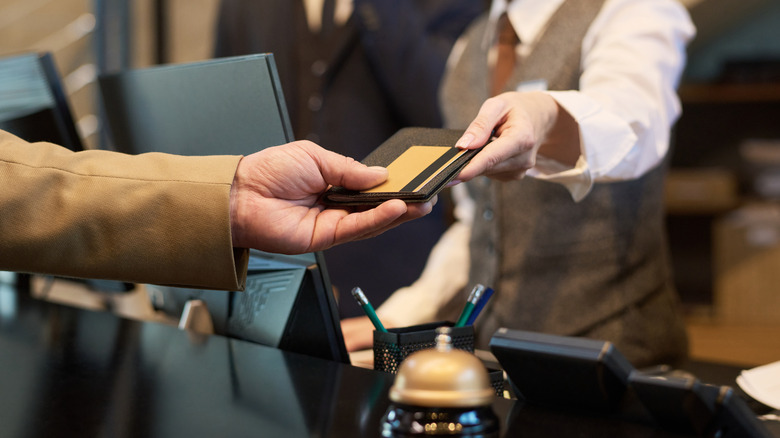
Checking into a hotel might seem like little more than a routine encounter with the front desk staff. But in between the procedural interactions you have with them regarding ID cards, payment details, and a room key handover, the information that is passed runs deeper than you may realize. Even before you have approached the front desk and said your first hellos, the reception staff has picked up on a number of non-verbal cues about you and set about creating a composite picture that tells them the kind of guest you are likely to be.
From the way you conduct yourself right through the door, to the way you react when the staff informs you about the deposit hold, everything is noticed at the front desk. These observations have little to do with the hotel staff judging their guests; if anything, these details help them tailor your stay experience to your needs and preferences, offering you an experience with maximized comfort and minimal snags. Some of the clues they pick up on seem so insignificant that you'll never guess that they contribute so greatly to the impression you create. Here are things hotel employees notice about you as soon as you check in and how to kick things off on the right note.
How you present yourself makes the first impression
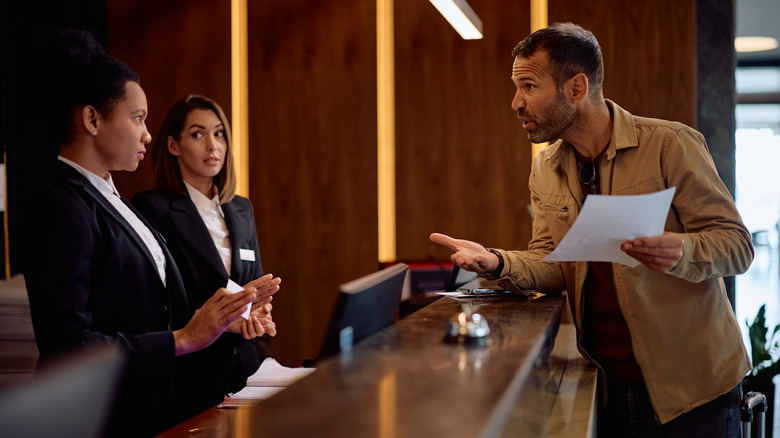
The moment you enter a hotel, you come under the purview of its employees hanging around the lobby — from the door attendants to the bellhops, but most importantly, the front desk. The staff behind the reception counter will be among your first points of interaction at the hotel and central to your entire stay. And considering their role as the coordinators of your visit, you can best believe that they will be highly observant.
Everything from your body language to the way you greet (or don't), how you're groomed, and the kind of energy you bring to the front desk contributes toward the first impression you make. At the core of these observations lies a simple idea: The staff is trying to discern how easy or challenging a guest you'll be. "Basically your attitude checking in says a lot. If you are kind most hotel staff will jump through hoops to make you happy," a Reddit user working in hospitality wrote, continuing, "...If you're giving off a sketch vibe we will be vigilant."
The front desk grapevine is also active in passing notes about standout guests who may require more attention during their stay, for reasons that aren't all related to difficult behavior. For instance, if a guest shows signs of being an inexperienced traveler, the staff might offer them a more detailed walkthrough of hotel policies during check-in and ensure that such keen assistance remains consistent across their whole team.
The luggage you are carrying says a lot
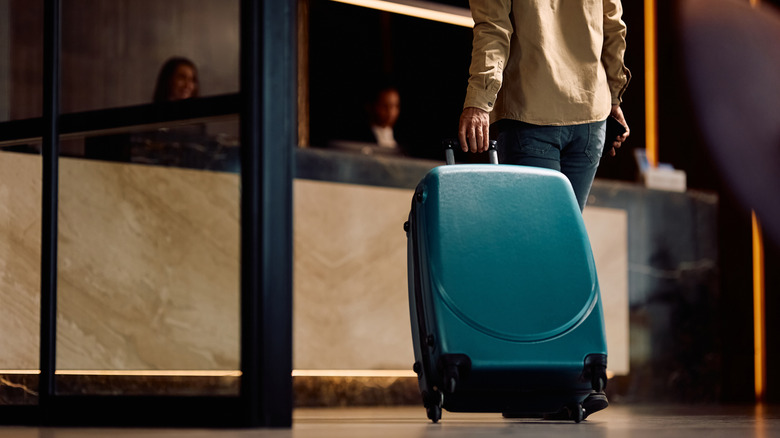
One thing hotel employees take stock of when you enter the establishment and make your way to the reception is the amount of luggage you are carrying. Such an observation will almost always be discreet, considering that hotel policies typically do not put any limits on baggage allowance. As one Reddit user wrote, "I've seen full stacked luggage carts for one night stays as a hotel employee before."
This monitoring essentially contributes to the larger character sketch the hotel staff may draw around every person who walks through their doors. Anything out of the ordinary can raise an alarm, but it is usually the issue of scanty baggage that can get a guest flagged as opposed to an abundance of suitcases. Consider this: Someone checking into a hotel with just a small bag for a 10-day-long stay is hardly regular. After all, no one usually travels that light!
While it is highly unlikely that the hotel staff will turn a guest away for just the size of their luggage, they could employ some safeguards to avoid possible walkouts. During check-in, the flagged visitor may be asked to make an upfront payment for their reservation, in addition to a deposit. Some report being required to settle their other bills periodically during the stay, instead of at the end. In such cases, housekeeping will also most probably keep an eye out and report any suspicious activity back to the front desk.
Body language communicates more than you think
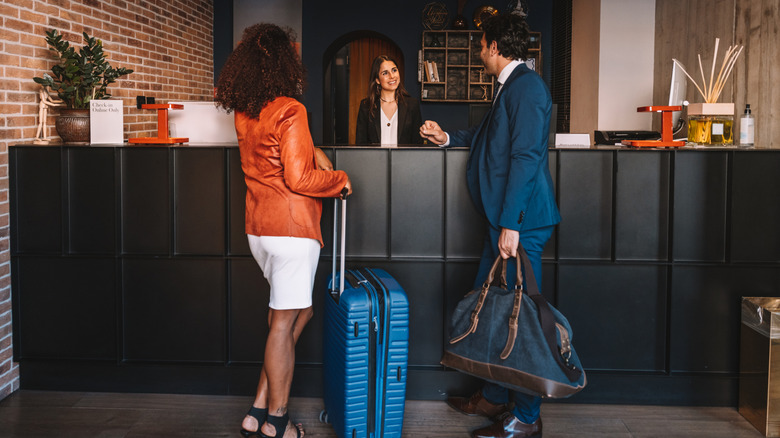
Many a time, what you're not communicating with words, the hotel staff might be able to catch in body language. In fact, reading those subtle non-verbal cues is a core skill hospitality professionals the world over are trained in. And since the nature of their job demands continuous guest interactions, they can get plenty of practice in on a daily basis and be better positioned to deal with all kinds of people walking in through their hotel doors.
Eye contact and a smile, for instance, could signal a friendly guest in a good mood and therefore a pleasant check-in experience. Tiredness or anxiety has other tells. "They'll grab their chin or pull on their ear. Those are cues that maybe I should be doing something to get them to their room quick or make them feel comfortable," according to hospitality executive John Moser (via ABC News). Of course, as Moser notes, body language is just one piece of the puzzle and is hardly a replacement for verbal exchange.
It does, however, guide the nature of the check-in process on both sides of the counter. Seasoned travelers who have ample experience with the check-in and check-out routine tend to be highly efficient at the reception without getting flustered, making the formalities seamless for all involved. As one such traveler noted on Reddit: "Not so fast as to be obnoxious or hurried, but as fast as possible while still being pleasant to deal with."
Your reaction to the deposit hold is noticed
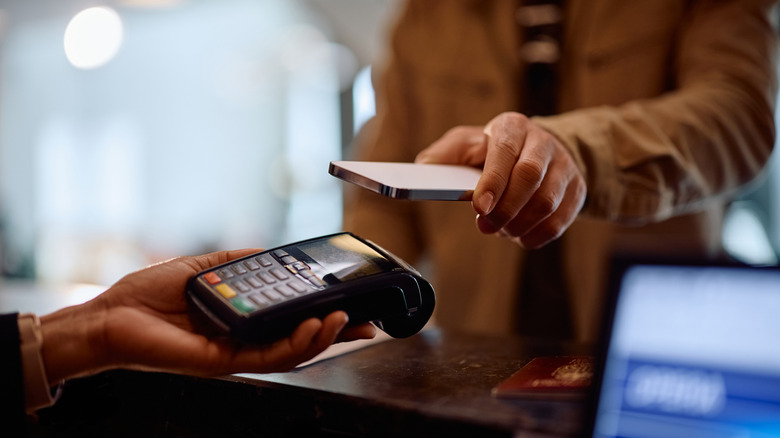
Among the extra hotel fees you should be aware of is the deposit hold, or security deposit, that you might be charged at check-in. To cover any incidental charges that could arise during your stay, such as use of the minibar or room service, establishments typically place a pre-authorized hold on your card. Funds aren't immediately charged. Instead, they're set aside temporarily and applied toward your final bill at check-out. If you don't incur any extra charges during your stay, the unused hold is simply released.
This deposit limit varies from hotel to hotel and can fall anywhere in the range of $50 to $500 (or beyond). One Reddit user who worked in hospitality recalled an incident while checking a guest in: "I was so irritated and preoccupied when doing his authorization that I didn't realize that I had typed in $10,000 for authorization, rather than the $1,000 that was required." However, the fact that the card owner hardly reacted to the goof-up helped the front desk get an idea about their social status.
But the hotel staff's observation around your reaction to the deposit hold is less about them trying to assess your wealth and more about ensuring that the property is covered against any potential losses that might be incurred during a person's stay. The reception staff may face resistance from guests over the deposit hold — something that can stick out as an early red flag.
The way you make freebie requests is important
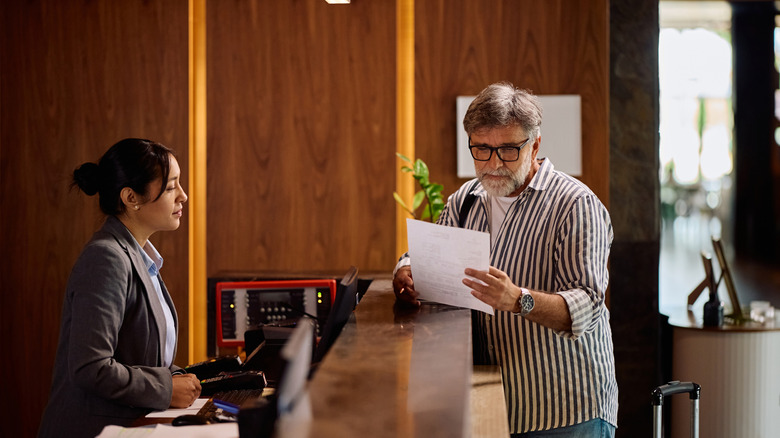
Who doesn't love hotel freebies? A free room upgrade or food coupons right at check-in can instantly elevate everything from your mood to the hotel experience. The catch is, you need to know how to ask for them. Hotel perks are not handed out at random. They typically come about as a consequence of the first impression you make on the staff behind the reception counter — in addition to whether or not there actually is space to accommodate your request.
One of the simplest tricks to increase your chances for extra perks while checking in is to just be nice to the hotel staff. "Everyone thinks there's a secret magic phrase like, 'Are there any complimentary upgrades available?' But honestly? The real key is genuine human connection and celebration," Terra Sampson, front office manager at The Alexander in Indianapolis, tells Travel+Leisure. As with many situations, a simple smile and good conversation can go a long way.
Hotels famously also tend to cater more exclusively to guests who are marking birthdays or other milestones on their property. As Sampson says, "[W]e will do everything in our power to surprise them with an upgrade." But the odds of scoring these complimentary benefits are higher when requests are made in advance to the hotel, so the staff can adjust the inventory accordingly. Because if the hotel is running full, getting an upgrade during check-in will be difficult — no matter how nicely you ask.
Your travel group/companion conveys more than you know
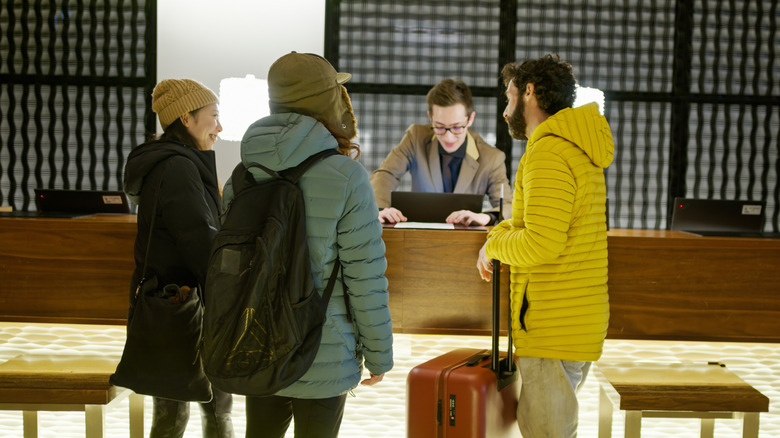
Your travel group size shapes your hotel experience more than you may think. Though the front desk won't typically change its standard of service depending on whether you are traveling alone or with a group, they might tailor the check-in interaction to best suit your needs during the stay. When receiving a solo backpacker, for instance, the hotel staff might be inclined to make polite inquiries about their travels and, in the process, also volunteer suggestions on must-see local attractions for their visit.
Larger parties, meanwhile, present a wildly different reality for the hotel staff. "Groups are the bane of the hotel industry. No matter how small the group is, they're going to act like the whole hotel is theirs and theirs alone," a Reddit user with experience working at the front desk noted. Among multi-person traveling groups too, families with children fall into one of the trickier check-in brackets to handle.
While the grownups are busy with front desk formalities, the little ones are often left free to run amok with little to no parental supervision. "If your kids are screaming around an echoing reception, you're not just making life harder for staff, you're making your own check-in take longer and holding up every guest behind you as well," a front desk professional wrote on Reddit. Such check-in difficulties also serve as early indicators of how the rest of the guests' hotel stay will pan out.
If you're a returning guest, it might bring you perks
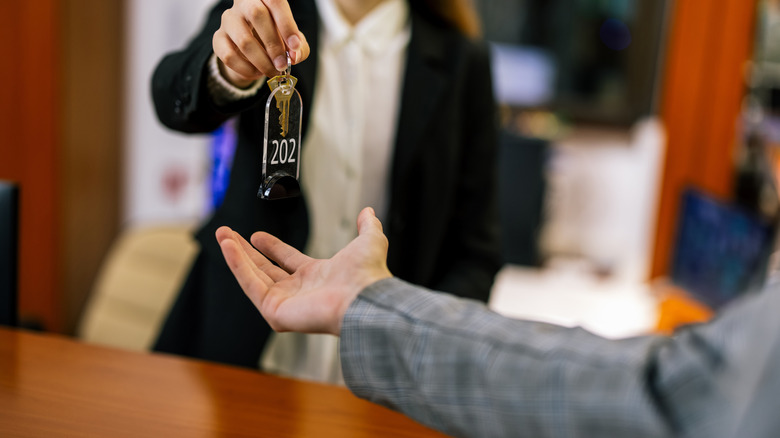
Guest retention is one of the foremost priorities across establishments in the hospitality industry. Hotels, especially bigger chains like Marriott and Hyatt, double down on this front through loyalty programs or reward systems that offer the promise of extra perks to guests who keep returning. So you can best believe that any past records of your stay might be one of the first things the front desk will look into when you check in.
Returning patrons often qualify for service that's a bit more personalized, so don't be surprised if the hotel employees welcome you with greater familiarity than you expected. One Reddit user with a frequent hotel haunt described what such recognition could look like: "I'm welcomed by first name now, and whenever a new member of staff joins the hotel, they are brought to me to introduce them to me ... The second I walk into the front desk's line of sight, someone will drop everything and be straight to me, offering hugs, free snacks, as many welcome drinks as I want."
Loyalty memberships are also among the easiest hacks to make your hotel stay more affordable, opening up an exclusive tier of discounts, upgrades, and freebies that you may be informed of during check-in. Not to mention, the staff will already know how best to tailor your experience to your preferences, so you won't have to spend more time than necessary at the front desk.
Sometimes, your address might matter
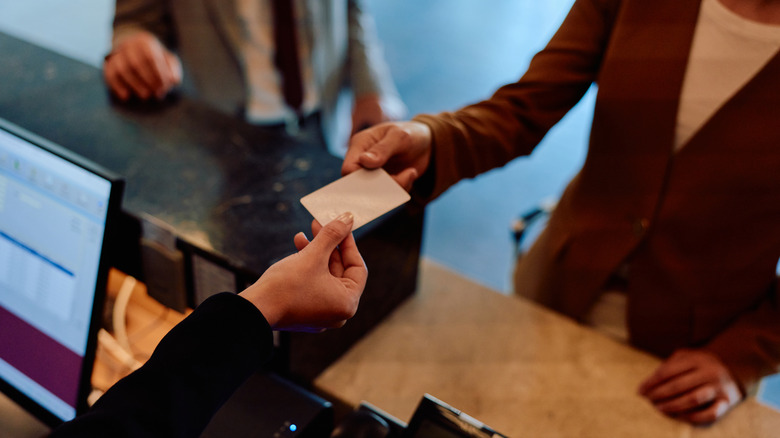
When you're handing the hotel staff your ID or filling a form with your personal details during check-in, one of the first things they notice is your address. In some cases, they can even run this check well in advance, right as you make a reservation with them. This seeming nosiness is hardly a bid at surveillance. Instead, it serves as an initial feeler for the staff as to the guest they may be dealing with.
"If they're local, they are most likely going to be a problem ... And the farther away they're from, the easier it is," one front desk employee said on Reddit. "The regionals just ask for and complain about every little f*****g thing." In fact, the level of caution some hotels exercise in this regard is so high that they don't allow local guests at all, for fear that they might engage in activities that disrupt the peace of other occupants.
Of course, that scenario doesn't always ring true, and a local check-in can be rooted in totally legitimate, unavoidable circumstances. As one guest who checked into a hotel right across from their home for a single night and was charged a whopping $500 deposit wrote on Reddit: "Man, my bedroom is being painted and I don't want to sleep in there bc of the fumes." At the end of the day, though, your address will have little bearing on the situation if you're an easy, considerate guest to host.
They can tell if you're sober or not
No matter how well one thinks they're masking it, it's usually pretty easy for the staff to tell if the person checking into their hotel is sober or not. And while it's not a crime to have enjoyed a drink (or a few) on the way to your accommodation — especially for vacationers swept up in holiday revelry — it might stick out as an immediate red flag to the hotel employees who greet you at the door. After all, an intoxicated guest doesn't always come with the promise of a straightforward check-in, let alone a predictable stay.
Besides some telltale signs — such as the smell of alcohol or slurred speech — the line of questioning they initiate is one of the clearest giveaways that a guest might be on substances. One Reddit user noted: "Alcoholics don't realise how obvious they are, it's mostly the smell but they talk a lot of s**t, 'I don't smoke anymore but if I did, where would I go?' ... 'How often is there going to be room service?' 'Can I order a drink to my room?'"
A related issue another Reddit user raised is that of smokers who don't inquire about the permissible smoking zones within the hotel during check-in and how that could point to a higher chance of them lighting up inside their room. With the help of housekeeping staff, the front desk might keep a closer eye on such guests.
Asking too many questions might get you flagged
It's true that the staff at a hotel's front desk is positioned to answer any and all questions a guest might confront them with. That does, after all, constitute a core part of their job requirement. But it's also true that they know exactly when to flag an interaction as a problem case. Asking the reception staff too many questions, especially those that disrupt their workflow, can present one such instance. Not always, but such a scenario could occasionally signal a difficult guest.
One Reddit user who worked the reception recalled how a guest repeatedly insisted on getting an early check-in during the holiday season despite unfavorable circumstances, which led to a breakdown in communication. "You can ask the same question over and over again, but I'm not going to have a different answer," they wrote.
Mistimed requests are yet another indicator of a guest who might keep the hotel staff on their toes throughout their stay. As one Reddit user vented: "Most annoying thing for me right now is when I finish the check-in process and hand the guest their keys, and they suddenly start having special requests: 'Oh, it's not too close to the elevator, right? Oh, but not too far away either. There's a view, right? It faces west, right?" To keep the check-in process smooth for both you and the staff, it's best to keep your queries short, reasonable, and straightforward.
The way you handle service issues can be telling
Check-in lines may be tiresomely long. Your room could still be under housekeeping maintenance, and you may have to wait. The front desk's credit card machine may be out of order. A million things can go wrong before you check in and finally make it to your room. But it is your reaction to these scenarios — which could stem from operational hiccups from the hotel's side and may, in some cases, even have been avoidable — that can be the reception staff's first introduction to you as a guest.
Nobody likes to be held up by service delays, especially if they have come off a long flight or a full day of back-to-back meetings. Even so, it does well to remember that there's a human on the other side of the desk who is as committed as you, if not more, in getting you to your room as quickly as possible. Kindness is one of the best ways to get on the good side of hotel staff.
One front desk professional took to Reddit to share their experience dealing with the misdirected frustration of guests who showed up to the hotel earlier than the allotted check-in times. And while there were a few polite voices in the crowd, the impatient ones made a deeper, sour impression on the employee: "Immediately sets the tone for the day and puts me behind in the things I have to get done."