
5 Brazilian Restaurant Rules American Tourists Break Within The First 10 Minutes

You may already know that when you walk into a Tokyo ramen shop, slurping is a sign of respect for the chef. Maybe you also know never to add ice, water, or any other mixer to your vodka in Russia, to never cast your eyes upon another diner's dinner plate in Egypt, and to never cut spaghetti with a knife in Italy. But what are the equivalent rules for dining at a Brazilian restaurant that mark you as a tourist the minute you break them? Some are to be expected if you've traveled in Latin America, while others might surprise you.
When most of us think of Brazilian cuisine, the churrascaria, or Brazilian steakhouse, springs to mind. Brazil invented rodízío, the tradition of serving spit-roasted meats all-you-can-eat-style, brought to you by roaming servers called gauchos, who carve the succulent slices of beef, chicken, or lamb table side, straight onto your plate. But before experiencing this unique dining format, there are certain etiquette rules you need to know.
Whether you're flying down to Rio de Janeiro for Carnival (one of the world's largest and best festivals), or eating your way through Latin America, knowing a bit of Brazilian dining etiquette can't hurt. So read on to find out what will get you the side-eye in Brazil.
Misusing utensils is a no-no
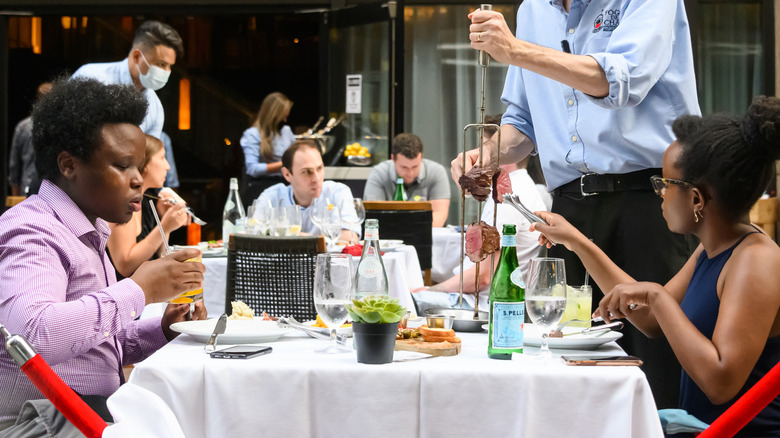
In the U.S., many of us were taught to hold our fork in the left hand and knife in the right, cut a bite, then switch hands to bring the morsel to our mouths with the fork held in our right hand. To Brazilians, this fussy switcheroo can look absurd. The residents of Brazil, aka 2026's Destination of the Year according to Travel + Leisure, hold their utensils similar to the European style, with the fork always in the left hand and the knife in the right. Master this technique, and you might pass as a Carioca.
Resist the temptation to use your knife or fork to pick off the juicy slice of meat being cut by the churrascaria's gaucho. A set of tongs has been provided for just such a purpose, and using them to pick up anything from a shared plate preserves hygiene — and politeness. By the same token, you should always use a clean plate when returning to the buffet table to load up on scrumptious side dishes. Same goes for the breakfast bar at your hotel.
If you order a burger or pizza in Brazil, you should eat it with a knife and fork. Some restaurants provide waxed paper sheets in what look like napkin dispensers, meant for grabbing your hand-held food without touching it. The reasoning behind this taboo against touching your food on its way to your mouth is rooted in hygiene, as one Redditor explained. With a tropical climate, Brazil is susceptible to the food-borne illnesses that flourish in such temperatures. So this is one instance where you aren't just saving face, but saving yourself a lot of unpleasant symptoms by avoiding a food-borne stomach virus on your vacation.
Don't hide your hands, but do hide your teeth

According to Miss Manners, it's proper American dining etiquette to leave the hand you aren't eating with resting demurely in your lap. That's not the case in Brazil, where, as in Europe, it's polite to leave both hands visible at all times. Try resting your wrists on the edge of the table. Nowhere, including Brazil, is it acceptable to put elbows on the table. According to the Tuscan Traveler, the reason for this rule is that hundreds of years ago, unsecured table tops were prone to flipping when elbow-leaners put weight on them. Needless to say, table design has come a long way, but traditions stay the same.
As hiding your hands at the table can be seen as bad form, showing your teeth is also considered a no-no. If you need to grab a toothpick on your way out of a restaurant in Brazil, politely conceal your use of it with your hand.
Arriving too early and leaving too soon are equally bad form
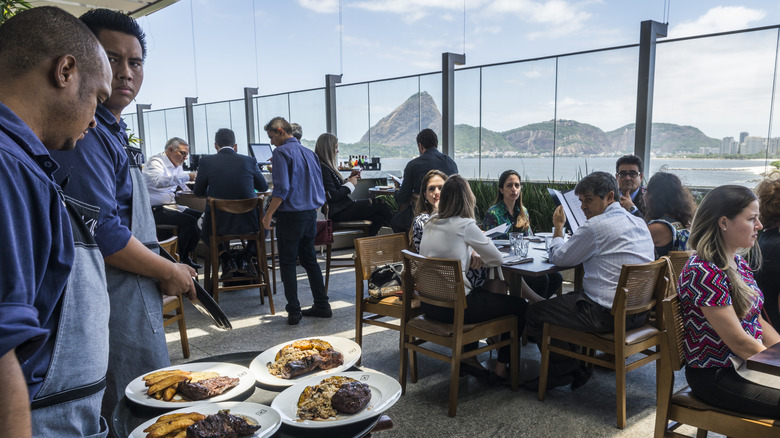
The first rule of Brazilian dining: Arrive late. If you arrive within 10 minutes of the appointed mealtime, you'll stand out like a sore thumb. Brazilians are famously tardy, especially in relaxed social settings like dining. In fact, they are so chronically late that, according to one Reddit thread, there's a common phrase, uttered with a whiff of disdain: "com pontualidade britânica" or "with British punctuality," which is used to describe on-time behavior. Even restaurant meet-ups run 10 to 30 minutes behind schedule. The same unwritten rules governing "island time" in the tropics apply to mainland Brazil.
As is the case for following restaurant rules in Mexico, and much of Latin America, meals are a time to linger and be social in Brazil. Lunch can take two hours to transpire, even on a work day, so relax, slow down, and savor every morsel. To avoid frustration, maybe don't dine at a classic Brazilian restaurant if you have a plane to catch or a certain time to make. Choose a day when the only thing on your agenda after the meal is a sunset stroll along Rio's famed Ipanema Beach. Or better yet, stretch out your dining day to take in "jogo bonito," or the "beautiful game," which is what Brazilians call soccer.
Get up to date with standard churrascaria etiquette
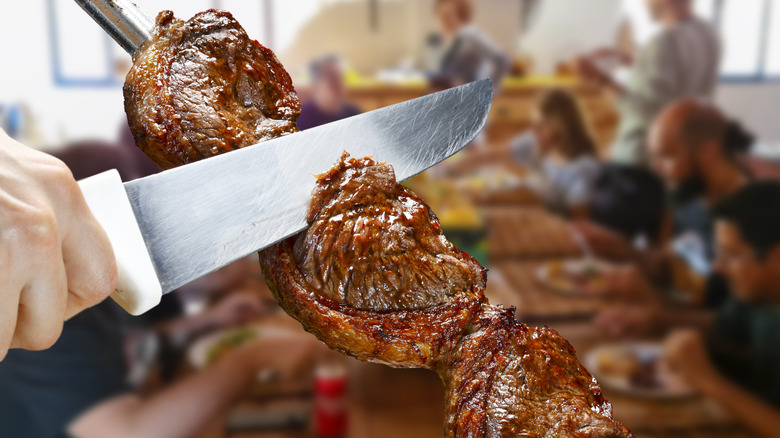
At the churrascaria, managing the rate at which your plate piles high with meat can be a challenge if you don't know the rules of rodízío (which means "rotation" in Portuguese). Diners are given cards with a green face and a red face — turning the green face up means you're ready for more meat, while red means you're taking a break. You can also pass on cuts and wait for your favorite to come back around. You can politely decline the chicken hearts, for example, and wait for the classic picanha — medallions of beef surrounded by a decadent fat cap — to make the rounds. To avoid looking like just another tourist, it's best to learn the ins and outs of the process.
Another rule newbies often flout on their first visit to a churrascaria is to try ordering drinks from the gauchos. These servers (gaucho means "cowboy" in Brazilian culture) are exclusively meat-wranglers, and are not there to tend to your other dining needs. You should be able to summon other wait staff with a glance or polite wave.
Leaving food on your plate will get you side-eyed, and so will paying as someone's guest
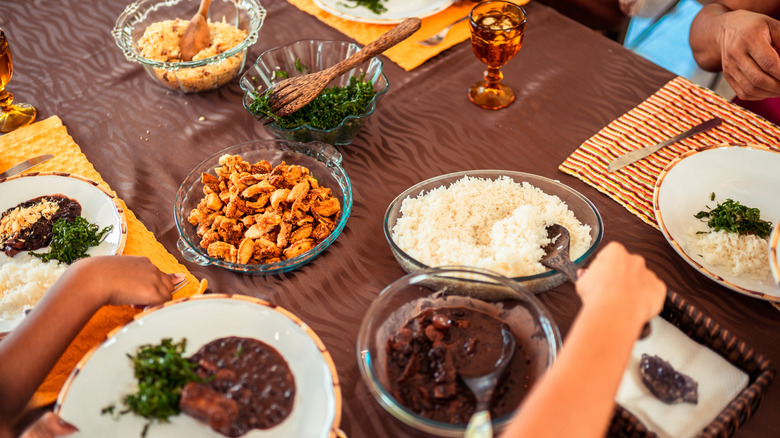
The abundance of appetizing food on offer at a Brazilian steakhouse can feel staggering, but resist the temptation to have the gaucho carve you off a thick slice of everything that comes by. Ask for a taste, and only re-up on what you can reasonably eat. In Brazil, as in much of Europe, leaving food on your plate will mark you as a gluttonous tourist. Slow down, order thoughtfully, and leave a clean plate. Don't worry about heaping it high on the first pass, as you'll be urged to take a second helping.
There are also etiquette traditions surrounding the differing roles of hosts and guests. As a guest to someone's home, it's considered polite to bring a host a gift, such as flowers (but not purple flowers, as they're reserved for funerals). If you've been invited out for the meal, by all means make a show of reaching for your wallet, but expect your host to prevail and pay the bill.