
The 10 Most Breathtaking Sightseeing Spots In Grand Teton National Park
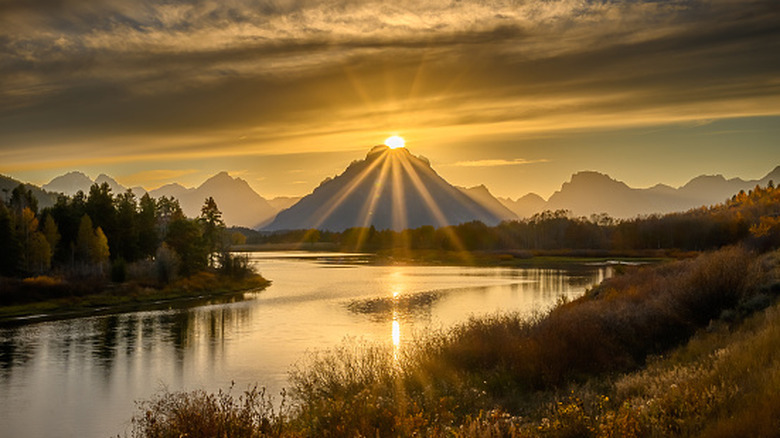
With its impressive 310,000 acres, Grand Teton National Park in Wyoming is a picture-perfect credit to the great outdoors, filled with gorgeously clear alpine lakes, towering trees, and awe-inspiring mountain ranges. With all this natural beauty, it's easy to see why it's also one of the best places in the country for sightseeing, taking iconic photographs, and getting a look at the wildlife.
Humans have occupied this area for more than 10,000 years, of course, but the modern chapter of Grand Teton National Park began in the 1920s when John D. Rockefeller bought up acres of land to protect it from commercial development. Today's park is part of the the Greater Yellowstone Ecosystem and sits just 10 miles from its arguably more-famous sister, Yellowstone National Park. But Grand Teton offers around 235 miles of trails in its own right. Plus, visitors can enjoy boating on the Snake River, fishing in glacier-cold water, and kayaking on lakes that can be so still, the mountains appear twice. It's also home to bison, moose, wolves, elk, and many birds, including bald eagles — so count on your sightseeing journey having plenty of variety and beauty.
To discover the most breathtaking sightseeing spots in Grand Teton National Park, we consulted official sources, including the National Park Service. Specialist outdoor publications like More Than Just Parks and 57Hours gave us some expert insight, while independent travel blogs and Reddit forums provided ground-level and local advice. Here are the 10 most beautiful sightseeing spots in Grand Teton that made the cut.
Mormon Row
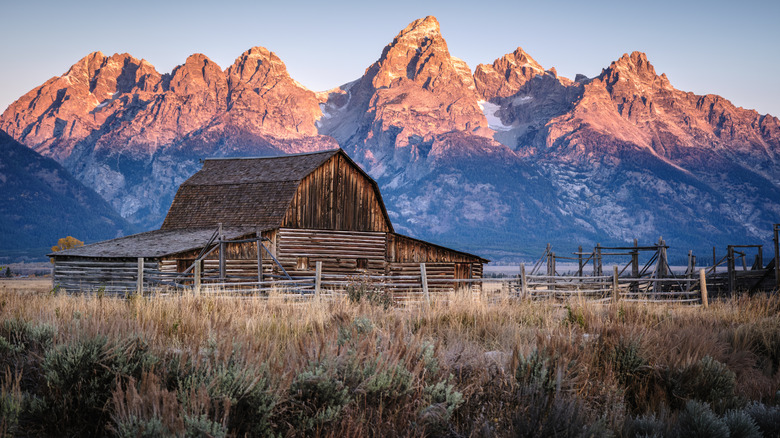
When Mormon settlers reached Jackson Hole in the 1890s, they did so on a promise from the federal government. The Homestead Act of 1862 said that any settlers who worked the land in this harsh corner of the American West would get to own 160 acres of it for free. The 27 homesteads this group put up helped form a close-knit community, and today it's recognized as one of the finest examples of a 1900s frontier farming settlement that's still standing.
It still sits on an open plain, and the Teton Range still erupts from the valley floor behind. The snow-capped peaks still cut sharply into the sky, and the timber frames and weathered corrals still stand. Bison and moose roam through the landscape as they always did, and kestrels continue to circle overhead. Visiting Mormon Row feels like a step back in time — a feeling reflected in its listing on the National Register of Historic Places. It's one of the most-visited spots in Jackson Hole, and the T.A. Moulton Barn is arguably one of the most photographed barns in the country, if not the world. Once you see it, you'll understand why, especially at sunrise when the Tetons glow in deep oranges, pinks, and purples behind and the plain falls into long shadow.
Given that Grand Teton is probably the best national park in America for people who hate hiking, you'll find Mormon Row an easy 20-minute drive from Jackson. It sits just off Antelope Flats Road in the southeast corner of the park and is the perfect day trip on a lazy Sunday for capturing postcard-worthy photos.
Schwabacher Landing
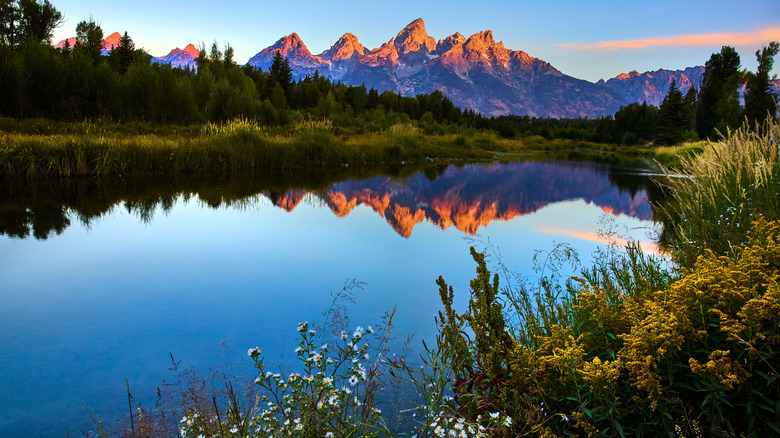
Just a short drive north of Mormon Row is Schwabacher Landing, an iconic spot for photography. It's a channel of the Snake River, and it has slowed so much that it's almost completely still on certain days. On a particularly calm day, the Teton peaks can reflect the water below as sharply as they rise above. You could practically take a photo here, flip it around, and not know which way was which. Incredibly, it was none other than beavers that made this spectacle possible. Their tangled dams of stripped branches and mud stretching across the channel make the river lose a lot of momentum in this spot. They're not the only wildlife that might gatecrash your photo here, though. Moose can lumber through the willows, and otters can weave through the reeds, while supremely lucky visitors might spot a bald eagle perched along the tree line.
The pool's name is thought to come from Albert Schwabacher, a former ranch owner who one owned Lost Creek Ranch (as it is known today) about a century ago. The Rockefeller family attempted to buy up his land back then, but he refused. And you can see the land he held onto so dearly when you walk the Schwabacher Landing Trail. It's a short, flat stroll easy enough for practically any age or fitness level, and particularly popular with birdwatchers who might spot blue herons or osprey. For the better part of the day, the trail is quiet. But you will see crowds with cameras in hand at sunrise and sunset. You can't blame them; it's probably the best sunrise spot in Wyoming. But the area soon empties out again, leaving you with some serenity and stunning views.
Jenny Lake
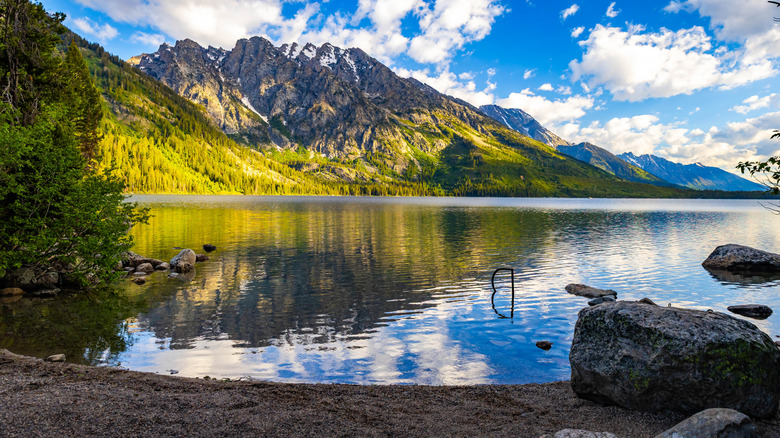
During the Ice Age, glaciers forced their way down from the mountains that occupy the area now known as Grand Teton National Park. They scooped out deep basins in the valley floor, and when the ice melted and retreated, those basins were left filled with water. It was a slow, grinding job, but it created deep lakes, including one that goes down for 256 feet at its lowest point. Fast forward around 11,700 years, and that lake was named Jenny Lake, after a Shoshone woman who was married to a British fur trapper. Together, they guided the Hayden Survey of 1872 through the Jackson Hole Valley. Today, it's the most visited spot in Grand Teton.
Deep blue and roughly oval in shape, Jenny Lake is an ethereal lake that may well be the most beautiful spot in Wyoming. From its eastern shore, you can see Teewinot Mountain, Mount St. John, and the mouth of Cascade Canyon filling the skyline. A loop trail runs for just over 7 miles around the lake. You can shave off a few of those miles by taking one of the regular shuttle boats in summer across the lake. It drops you on the western shore, where you can hike a trail to Hidden Falls, a 100-foot cascade that thunders through the forest. Push on another half mile to Inspiration Point, and you get a full sweep of Jenny Lake and the Jackson Hole Valley below.
Hidden Falls
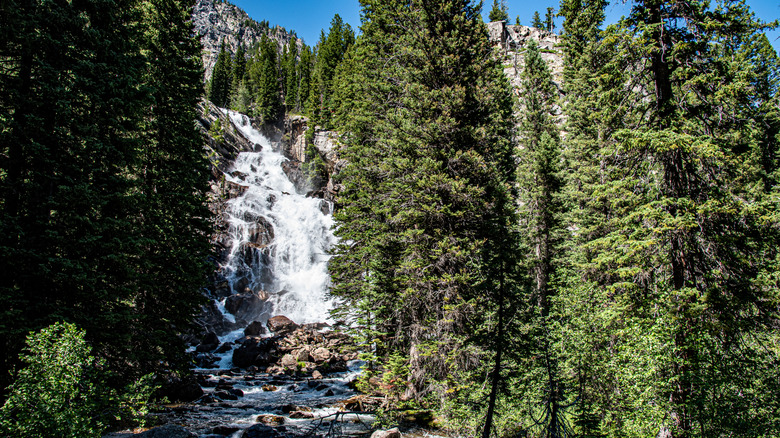
Just a short walk west of Jenny Lake is Hidden Falls, a 100-foot wall of snowmelt exploding out of Cascade Canyon. It sits at the base of the Teton Range and roars as you approach, sending its white water crashing through a corridor thick with pine trees on either side. It's one of Grand Teton's finest spots, and getting there is all part of the fun.
There are a couple of ways to do this. The first is to hike from the southern shore of Jenny Lake, which is a 4.9-mile trail, round trip, with 620 feet of elevation gain. This takes you to the west side of the lake, which is the most beautiful section of the trail. There are plenty of swimming and fishing spots along the way, and you eventually wind upward through the forest alongside Cascade Creek.
The second is to take the regular shuttle boat across from Jenny Lake. This cuts the trail down to 1 mile and 300 feet of elevation gain. But whichever way you choose to go, it's a pretty easy walk. It's perfect for families with young children, too. However, you should go there early since the trail can fill up quickly, especially in peak season when there are lots of people with the same idea as early as 8 a.m.
Inspiration Point
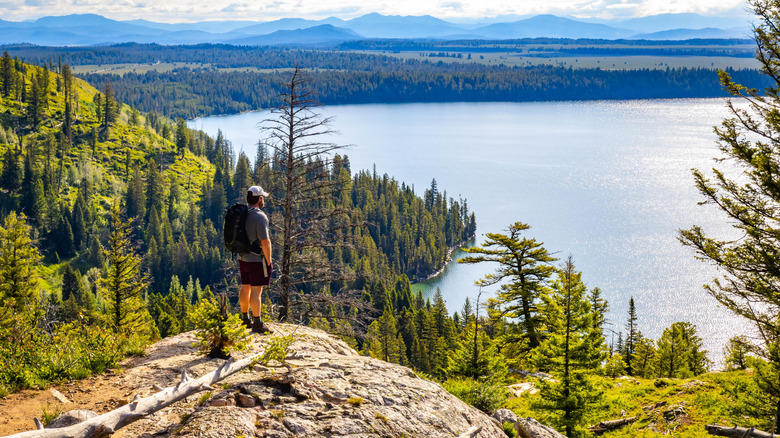
Push on for a third of a mile past Hidden Falls, and you'll reach Inspiration Point. But the trail shifts a bit along the way. It's rockier and more exposed than the lakeshore, the steep switchbacks can be tiring, and there are some sharp drop-offs to manage on the final approach. Still, it's not terribly difficult. In fact, it's manageable for most — and what awaits at the top is worth it.
Inspiration Point is a wide-open rocky platform perched above Cascade Canyon. Face east, and you'll see Jenny Lake 420 feet below filling the valley floor in deep blue. Beyond, the full sweep of Jackson Hole opens up, including the Gros Ventre and Absaroka ranges, while the Wind River mountains may even appear if the sky is blue and the horizon is clear.
On those clear days, you might also catch sight of the Yellowstone Plateau to the north. To the west, you might have to crane your neck up to take in the Cathedral Group rising straight out of the canyon behind you. Teewinot Mountain, Mount Owen, and the Grand Teton rise directly above the viewpoint into Cascade Canyon. There are actually two viewpoints, and it's worth taking the extra steps to get to the second one. But the most important thing to do on a hike to Inspiration Point is beat the crowds. Start hiking before 8:30 a.m., and if you take the shuttle across Jenny Lake, do so before 9:30 a.m.
Oxbow Bend
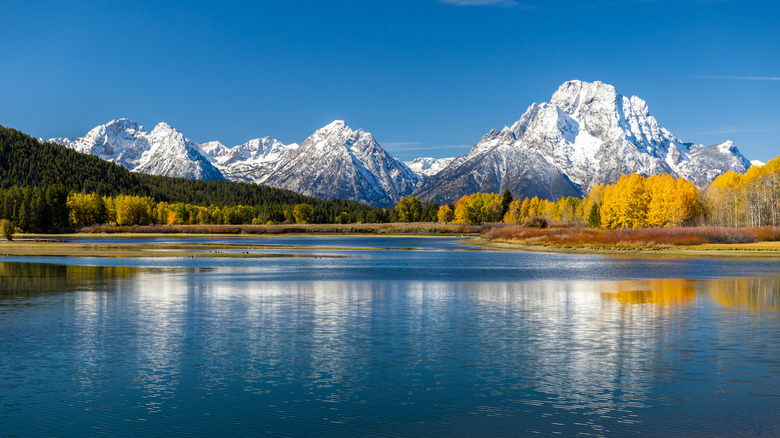
The Snake River doesn't rush through Oxbow Bend. It curves, it slows, and it settles into a crescent-shaped stillness that took years to create. Drive the highway north from Moran Junction, find the pullout, and it's there. Go on a particularly calm morning, and you'll see Mount Moran twice. Once in the sky, and once reflected in the water below. It reflects in such symmetry that you might struggle to find the point where the reflection ends and reality begins.
The best time to arrive is around sunrise or sunset, when the water reflects splashes of pink and orange. Photographers line the banks at these times, and nobody seems to want to leave. You might catch sight of pelicans gliding in low over the water, blue herons picking their way along the banks, and maybe even the occasional bald eagle wheeling silently above. On the water, river otters surface and vanish in the current while moose graze silently. Grizzlies have been spotted here, too, including Bear 399, who became the most famous wild bear in the world before tragically passing away after being hit by a vehicle in 2024. A timely reminder to drive these roads with care.
In fall, the trees along the bank turn gold and amber, framing Mount Moran and its reflection in surreal color. But the best part about Oxbow Bend is that all this stunning landscape takes little effort to get to. And when it's time to go, just hop back in your car and drive on to the next spot because Oxbow Bend is part of one of Grand Teton National Park's most scenic drives.
Snake River Overlook
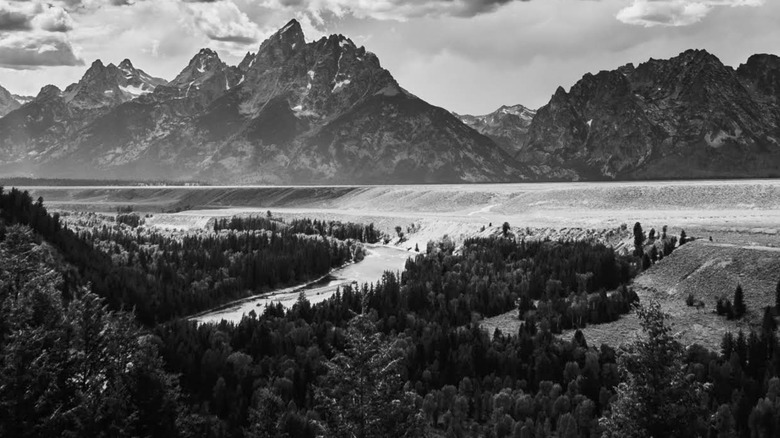
About a 20-minute drive south of Oxbow Bend, just off Highway 191, is a view that changed how the American public saw its own wilderness. The story began in 1941, when the National Park Service hired iconic American landscape photographer Ansel Adams and sent him out into the wilderness with a solitary purpose: to document the country's wild landscapes and make a case for keeping them that way. A year later, he stood at what is now called the Snake River Overlook and shot the winding ribbon curving its S-bend below the Tetons in stunning black and white. He called it "The Tetons and the Snake River," and it went on to become one of the most iconic photographs in American history.
Visitors still stand there today taking their own versions of that perspective-changing shot. Those trees have grown steadily since 1942, and they now hide much of the famous S-bend that dominated the original image. But with the Teton Range above as unobstructed as ever, it's still a mightily impressive view. Sunrise is the best time to catch it. That early alarm is well worth the trouble the moment you see those peaks catching the early light before the valley floor awakens. Should you wish to capture exactly the kind of sky Ansel Adams did when he pressed his shutter, Grand Teton storm clouds are at their most dramatic on summer afternoons.
Taggart Lake
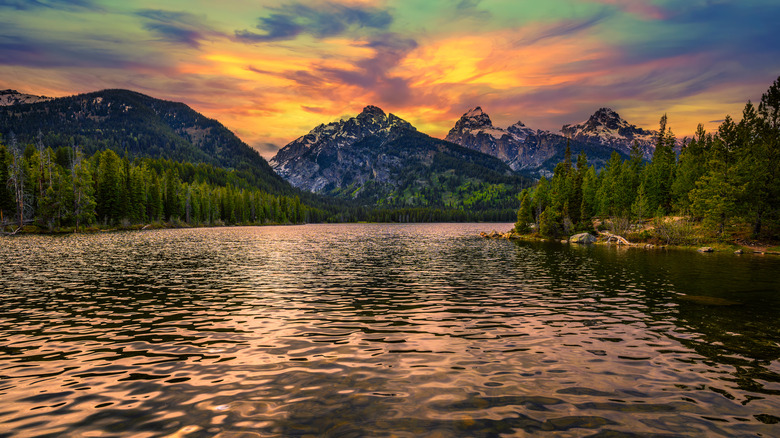
Taggart Lake is a picturesque lake with wildflower trails and postcard views, and when you walk the trail to get there, you'll be treated to the full Teton Range directly ahead of you the entire way. The peaks are not lost behind forest or canyon walls. Instead, they spread out along the horizon in all their splendor, and grow bigger with every step you take. The trail passes through stands of aspen and crosses mountain streams before the path levels out and you reach Taggart Lake. Here, the peaks almost seem to rise straight out of the water, and when you hear the silence, all you'll want to do is stop, admire, and let the moment sink in.
The trailhead is a short drive south of Jenny Lake. It's an easy 3-mile jaunt out and back, and along the way you might catch sight of mule deer watching from the trees or elk grazing in the open meadows. Once you're at the water's edge, you can fish for trout in water so clear you can see the lake bed in some places, while the rocky shoreline offers ample swimming opportunities. Keep in mind, the NPS has closed some sections of the trail for improvements in 2026, but there are alternative routes available.
If you have the energy, you could even extend the walk to Bradley Lake. It's just over a mile north of Taggart Lake and is quieter, but no less beautiful. The mountains reflect off the surface there just as perfectly as at Taggart and are well worth the extra effort. This is especially true in peak season when Taggart can get pretty busy by mid-morning. Come in winter for true seclusion when the area transforms into snowshoe and cross-country ski territory.
Jackson Lake
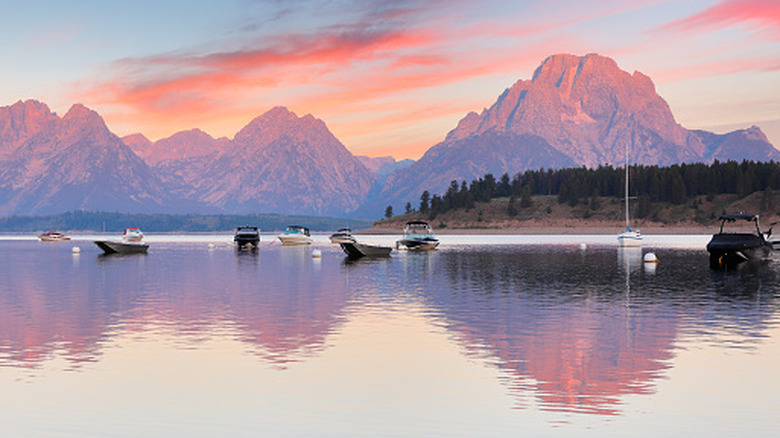
Stretching across the northern end of the Jackson Hole Valley is Jackson Lake, the largest lake in Grand Teton National Park. It's 15 miles long, and the Tetons line the western shore, with Mount Moran particularly prominent and presides over on the water below. It's the only lake in the park where motorized boating is permitted, so it's the place to come for a fun day out on the water. You can rent a motorboat and spend the day water-skiing, wakeboarding, or just exploring the lake's islands. Sailboats are also common, while kayaking in the early morning calm is the perfect start to the day.
At Colter Bay, there's a designated swimming beach, but beware: The water can be exceedingly cold. For something unique, the largest island on the lake, Elk Island, has a primitive camping spot where you can spend the night. Fishing is also excellent at Jackson Lake. Cutthroat and trout are the prize catches in this area. In winter, you can try ice fishing, and there are trails of varying lengths on the eastern side of the lake near Hermitage Point for snowshoeing and cross-country skiing.
Above it all on a natural bluff sits Jackson Lake Lodge. This National Historic Landmark was the first lodge in the national park system to embrace modern architecture. The Tetons fill every window inside, and it's a magical place to stay. Even if you don't sleep here, the lodge offers excellent restaurants and shopping, and is well worth a stop.
String Lake
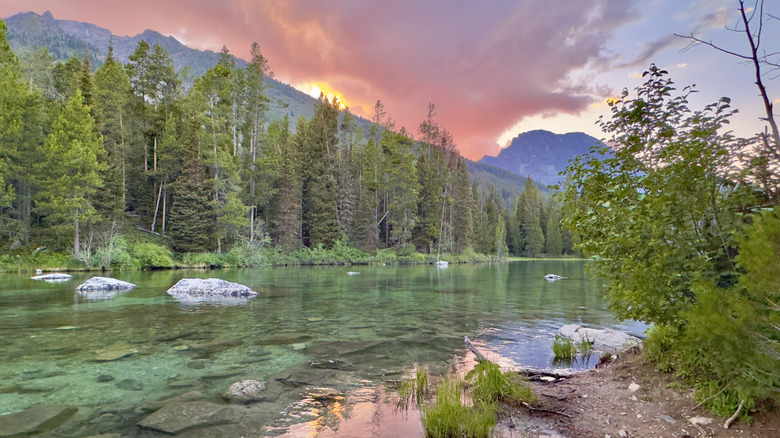
The Teton Range peaks sit so close to String Lake that they're the first thing you'll take in upon arrival. They loom directly over the far shore and fill the sky, giving you a view that will may you staring in quiet disbelief for those first few minutes. The biggest differentiator between String Lake and others in Grand Teton National Park is how narrow and shallow it is. In fact, it's so shallow that there are spots where you can actually walk right across the lake, and the water never rises above waist level. And it's that shallowness that makes String Lake the best spot for swimming in the park.
On warm afternoons, the shore fills with kayaks, paddleboards, and inflatables as people have fun splashing and paddling. People wade out to their knees in water so clear in places that you can see practically every pebble in your path. Late afternoon is best for activities when the sun has had all day to work on the water temperature. If you want to escape the crowds, head to the northern end, where the numbers thin. You can even move on to the bigger and quieter Leigh Lake, just a short walk from String Lake's northern shore. A path to Leigh Lake connects to String Lake Loop, an easy 3.7-mile trail around String Lake that takes in the sights of Mount St. John, Rockchuck Peak, and a sweep of Jackson Hole Valley. Go in the fall to see aspens ablaze in gold, and keep a lookout for bears along this stretch and the northern shore.